Alpine A522 Formula One
The Alpine A522 was Alpine’s 2022 Formula One car, introduced for a major change in the sport’s technical regulations. It paired a new chassis with the Renault RE22 hybrid power unit and carried Esteban Ocon and Fernando Alonso through that season.
The Alpine A522 was Alpine’s 2022 Formula One car, introduced for a major change in the sport’s technical regulations. It paired a new chassis with the Renault RE22 hybrid power unit and carried Esteban Ocon and Fernando Alonso through that season.
Alpine A522 Formula One at a glance
| Manufacturer | Alpine |
|---|---|
| Model family | A522 |
| Profile scope | Competition archive |
| Inventory reference | ALP-080 |
| Propulsion | Formula One hybrid power unit |
| Engine reference | Renault RE22 hybrid Formula One power unit — 2022 programme |
A second season under the Alpine name
Alpine presented the A522 in Paris on 21 February 2022. It followed the A521’s first Alpine-branded season but arrived in a different technical context. The manufacturer describes a new chassis and car build for the revised regulations, rather than a simple livery change on the previous car. This is the central reason to give the A522 a separate profile. In a competition archive, the model code, season and technical programme identify the subject more precisely than the broad label Alpine Formula One car.
Regulation change and the new power unit
The launch identifies the new Renault RE22 power unit and explains that its specification and packaging supported the revised car design. It also notes the move to E10 fuel. These are dated programme details, not evidence that a particular surviving display object contains the original working systems. The profile classifies the competition architecture as hybrid without inventing an output figure. An object-level record should list the assemblies actually installed and document any removed or substituted equipment, keeping that current inventory separate from the original season specification.
Ocon, Alonso and reserve-driver context
The launch retained Esteban Ocon and Fernando Alonso as race drivers and identified Oscar Piastri as reserve. These roles should not be collapsed into a claim that every associated driver raced the A522 in a Grand Prix. Testing and reserve participation need their own dates and records. For an individual chassis, establish who drove it, at which event and in what capacity. The model-level line-up gives context, while a driver autograph or a painted number does not independently prove that physical car’s competition history.
Two liveries at the launch
Alpine showed a blue-and-pink presentation alongside a version with pink as the dominant colour. This is a reminder that a change in exterior presentation does not automatically create a separate chassis model. A catalogue should date the livery and explain the event context. Likewise, a later display appearance in another season’s colours does not change the original chassis identity without supporting records. The useful archive follows the physical car and its configuration, rather than treating paint alone as a reliable way to distinguish manufacture or race use.
The 2022 season endpoint
Alpine’s November post-season test account confirms that the team had finished fourth in the Constructors’ Championship. The same release records Pierre Gasly and Jack Doohan driving A522 machinery at Yas Marina after the final race. This gives the model a documented role beyond the regular driver line-up and season races. Testing a car after the championship does not turn it into the following year’s A523. Preserve the date and purpose of each appearance when building a history of the model or a particular chassis.
Production and why two drivers is not two cars
The public releases do not provide a comprehensive census of racing tubs, spare structures, replaced assemblies and exhibition vehicles. Two race drivers do not establish that only two physical A522s existed. A Formula One programme can use multiple chassis and later produce display objects with a similar appearance. The completed-production field is therefore unset. A serious count would define what is included and follow constructor identity through manufacture, repair and replacement. The verified programme identity remains useful while the physical-object census is unresolved.
A chassis history needs connected evidence
Seek constructor identification, team custody records, event entries, technical logs and repair documentation. Tie dated photographs to the physical car where possible. A repeated race number can appear on different chassis, and a livery can be recreated after the season. Explain how the identifying evidence connects the car with each claimed appearance. If access to internal team records is limited, state what is documented rather than expanding the claim through visual similarity. A narrower traceable history is stronger than an impressive but unsupported season narrative.
Race car, show object or replica
Determine which type of object is being described before discussing originality or operation. A team exhibition object may be historically interesting without having raced, while a genuine competition tub may now carry non-running display equipment. Record the structure, major assemblies and sources of substituted parts. A catalogue should make those distinctions intelligible to readers. They affect the physical history and collecting role, but do not need to diminish a correctly described display object’s usefulness in explaining the A522 programme.
Installed systems and support requirements
An original hybrid racing architecture involves more than a visible engine or familiar body panels. For any proposed operation, establish the current equipment and available technical support with specialists responsible for the actual car. A stationary display, controlled demonstration and competitive activity impose different requirements. Past running evidence belongs to its date and does not certify continuing readiness. Keep records of preparation and subsequent changes with the object so that its present condition can be understood alongside its historical specification.
Preservation of a regulatory-era milestone
Document the car’s configuration before restoration or repainting. Retain technical material, photographs, significant replaced parts and the reasons for changes where possible. The A522 can illustrate how Alpine responded to a new regulatory framework, but that story becomes harder to interpret if every surviving object is reduced to a generic fresh livery. Choose a clearly defined presentation, such as a documented event configuration, and explain what remains authentic to it. This makes conservation decisions part of the archive rather than invisible work.
Comparison with A521 and A523
The three cars form a useful sequence: the first Alpine-branded season, a new-regulation car, and the next season’s development. Compare their programme descriptions, driver line-ups and dated presentations without transferring technical claims or results between them. A collector should also distinguish model history from the individual object’s career. A well-supported A522 file can be more valuable for interpretation than a superficially more dramatic car with uncertain identity. The comparison works best when each profile keeps its own evidence, season and specification boundaries.
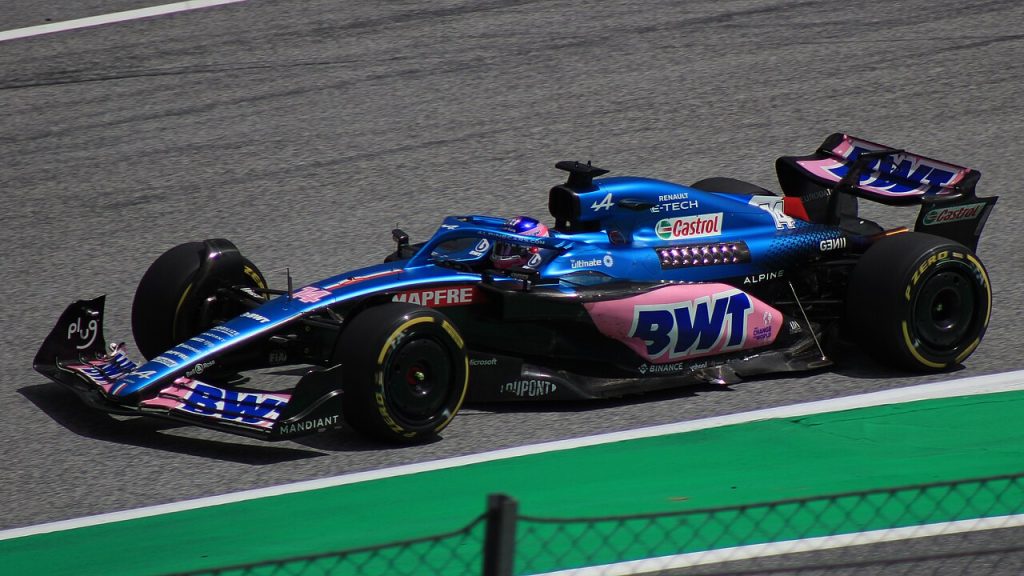
The 2022 Austrian competition photograph
The supplied licensed photograph records Alonso’s number 14 A522 at the 2022 Austrian Formula One event. It is a period competition image, with the event and year preserved in its caption. It does not disclose an individual chassis serial number or prove that a later offered car is the pictured object. Visible attribution links the photographer, original source and licence. For a specific chassis feature, add identifying photographs and team records to establish the connection between the car and its claimed race appearances.
Frequently asked questions
When was the A522 revealed?
Alpine presented it in Paris on 21 February 2022 for that season’s revised technical regulations.
Which power unit does the launch identify?
The manufacturer identifies Renault’s new RE22 power unit; the programme belongs to Formula One’s hybrid architecture.
Did Gasly ever drive A522 machinery?
Yes. Alpine records his post-season test at Yas Marina in November 2022, before his race partnership with the team in 2023.
Does the driver line-up establish the build total?
No. Racing chassis, spare structures and display vehicles need a defined census. No exact manufacturing count is asserted here.
Explore related Alpine profiles
Sources
Historical statements follow the linked manufacturer and competition-programme records. Inspection and collecting guidance is editorial analysis. Individual catalogue claims remain attributed to the relevant car and source.
Photography and credit
Fernando Alonso’s number 14 Alpine A522 at the 2022 Austrian Formula One event; no individual chassis serial number is inferred. Photo: Lukas Raich / Wikimedia Commons · CC BY-SA 4.0. Wikimedia thumbnail resized from the original; no cropping or colour changes.
Why this machine matters
The Alpine A522 was Alpine’s 2022 Formula One car, introduced for a major change in the sport’s technical regulations. It paired a new chassis with the Renault RE22 hybrid power unit and carried Esteban Ocon and Fernando Alonso through that season.
Built in limited numbers
The public releases do not provide a comprehensive census of racing tubs, spare structures, replaced assemblies and exhibition vehicles. Two race drivers do not establish that only two physical A522s existed. A Formula One programme can use multiple chassis and later produce display objects with a similar appearance. The completed-production field is therefore unset. A serious count would define what is included and follow constructor identity through manufacture, repair and replacement. The verified programme identity remains useful while the physical-object census is unresolved.
Gallery
Specifications
Factory specifications may vary by model year, market and configuration.
Identity & production
- Official model
- Alpine A522 Formula One
- Base model
- A522
Powertrain & performance
- Engine
- Renault RE22 hybrid Formula One power unit — 2022 programme