Alpine A523 Formula One
The Alpine A523 was the team’s 2023 Formula One car, raced by Esteban Ocon and Pierre Gasly. It developed the A522 programme and achieved Grand Prix podiums at Monaco and Zandvoort, with later demonstration use requiring its own dated configuration record.
The Alpine A523 was the team’s 2023 Formula One car, raced by Esteban Ocon and Pierre Gasly. It developed the A522 programme and achieved Grand Prix podiums at Monaco and Zandvoort, with later demonstration use requiring its own dated configuration record.
Alpine A523 Formula One at a glance
| Manufacturer | Alpine |
|---|---|
| Model family | A523 |
| Profile scope | Competition archive |
| Inventory reference | ALP-086 |
| Propulsion | Formula One hybrid power unit |
| Engine reference | Renault RE23 1.6-litre turbocharged V6 hybrid — 2023 press-pack reference |
The 2023 car and its public launch
Alpine unveiled the A523 at London’s Printworks on 16 February 2023. The launch describes it as an evolution of the preceding A522, in the second season of the technical framework introduced in 2022. This places the car between a major regulation change and the continued development that followed. It should have its own season-specific competition profile rather than being treated as another livery of the A522. The model code and programme identify the subject, while an individual chassis still needs its own documented manufacture and use history.
The shakedown preceded the reveal
Alpine recorded a Silverstone filming-day shakedown on 13 February, before the public launch. Ocon and Gasly shared that initial running. This chronology is useful because first running and first presentation are separate milestones. A public reveal date does not prove the car had never turned a wheel before it, and a filming day is not equivalent to a Grand Prix entry or unrestricted test. Preserve event purpose and dates in an archive so that development, presentation and competition footage can be interpreted accurately.
Power-unit and technical identity
The manufacturer’s 2023 press pack describes the A523 with Renault’s RE23 power unit, a 1.6-litre turbocharged V6 and energy recovery systems. This is the original hybrid competition reference. It does not establish an output figure for every session or certify the contents of a later show object. Keep technical fields scoped to the programme and record the installed assemblies separately for an individual car. A display vehicle may retain the appearance of the A523 while carrying removed, substituted or non-running systems that need explicit description.
Ocon and Gasly as the race pairing
The launch introduced Pierre Gasly alongside Esteban Ocon and named Jack Doohan as reserve. These roles help date photographs and programme records, but they do not prove that every associated driver used every chassis. Testing and reserve participation should be documented separately from Grand Prix starts. A painted driver number can move between structures or appear on exhibition objects. For a collector, the model-level line-up gives context while team records establish which physical car was driven at a claimed event and in what capacity.
The Monaco and Dutch podiums
Alpine’s contemporary reports record Ocon third at Monaco in May 2023 and Gasly third at Zandvoort in August. These are two distinct Grand Prix podiums with different drivers and events. They should not be summarized as a race win or assigned collectively to an arbitrary A523-shaped display car. A model history can celebrate the programme’s results while an individual chassis profile still needs the relevant identification link. Keep the driver, event and result together, and distinguish a Grand Prix from any sprint-session result added elsewhere.
Later livery does not mean a later chassis model
Alpine’s Goodwood 2025 announcement planned demonstration running of an A523 wearing the team’s then-current livery. This is a useful manufacturer example of appearance changing while an earlier model identity remains. A 2025 paint scheme should therefore not be used alone to identify an A525 chassis. Equally, a demonstration appearance is not proof of a particular 2023 race career. The archive should trace the actual structure and dated configuration, preserving the distinction between later presentation and original competition use.
Production and a defined physical census
The reviewed public material does not reconcile the number of A523 racing tubs, spare structures, replacements and show vehicles. The completed-production field remains unset. A season entry list counts sporting appearances, not necessarily unique manufactured cars. A serious census needs constructor identification and rules for counting a rebuilt or replaced structure. It should also keep replicas and exhibition assemblies distinguishable from competition chassis. This avoids a numerical claim that looks precise while its underlying definition and connection with physical objects remain uncertain.
Authentication of a claimed podium chassis
Seek team confirmation, constructor identity, technical logs, custody records and event-specific evidence. Connect photographs to the relevant physical car rather than relying on matching race numbers or sponsor graphics. A later autograph may be interesting memorabilia without proving that its signer drove that chassis in a particular race. If some internal records are unavailable, describe the documented boundary clearly. An individual-object file should enable another specialist to follow the same structure through the relevant event, subsequent repairs and later ownership or display preparation.
Configuration and current condition
Document body specification, major mechanical assemblies, electronics and safety equipment at a stated date. Review repair and service records with specialists familiar with the car. A competition chassis prepared for exhibition can retain an important history while requiring a different description from a running demonstration car. Establish what is installed and what works before discussing capability. The original hybrid specification is programme evidence; the current equipment schedule is object evidence. Both matter, but they should remain distinguishable in a collecting report.
Conservation and chosen presentation
Record the existing object before repainting or replacing material. Define whether the intended presentation represents a particular event, the last competitive configuration or a later documented demonstration. Keep significant removed parts and their records where practical. A generic fresh livery can obscure changes that helped explain the car’s working life. The restoration file should show which historic evidence remains and why alterations were made. This allows a display to be attractive and intelligible without presenting every renewed surface as unchanged since a celebrated race.
Comparison with the A522 and road editions
The A522 and A523 show successive stages of a competition programme, while the Fernando Alonso road edition reflects a different kind of Formula One association. Compare those roles instead of transferring race results or power-unit specifications into a customer A110. A collection can connect team identity with a driver-themed road car, but each object needs its actual history. For the A523, the most useful comparison considers dated engineering context and documentary depth. A familiar name or dramatic livery alone cannot replace the identity file.
The Austrian photograph
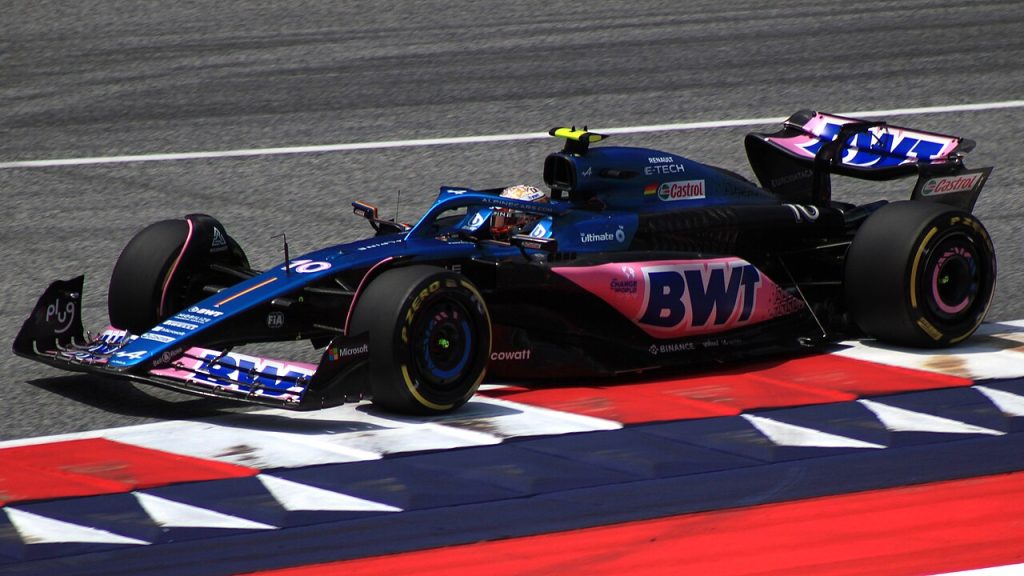
The bundled licensed photograph records Gasly’s number 10 A523 at the 2023 Austrian Formula One event. Its caption does not present it as the Dutch podium photograph or reveal an individual chassis serial number. It provides a clear period illustration of the model and carries visible links to photographer, source and licence. An individual chassis feature should add its own identifying photographs and team documentation. Those records would establish whether a physical car connects with the pictured event or one of the programme’s other claimed appearances.
Frequently asked questions
Did the A523 first run at its public launch?
No. Alpine recorded its Silverstone shakedown on 13 February 2023, before the London reveal on 16 February.
Who raced the A523 in 2023?
The regular race pairing was Esteban Ocon and Pierre Gasly; reserve and test activity requires its own dated records.
Which Grand Prix podiums are covered here?
Ocon finished third at Monaco and Gasly third at Zandvoort in the contemporary Alpine reports.
Can a 2025 livery identify a 2025 chassis?
No. Alpine planned an A523 demonstration in 2025 colours. Physical identity and livery date must be documented separately.
Explore related Alpine profiles
Sources
- Alpine: A523 London launch, February 2023
- Alpine: A523 Silverstone shakedown before its public reveal
- Alpine: 2023 press pack, A523 and Renault RE23 technical specifications
- Alpine: Ocon third at Monaco, May 2023
- Alpine: Gasly third at Zandvoort, August 2023
- Alpine: A523 planned with a later livery for Goodwood 2025
Historical statements follow the linked manufacturer and competition-programme records. Inspection and collecting guidance is editorial analysis. Individual catalogue claims remain attributed to the relevant car and source.
Photography and credit
Pierre Gasly’s number 10 Alpine A523 at the 2023 Austrian Formula One event; not a photograph of its Dutch Grand Prix podium. Photo: Lukas Raich / Wikimedia Commons · CC BY-SA 4.0. Wikimedia thumbnail resized from the original; no cropping or colour changes.
Why this machine matters
The Alpine A523 was the team’s 2023 Formula One car, raced by Esteban Ocon and Pierre Gasly. It developed the A522 programme and achieved Grand Prix podiums at Monaco and Zandvoort, with later demonstration use requiring its own dated configuration record.
Built in limited numbers
The reviewed public material does not reconcile the number of A523 racing tubs, spare structures, replacements and show vehicles. The completed-production field remains unset. A season entry list counts sporting appearances, not necessarily unique manufactured cars. A serious census needs constructor identification and rules for counting a rebuilt or replaced structure. It should also keep replicas and exhibition assemblies distinguishable from competition chassis. This avoids a numerical claim that looks precise while its underlying definition and connection with physical objects remain uncertain.
Gallery
Specifications
Factory specifications may vary by model year, market and configuration.
Identity & production
- Official model
- Alpine A523 Formula One
- Base model
- A523
Powertrain & performance
- Engine
- Renault RE23 1.6-litre turbocharged V6 hybrid — 2023 press-pack reference
Sources and verification
- media.alpinecars.com
- media.alpinecars.com
- media.renault.ch
- media.alpinecars.com
- media.alpinecars.com
- media.alpinecars.com