Alpine A521 Formula One
The Alpine A521 was the Formula One car of Alpine’s first season under that team name in 2021. Its Renault hybrid power unit, Esteban Ocon’s Hungarian Grand Prix win and Fernando Alonso’s Qatar podium make it an important competition archive subject.
The Alpine A521 was the Formula One car of Alpine’s first season under that team name in 2021. Its Renault hybrid power unit, Esteban Ocon’s Hungarian Grand Prix win and Fernando Alonso’s Qatar podium make it an important competition archive subject.
Alpine A521 Formula One at a glance
| Manufacturer | Alpine |
|---|---|
| Model family | A521 |
| Profile scope | Competition archive |
| Inventory reference | ALP-074 |
| Propulsion | Formula One hybrid power unit |
| Engine reference | Renault E-Tech 20B 1.6-litre V6 hybrid power unit |
The first Alpine-branded Formula One season
The A521 introduced Alpine’s Formula One identity in 2021. The team’s name and presentation changed, but the car belonged to an established racing operation with engineering continuity. That context is useful: this was a new Alpine chapter rather than proof that an entirely unrelated team and technical organization appeared from nothing. A model profile should identify the A521 by season and programme. Its significance is the first year under the Alpine name and the results achieved during that year, rather than a conventional manufactured road-car edition.
The hybrid power-unit identity
The launch identifies the Renault E-Tech 20B power unit, a 1.6-litre V6 hybrid developed at Viry-Châtillon. The hybrid label matters in a vehicle database; classifying the car simply as a petrol road model loses part of its technical identity. Public launch details should remain scoped to the season, with unsupported output numbers omitted. An individual car may later be displayed without its competition power unit or associated systems. The model’s original architecture and a surviving object’s installed equipment should therefore be documented separately.
Evolution and the first running
Alpine’s Silverstone shakedown account describes the A521 as an evolution of the preceding R.S.20 adapted to the season’s aerodynamic changes. Esteban Ocon drove the car during the March 2021 filming-day outing. This is a first-running milestone with its own context, not a Grand Prix start or a full unrestricted test programme. Distinguish reveal photographs, filming-day material, tests and race weekends in an archive. That sequence shows development and use accurately without presenting every appearance as equivalent competition evidence.
Esteban Ocon’s Hungarian Grand Prix victory
Alpine’s August 2021 race account records Ocon’s first Formula One victory and the team’s first win under the Alpine name at the Hungarian Grand Prix. It is the season’s defining competitive milestone for this profile. The result belongs to the race car and entry documented at that event. A later show car or another A521 chassis wearing a similar number does not acquire the win automatically. Any offered object described as the Hungarian winner needs additional chassis identification and team records to support that specific claim.
Fernando Alonso’s Qatar podium
In November 2021 Alpine recorded Alonso’s third place in Qatar and Ocon’s fifth-place finish, emphasizing the team effort behind the result. This adds a second distinct sporting milestone to the season narrative. It should not be merged with the Hungarian result into a vague statement that every A521 was a winning and podium-finishing chassis. A model can have a celebrated season while individual cars have different careers. Date each result and preserve the driver and event context when describing a specific physical object.
Production and the Formula One chassis question
The reviewed public releases do not provide a complete manufacturing census of A521 tubs, replacement structures and show vehicles. Two race drivers do not imply that only two physical cars were made. Different chassis can be used across a season, while exhibition replicas may resemble a race car without sharing its structure or systems. The generic completed-production field remains unset. A reliable census would define the class of object being counted and connect constructor identity to records of manufacture, replacement and subsequent custody.
Race chassis, show car and replica
For an individual A521 claim, determine whether the object is a competition chassis, a team-built display object or a replica constructed later. Record its structure, installed assemblies and supporting provenance. None of these categories needs to be hidden: a properly identified show car can be a useful exhibition object. The problem is presenting a display body as a documented race winner without the evidence. A catalogue should state what survives and what was substituted, enabling readers to understand the physical object rather than relying only on its livery.
Linking a chassis to a famous event
Seek team confirmation, identification records, component or chassis logs, dated custody documents and event-specific photographs. A race number may be carried by more than one chassis during a season. A painted number and a driver’s signature are therefore insufficient to prove a particular Grand Prix identity. Where access to internal records is limited, state the boundary of the available evidence. A narrower documented history is more useful than an expansive claim that cannot be traced beyond a seller’s description.
Installed equipment and display preparation
A Formula One car prepared for display may have removed power-unit systems, substituted assemblies or altered electronics. Record those changes rather than describing every surviving object as ready to race. Ask what is installed, what is functional and what specialist support would be required for the intended activity. Demonstration capability and competition eligibility are separate matters. Public launch specifications describe the model’s original programme, while an object-level equipment schedule describes the car as it stands today. Both belong in a serious archive file.
Preserving evidence rather than only the livery
Document identification, repair history, body components, cockpit equipment and dated configurations before restoration or repainting. Where historical components are removed, keep their records and connection with the car. A fresh presentation can be appropriate for an exhibition, but should not erase the account of what changed. The most persuasive display explains the season, the event being represented and the object’s actual history. It need not rely on an unsupported assertion that all painted surfaces or assemblies remained unchanged since a celebrated race.
An Alpine competition comparison
The A521 and contemporary A480 show Alpine pursuing different forms of international circuit competition in the same period. Formula One and endurance racing involve different technical rules, race formats and evidence trails. Comparing them can clarify the breadth of the marque’s competition identity without transferring specifications or results between programmes. Place the A521’s hybrid architecture and Grand Prix milestones beside the A480’s endurance context. Earlier Alpine competition cars can extend the historical story, provided each retains its own season, category and physical identity.
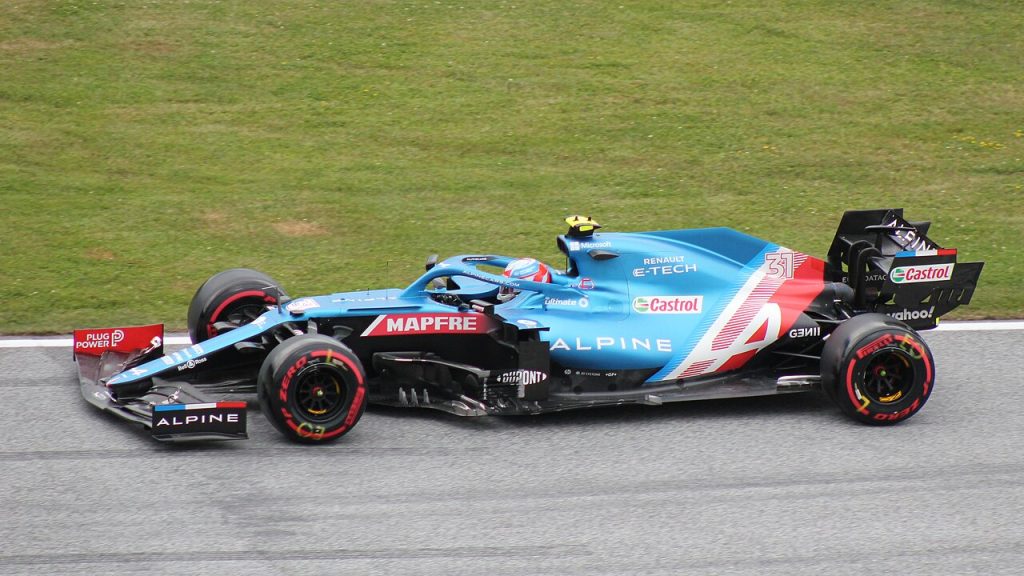
The Ocon photograph supplied here
The bundled image records Ocon’s number 31 A521 at the 2021 Austrian Formula One event. It is an actual period competition photograph and is captioned with that context. It does not show the Hungarian Grand Prix win or establish a winning chassis number. The clear side view helps readers recognize the season’s Alpine presentation. Photographer, source and licence are linked beside the image. For an individual chassis feature, add its own identifying views and the records needed to connect it to a claimed race appearance.
Frequently asked questions
Which season used the A521?
The A521 belongs to Alpine’s 2021 Formula One programme, the first season under the Alpine team name.
Was its power unit hybrid?
Yes. Alpine identifies the Renault E-Tech 20B 1.6-litre V6 hybrid power unit.
What was its most notable victory?
Esteban Ocon won the 2021 Hungarian Grand Prix, his first Formula One win and the first under the Alpine team name.
Is every A521-shaped display car a race-winning chassis?
No. Competition identity, display preparation and replica status require object-level documentation. Livery and race numbers alone do not prove a chassis history.
Explore related Alpine profiles
Sources
- Alpine F1 Team: A521 launch, March 2021
- Alpine F1 Team: A521 first Silverstone outing, March 2021
- Alpine F1 Team: Esteban Ocon’s Hungarian Grand Prix win, August 2021
- Alpine F1 Team: Fernando Alonso’s Qatar podium, November 2021
Historical statements follow the linked manufacturer and competition-programme records. Inspection and collecting guidance is editorial analysis. Individual catalogue claims remain attributed to the relevant car and source.
Photography and credit
Esteban Ocon’s Alpine A521 number 31 at the 2021 Austrian Formula One event; the source does not identify a particular chassis serial number. Photo: Lukas Raich / Wikimedia Commons · CC BY-SA 4.0. Wikimedia thumbnail resized from the original; no cropping or colour changes.
Why this machine matters
The Alpine A521 was the Formula One car of Alpine’s first season under that team name in 2021. Its Renault hybrid power unit, Esteban Ocon’s Hungarian Grand Prix win and Fernando Alonso’s Qatar podium make it an important competition archive subject.
Built in limited numbers
The reviewed public releases do not provide a complete manufacturing census of A521 tubs, replacement structures and show vehicles. Two race drivers do not imply that only two physical cars were made. Different chassis can be used across a season, while exhibition replicas may resemble a race car without sharing its structure or systems. The generic completed-production field remains unset. A reliable census would define the class of object being counted and connect constructor identity to records of manufacture, replacement and subsequent custody.
Gallery
Specifications
Factory specifications may vary by model year, market and configuration.
Identity & production
- Official model
- Alpine A521 Formula One
- Base model
- A521
Powertrain & performance
- Engine
- Renault E-Tech 20B 1.6-litre V6 hybrid power unit