Audi Sport quattro
The Audi Sport quattro is the short-wheelbase road and homologation programme associated with Group B, distinct from the original long-wheelbase quattro and later S1 E2 competition cars. Its 1983 reveal and 1984 homologation milestones are well supported. The guide explains why Audi’s published 200, 214 and 220 figures should not be compressed into one falsely reconciled total.
The Audi Sport quattro is the short-wheelbase road and homologation programme associated with Group B, distinct from the original long-wheelbase quattro and later S1 E2 competition cars. Its 1983 reveal and 1984 homologation milestones are well supported. The guide explains why Audi’s published 200, 214 and 220 figures should not be compressed into one falsely reconciled total.
Audi Sport quattro at a glance
| Manufacturer | Audi |
|---|---|
| Archive connection | Audi |
| Model / programme | Sport quattro |
| Profile scope | Short-wheelbase Group B homologation archive |
| Historical reference year | 1984 |
| Inventory reference | AUDI-008 |
| Historical engine reference | Turbocharged four-valve inline five-cylinder |
| Published broader-series figures | 214 and220; exact completed total remains unreconciled |
| Homologation milestone | 200 completed by 26 April 1984; not additional to broader series |
| Historical displacement reference | 2133 cc; programme source, not present engine measurement |
The short-wheelbase quattro in its own right
Sport quattro is a specific programme, not a loose description of any sporty Audi with four-wheel drive. Its identity matters because photographs and advertisements often place it beside the original quattro and later rally evolutions. The guide focuses on the homologation-series road car while retaining its relationship with competition development. A genuine Sport quattro should be assessed through the correct chassis and specification records, rather than assumed from a short-looking body, rally paint or an engine conversion on a different quattro.
A 1983 reveal and a 1984 milestone
Audi’s model-year image record identifies the September 1983 Frankfurt presentation and May 1984 delivery commencement. The Swiss retrospective marks April 26, 1984 as the completion of the required 200 homologation examples. Those are different milestones, so the inventory’s 1984 reference is retained without erasing the earlier reveal. An individual car’s manufacture date is another matter and should come from its records. The supplied example is source-labelled 1985, which illustrates the model without redefining the date of the programme’s public introduction.
Rarity: 200, 214 and 220 need their scopes
The central Audi image record describes a series limited to 214 vehicles. The Swiss manufacturer retrospective confirms 200 homologation cars and gives a broader colour breakdown summing to 220, with prototypes, test and competition uses also discussed. This guide preserves those primary-source differences and leaves a reconciled exact completed total unset. It does not add 200 to 214 or 220. All are below the archive threshold, but that agreement on rarity does not solve how the underlying records define the vehicles being counted.
What homologation does and does not prove
Homologation is an approval context for a model or competition specification. It does not automatically certify the identity or current eligibility of every car described as a Sport quattro. A road car, a works competition example and a later conversion may have different documents and histories. A collector should connect the actual vehicle with its original specification and then describe subsequent work. The published milestone helps explain why the programme existed, while a car-specific technical and documentary review explains what a particular object is today.
The four-valve five-cylinder road engine
Audi specifies 225 kW and 306 PS for the road programme’s turbocharged five-cylinder engine with four-valve technology. That power rating belongs to the factory specification, not a present-day dynamometer result for every surviving example. The central record also supplies 350 Nm and the 2,133 cc displacement context. Preserve the PS and kW units rather than using an identical numeral as bhp. A modified engine can remain interesting, but its current output and component history should be recorded as later evidence.
Shorter wheelbase, different visual identity
Audi’s five-cylinder retrospective describes the Sport quattro as 24 centimetres shorter with a wider track. Those changes explain why its proportions are recognizable even when photographed next to the ordinary quattro. Visual recognition is a starting point, however, rather than final authentication. A properly documented gallery should show the body as a whole and relevant identifying details. That makes it easier for a reader to understand what changed without suggesting that an outward resemblance alone establishes a genuine homologation-series chassis.
Road specification versus the rally evolution
The road car’s 306 PS rating should not be replaced with figures from Group B competition engines or the later S1 E2. The manufacturer discusses those racing developments separately, and the archive should do the same. A profile can explain the relationship while maintaining each programme’s configuration and count. This is particularly important for cars displayed in a motorsport-inspired finish. The livery may be an homage, an original competition presentation or a later conversion; only the actual record can establish which description applies.
Body construction and restoration questions
Audi Switzerland describes a body built around a supporting metal structure with extensive composite components and identifies Baur’s role. For a collector, that creates practical questions about accident repairs, replacement panels and finish history. A new panel need not be a defect, but it should be documented against the car’s identity and restoration. Photographs of concealed structure and repair stages can be more informative than a freshly polished exterior. The record should also distinguish a restored original body from a replica shell or a shortened standard-car conversion.
Colour counts are not an individual certificate
The Swiss colour figures are useful to the broader historical discussion but do not independently authenticate the paint of one surviving car. The car’s original order, period photographs and later refinishing records remain important. A red example should not automatically be assigned a production subset because it currently wears a familiar factory colour. Nor does a rare shade establish a separate edition unless its identity is documented. Preserve the distinction between a programme colour breakdown and evidence for the actual finish on the vehicle being considered.
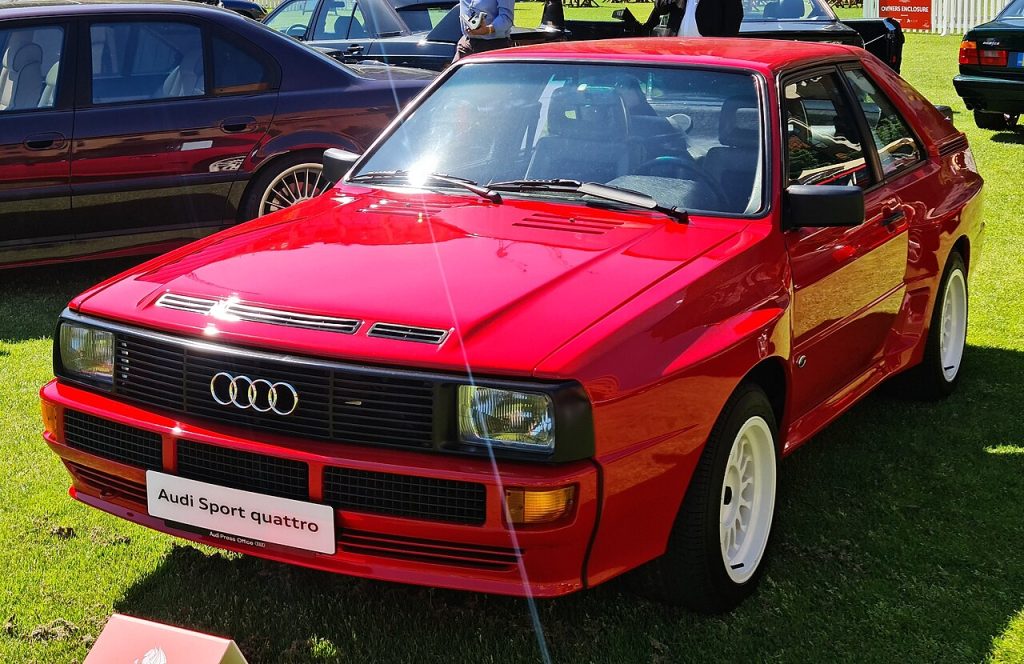
The licensed red road-car photograph
The bundled photo is source-identified as a Sport quattro at London Concours in 2021, with the example labelled 1985. It provides a clear illustration of the short-wheelbase road form. The caption does not assign a build number, original colour certificate, race result or present ownership. This is a photograph of the appropriate model rather than a substituted modern concept or S1 E2. Its photographer and licence remain visible, giving the editor a traceable illustration while leaving individual authentication to a fuller object file.
What to ask when reviewing a Sport quattro
Begin with its identity records, then connect the engine, body and drivetrain to the documented original specification. Ask for dated maintenance and restoration evidence, particularly where extensive work or competition use is claimed. Separate the model’s general history from the specific car’s mileage and events. A professional inspection should address the actual condition rather than infer it from rarity or a prestigious exhibition. The result is a useful collector account that can describe originality, changes and mechanical needs without guessing from a photograph.
Why this programme remains important
The Sport quattro connects a road-going special series with an ambitious competition brief, making its rarity understandable through purpose as well as quantity. Related guides to the Trans-Am and IMSA GTO programmes show different uses of Audi’s five-cylinder and all-wheel-drive ideas. That comparison is more useful than transferring rally specifications into circuit cars. The profile’s strongest conclusion is the clearly documented identity of the programme, with source disagreements retained and each surviving road or racing example still requiring its own evidence.
Frequently asked questions
Was the Sport quattro unveiled in 1984?
Audi dates its Frankfurt reveal to September 1983; homologation and delivery milestones followed in 1984.
Were 200 or 214 Sport quattros built?
Audi sources use 200 for homologation and 214 for the limited series; a Swiss retrospective gives a broader 220 breakdown. An exact reconciled completed total remains unset.
What is the factory road-car power rating?
Audi specifies 225 kW, or 306 PS; race-engine ratings are separate.
Is an S1 E2 the same archive subject?
No. The later competition evolution is a separate subject and is not substituted for the road homologation programme.
Explore related vehicle profiles
Sources
- Audi — Sport quattro B2, model year 1984
- Audi Switzerland — Forty years of Sport quattro
- Audi — Fifty years of the five-cylinder
Programme history and specifications follow the linked manufacturer and heritage records. Where figures or dates differ, their source contexts are retained. Collector-file and inspection guidance is editorial analysis; exact physical-car identity requires its own evidence.
Photography and credit
Source-identified Audi Sport quattro photographed at London Concours 2021. The source labels the example 1985; this is distinct from the 1983 reveal and 1984 homologation milestones. No individual build number assigned. Photo: MrWalkr / Wikimedia Commons · CC BY-SA 4.0. Wikimedia thumbnail resized from original; no cropping or color changes.
Why this machine matters
The Audi Sport quattro is the short-wheelbase road and homologation programme associated with Group B, distinct from the original long-wheelbase quattro and later S1 E2 competition cars. Its 1983 reveal and 1984 homologation milestones are well supported. The guide explains why Audi’s published 200, 214 and 220 figures should not be compressed into one falsely reconciled total.
Built in limited numbers
The central Audi image record describes a series limited to 214 vehicles. The Swiss manufacturer retrospective confirms 200 homologation cars and gives a broader colour breakdown summing to 220, with prototypes, test and competition uses also discussed. This guide preserves those primary-source differences and leaves a reconciled exact completed total unset. It does not add 200 to 214 or 220. All are below the archive threshold, but that agreement on rarity does not solve how the underlying records define the vehicles being counted.
Gallery
Specifications
Factory specifications may vary by model year, market and configuration.
Identity & production
- Official model
- Audi Sport quattro
- Base model
- Sport quattro
Powertrain & performance
- Engine
- Turbocharged four-valve inline five-cylinder