Audi 200 quattro Trans-Am
The Audi 200 quattro Trans-Am brought the company’s turbocharged five-cylinder and all-wheel-drive approach to American circuit racing in 1988. This profile concerns the works competition programme, not ordinary Audi 200 road production. Its championship significance is supported, while an exact original race-car census and the history of the photographed chassis remain separate questions.
The Audi 200 quattro Trans-Am brought the company’s turbocharged five-cylinder and all-wheel-drive approach to American circuit racing in 1988. This profile concerns the works competition programme, not ordinary Audi 200 road production. Its championship significance is supported, while an exact original race-car census and the history of the photographed chassis remain separate questions.
Audi 200 quattro Trans-Am at a glance
| Manufacturer | Audi |
|---|---|
| Archive connection | Audi |
| Model / programme | 200 quattro Trans-Am |
| Profile scope | Factory Trans-Am competition archive |
| Historical reference year | 1988 |
| Inventory reference | AUDI-011 |
| Historical engine reference | 2.1-litre turbocharged two-valve inline five-cylinder |
| Exact original build total | Unresolved; no certified production number populated |
A racing programme rather than a road edition
The words 200 quattro identify a familiar model family, but Trans-Am changes the subject to a competition car and programme. That boundary matters for rarity: the number of ordinary road cars is not the count being discussed here. Nor does a street car with matching decals automatically become a Trans-Am chassis. The guide presents the racing identity directly, with specific vehicles left to their individual construction and event records. This makes the archive entry useful without turning a popular road-car name into a falsely limited production series.
Why 1988 anchors the profile
Audi’s manufacturer accounts place the Trans-Am programme in the 1988 American season. The year describes the campaign rather than the date of a later museum photograph or every preparatory component. An individual car can have development, competition and restoration dates that span more than one year. Keep those events separate in a collector file. A factory retrospective gives the overall chronology, while a frame identity and dated team record are needed before a specific photographed vehicle is assigned to a particular race or driver.
A five-cylinder against a different field
Audi’s current five-cylinder history lists a 2.1-litre turbocharged engine with the earlier two-valve cylinder head and 375 kW, or 510 PS, for the Trans-Am car. That is a manufacturer programme reference, not a universal output measurement for all surviving engines. It should remain distinct from the four-valve Sport quattro and the later IMSA GTO’s higher stated rating. A technical report can add exact build and tuning information for one engine, but should not fill unknowns by borrowing the best-known figure from another Audi competition programme.
All-wheel drive moves onto the circuit
The programme provides a concrete example of Audi taking its all-wheel-drive identity beyond rallying. It is tempting to summarize that transition as one unchanging technology, but a collector profile needs the actual racing specification rather than assumptions drawn from a modern quattro badge. Inspect the installed drivetrain, its service history and any later alterations. The useful historical question is how Audi approached this particular circuit-racing brief. A comparison with the IMSA GTO or V8 DTM can then explain another application without declaring all three mechanically equivalent.
Championship success at programme level
Audi confirms Hurley Haywood’s 1988 Trans-Am success. That achievement is a sound part of the model history, but it does not establish which physical chassis appears in a later photograph. A race number can be retained, reapplied or adopted for demonstration purposes. To assign a result to an individual car, connect the event entry with a chassis reference and subsequent history. The guide therefore keeps championship significance prominent while avoiding a claim that every surviving or displayed Trans-Am car was the particular title-winning object.
Rarity: the works-car census stays unresolved
The retrieved manufacturer sources establish the factory programme without providing a complete, reconciled original chassis total. The production field remains unset. A photographed pair, an entry list or a surviving collection can document some cars without counting the entire programme. Development cars and later replacements also need clear treatment in any eventual register. The profile qualifies through its specific works-racing identity and documented small-programme context, while numerical certainty remains open to further archive evidence rather than being created from repeated secondary estimates.
Appearance is useful but not enough
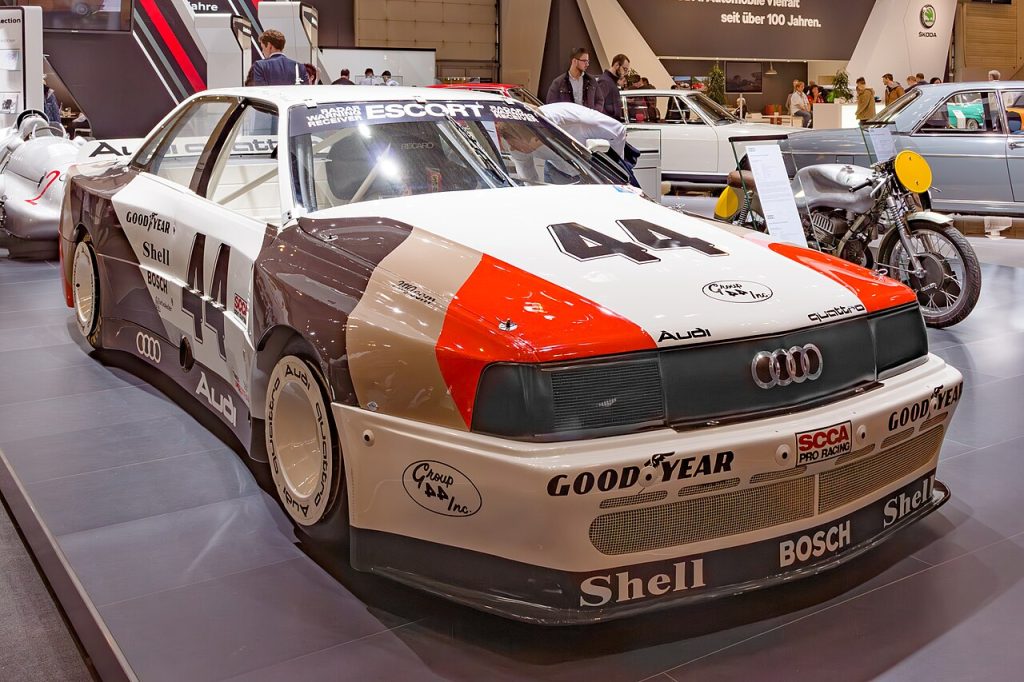
The wide racing body and period competition graphics make the car recognizable, but a photograph cannot certify the identity beneath the exterior. A detailed collector record should document the underlying structure, identification marks and the history of replacement panels. It should also say whether the current body represents a particular race setup or a later display configuration. This gives the reader a way to understand both the visual character and the physical object. Livery is valuable historical evidence only when it is connected to a dated and identified car.
The 2018 exhibition photograph
The supplied Commons image identifies an Audi 200 Trans-Am at Techno-Classica in Essen in 2018. The caption records that modern display setting instead of presenting it as a photograph from the 1988 season. It supplies an appropriate racing-model illustration with visible photographer and licence links. It does not assign a chassis number, original driver or championship result to the pictured example. A larger gallery could add the exhibition label and object documentation, allowing the model illustration to become a more specific physical-car record.
Trans-Am and IMSA GTO are separate programmes
The following Audi 90 quattro IMSA GTO guide is a natural related subject, but the two cars should not be described as the same chassis with a new badge. Different competition settings require different specifications and evidence. The manufacturer’s engine references alone show why a single shared headline output would mislead. A useful comparison examines programme year, model identity and stated configuration, then explains where a particular fact is unknown. It does not transfer the earlier championship outcome automatically to the later American campaign.
Documentation before a competition attribution
For a specific Trans-Am car, seek the earliest construction and team records, then trace the car through its competition and later life. Dated photographs, entry records, invoices and restoration notes can all contribute, provided their connection to the physical vehicle is explained. A famous driver’s name should come from that evidence, not just a retrospective model article. Record uncertainty where identifiers are absent or conflicting. The resulting file is more useful to a later owner than a polished narrative that skips the exact point where identity became unclear.
Mechanical review follows the present car
Historical power and success do not describe the current service condition of a racing vehicle. An inspection should address its actual engine, drivetrain, fuel system, structure and maintenance needs. The work can then be placed within a historical context: representative restoration, retained competition components or a changed operating setup. Those categories help explain what a demonstration or collector car can reasonably be expected to do today. They also prevent a factory period rating from becoming an unsupported assurance of present performance or reliability.
Why this car matters to the connected archive
The Trans-Am programme creates a useful bridge between Audi’s rally-homologation road car and its later circuit machines. It shows a different competition purpose rather than another consumer special edition. Related links to Sport quattro, IMSA GTO and V8 DTM let readers follow that development through distinct profiles. The collector appeal lies in documented construction and programme history, with each surviving chassis carrying its own evidence. A clear boundary between the works car and ordinary road production keeps rarity meaningful and the guide easier to verify.
Frequently asked questions
Is this an ordinary Audi 200 road car?
No. This profile concerns the factory Trans-Am competition programme.
What power does Audi list?
The manufacturer’s retrospective lists 375 kW, or 510 PS, for the 2.1-litre two-valve turbocharged five-cylinder.
Which season identifies the programme?
Audi places the Trans-Am campaign and Hurley Haywood’s title in 1988.
Does the supplied photo identify a title-winning chassis?
No. It identifies a modern exhibition car of the correct programme; individual race provenance remains unset.
Explore related vehicle profiles
Sources
Programme history and specifications follow the linked manufacturer and heritage records. Where figures or dates differ, their source contexts are retained. Collector-file and inspection guidance is editorial analysis; exact physical-car identity requires its own evidence.
Photography and credit
Source-identified Audi 200 Trans-Am exhibit at Techno-Classica 2018, Essen. Modern display photograph; livery does not certify a particular 1988 race chassis or driver history. Photo: Matti Blume / Wikimedia Commons · CC BY-SA 4.0. Wikimedia thumbnail resized from original; no cropping or color changes.
Why this machine matters
The Audi 200 quattro Trans-Am brought the company’s turbocharged five-cylinder and all-wheel-drive approach to American circuit racing in 1988. This profile concerns the works competition programme, not ordinary Audi 200 road production. Its championship significance is supported, while an exact original race-car census and the history of the photographed chassis remain separate questions.
Built in limited numbers
The retrieved manufacturer sources establish the factory programme without providing a complete, reconciled original chassis total. The production field remains unset. A photographed pair, an entry list or a surviving collection can document some cars without counting the entire programme. Development cars and later replacements also need clear treatment in any eventual register. The profile qualifies through its specific works-racing identity and documented small-programme context, while numerical certainty remains open to further archive evidence rather than being created from repeated secondary estimates.
Gallery
Specifications
Factory specifications may vary by model year, market and configuration.
Identity & production
- Official model
- Audi 200 quattro Trans-Am
- Base model
- 200 quattro Trans-Am
Powertrain & performance
- Engine
- 2.1-litre turbocharged two-valve inline five-cylinder