Audi V8 quattro DTM
The Audi V8 quattro DTM is the factory touring-car programme that brought a naturally aspirated V8 and four-wheel drive to the German championship in 1990. Its title-winning history is distinct from ordinary Audi V8 road production and from later Audi DTM machinery. The guide preserves season-specific specification and treats the modern demonstration photograph as model evidence, not a chassis certificate.
The Audi V8 quattro DTM is the factory touring-car programme that brought a naturally aspirated V8 and four-wheel drive to the German championship in 1990. Its title-winning history is distinct from ordinary Audi V8 road production and from later Audi DTM machinery. The guide preserves season-specific specification and treats the modern demonstration photograph as model evidence, not a chassis certificate.
Audi V8 quattro DTM at a glance
| Manufacturer | Audi |
|---|---|
| Archive connection | Audi |
| Model / programme | V8 quattro DTM |
| Profile scope | Factory DTM competition heritage archive |
| Historical reference year | 1990 |
| Inventory reference | AUDI-014 |
| Historical engine reference | 3.6-litre naturally aspirated V8 |
| Exact original build total | Unresolved; no certified production number populated |
A luxury-saloon identity in touring-car racing
Audi’s historical account emphasizes that the V8 competition car came from a luxury-saloon model family while many competitors favored smaller cars. That contrast explains the programme more clearly than describing it as a modern numbered special edition. The DTM car is the archive subject; ordinary road-model production is outside its count. A street Audi V8 with matching graphics needs its own description and cannot acquire works-car identity through appearance alone. The title therefore retains DTM throughout the guide and photograph metadata.
Why the programme starts with 1990
Audi places its entry into this DTM chapter in 1990. The guide uses that year as the historical reference while retaining the later 1991 and 1992 development context. An individual car may have its own construction and competition chronology, which should be established through records rather than inferred from the earliest programme date. This distinction is useful for modern event photographs: an exhibit can represent the broader V8 DTM family without proving that it is in the exact debut-season specification or carrying untouched 1990 components.
A naturally aspirated 3.6-litre V8
The manufacturer describes a 3.6-litre naturally aspirated V8 for the racing programme. This is a clear contrast with the turbocharged five-cylinder Trans-Am and IMSA GTO cars. It should not be replaced by a later Audi DTM engine figure merely because the championship name is shared. A car-specific technical description needs the installed unit and its rebuild history. The profile’s engine field gives the supported historical programme reference, while present output and precise configuration remain matters for an identified vehicle’s inspection and documents.
Power changed across the seasons
Audi’s circuit-history page describes an increase from 420 to 470 hp between the beginning in 1990 and the final racing period in 1992. The guide retains that source-labelled evolution rather than assigning the final figure to every 1990 example. It also does not silently relabel hp as an equivalent numeral in another unit. Historical racing power often depends on configuration and measurement context. For an individual car, the relevant season and current engine specification should be established before a numerical rating is placed in definitive metadata.
The two championship years
The factory account identifies Hans-Joachim Stuck as the 1990 champion and Frank Biela as the 1991 champion. Those supported programme results explain the V8 DTM’s significance. They do not identify the driver history of every modern display car. A recognizable race number or copied livery may represent a championship season without proving physical continuity with the car used in a particular event. An individual chassis profile should connect its entries and results through a traceable record, keeping driver association distinct from a general manufacturer achievement.
Rarity: race-car totals need a register
The retrieved primary sources do not establish a complete original V8 DTM build census. An exact verified production total is therefore not populated. The number of drivers entered in one season, or the cars visible in a race photograph, is not automatically a build total. Development, replacement and later altered cars need consistent treatment in a register. The programme remains a documented works-racing archive subject, but numerical rarity should be refined through the actual chassis records rather than copied from ordinary road-car production or a partial display inventory.
DTM then and later Audi machinery
The Audi account describes withdrawal in 1992 and a later return to DTM, but that corporate continuity does not make the later cars V8 quattro chassis. Championship categories, rules and machinery can change substantially. This guide remains focused on the early V8 touring-car programme. A related profile should identify its own period rather than borrowing these engine, drivetrain or result fields. For readers, the distinction makes Audi’s competition history easier to follow because the same series name no longer conceals several different technical eras.
The body and livery need a dated description
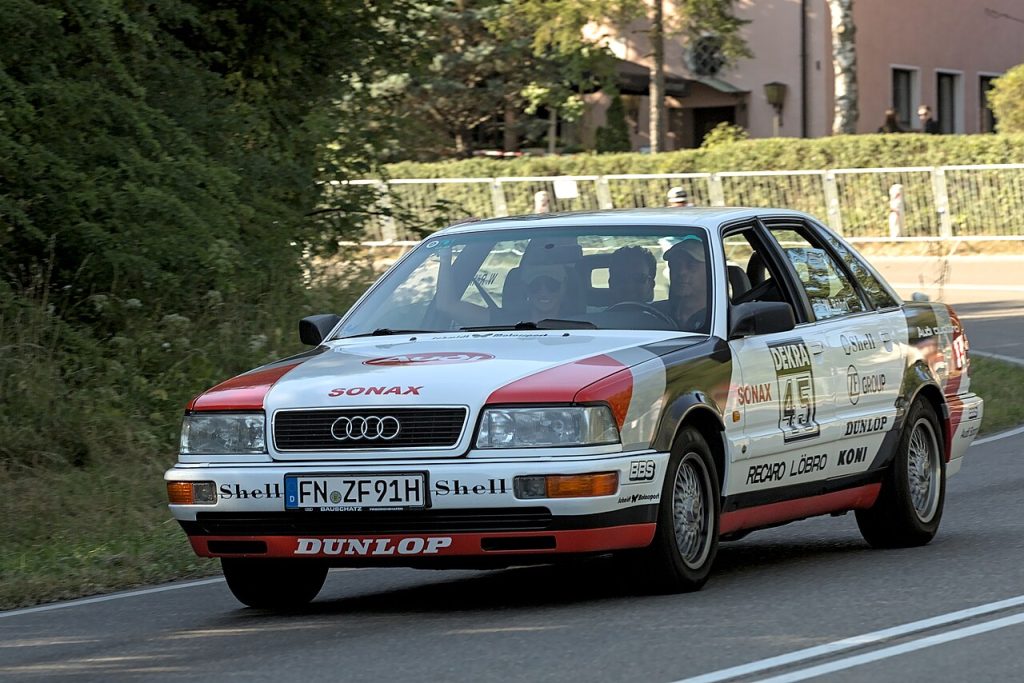
The large sedan body is a useful visual feature, while individual aerodynamic details and graphics should be linked to a particular season or event. A later restoration can reproduce a known championship presentation without proving every panel is period material. Document replacement work and record the date represented by the current finish. An expanded gallery should include identity details and relevant body areas rather than rely on a front three-quarter view. That lets a reader appreciate the presentation while understanding what further evidence is needed.
The Solitude Revival photograph
The bundled photo source identifies an Audi V8 quattro DTM at Solitude Revival in 2022. Its caption describes a modern programme illustration, leaving precise 1990, 1991 or 1992 specification and original chassis identity unset. It is not presented as a picture of the championship-winning car in its period race. The photographer and reuse licence are visible. This provides an accurate model illustration while keeping the demonstration event’s documentation separate from competition provenance, present condition and the ownership history of the particular car.
What to examine in a competition-car file
Begin with frame and component identities, then examine the earliest construction or team documentation that connects them with the programme. Record race entries, changes between seasons, major repairs and subsequent storage or restoration. If a body or engine was replaced, say when and why where the evidence permits. A good file explains which parts of the story are documented and where the record stops. The familiar quattro name and a famous driver’s graphics should support research questions, not supply answers that the actual chassis history lacks.
Current operation is separate from period success
A preserved racing car can require extensive specialist work even when it appears complete. A contemporary condition report should address the installed mechanical systems, structural state and maintenance record. It should also distinguish a representative demonstration setup from a restored competition specification. The historic championship result explains importance, while the current inspection explains the physical object. Keeping those two layers separate helps a collector understand what is being acquired and prevents a model-history article from sounding like an assurance of present reliability or event eligibility.
A useful closing link in the first Audi batch
The V8 DTM joins the Sport quattro, Trans-Am and IMSA GTO guides through a documented sequence of performance programmes. The connections show different answers to different competition briefs, including a change from turbocharged five-cylinder power to a naturally aspirated V8. That makes the archive more informative than a list of badges. The model’s significance is well supported; a precise count and each surviving object’s provenance remain attached to their own evidence. Readers can appreciate the achievements without the guide inventing production, originality or current-custody certainty.
Frequently asked questions
What engine did the V8 DTM use?
Audi describes a naturally aspirated 3.6-litre V8 in the early programme.
Who won the two supported titles?
Audi identifies Hans-Joachim Stuck in 1990 and Frank Biela in 1991.
Does every car have the final 470 hp rating?
No. Audi describes a programme increase from 420 to 470 hp across 1990–1992; season and individual specification matter.
Is the supplied photo a period championship image?
No. It records a source-identified V8 DTM appearance at Solitude Revival in 2022.
Explore related vehicle profiles
Sources
Programme history and specifications follow the linked manufacturer and heritage records. Where figures or dates differ, their source contexts are retained. Collector-file and inspection guidance is editorial analysis; exact physical-car identity requires its own evidence.
Photography and credit
Source-identified Audi V8 quattro DTM at Solitude Revival 2022. Programme illustration; no exact 1990/1991/1992 specification, original chassis identity or driver race history inferred from livery. Photo: Alexander Migl / Wikimedia Commons · CC BY-SA 4.0. Wikimedia thumbnail resized from original; no cropping or color changes.
Why this machine matters
The Audi V8 quattro DTM is the factory touring-car programme that brought a naturally aspirated V8 and four-wheel drive to the German championship in 1990. Its title-winning history is distinct from ordinary Audi V8 road production and from later Audi DTM machinery. The guide preserves season-specific specification and treats the modern demonstration photograph as model evidence, not a chassis certificate.
Built in limited numbers
The retrieved primary sources do not establish a complete original V8 DTM build census. An exact verified production total is therefore not populated. The number of drivers entered in one season, or the cars visible in a race photograph, is not automatically a build total. Development, replacement and later altered cars need consistent treatment in a register. The programme remains a documented works-racing archive subject, but numerical rarity should be refined through the actual chassis records rather than copied from ordinary road-car production or a partial display inventory.
Gallery
Specifications
Factory specifications may vary by model year, market and configuration.
Identity & production
- Official model
- Audi V8 quattro DTM
- Base model
- V8 quattro DTM
Powertrain & performance
- Engine
- 3.6-litre naturally aspirated V8