Renault Alpine A110-50
The Renault Alpine A110-50 is the 2012 concept that marked the original Berlinette’s fiftieth anniversary and made Alpine’s revival visible. A running demonstration car based on Renault Sport competition know-how, it belongs in the concept archive rather than a customer-edition production list.
The Renault Alpine A110-50 is the 2012 concept that marked the original Berlinette’s fiftieth anniversary and made Alpine’s revival visible. A running demonstration car based on Renault Sport competition know-how, it belongs in the concept archive rather than a customer-edition production list.
Renault Alpine A110-50 at a glance
| Manufacturer | Alpine |
|---|---|
| Model family | A110-50 |
| Profile scope | Concept archive |
| Inventory reference | ALP-056 |
| Engine reference | Mid-mounted competition-derived V6 — 2012 concept reference |
Why the A110-50 matters
The A110-50 gave Alpine’s anniversary a physical form at a time when the marque’s future road-car identity was still being developed. Renault’s 2012 account places its premiere at the Monaco Grand Prix in May and describes it as a tribute to the original A110 Berlinette. For a collection, its significance is the revival signal and the design proposal. It is not a 2012 customer-production A110 or a numbered modern edition. That distinction helps explain why a single concept can be historically important without having a conventional sales or ownership story.
A running concept with competition foundations
Renault Netherlands describes the A110-50 as drawing on Renault Sport Technologies’ experience and the Mégane Trophy’s technical basis. It was therefore more than a static styling exercise. The manufacturer recorded demonstration plans and later an appearance at City Racing Rotterdam with Giedo van der Garde driving. These events support its identity as a running concept. They do not establish road homologation, a customer racing programme or a complete competition career. Keep demonstration use separate from race entries and production-road approval when writing the car’s history.
The published technical reference
The July 2012 Renault release lists a mid-mounted 24-valve V6, 400 metric horsepower, 422 Nm, a six-speed sequential semi-automatic transmission and an 880 kg weight. It also describes carbon-fibre bodywork. These are manufacturer concept specifications. They should not be entered as measurements of the exhibition car shown in a later photograph or as promises about an undocumented present configuration. A technical file for the actual object would need build records, engine identification and any later modifications made for display, storage or demonstration use.
Design cues and the Alpine name
The A110-50 uses a familiar name to introduce a very different shape. Studying it as a concept means asking which ideas evoke Alpine and which were exploratory. Compare the front treatment, overall proportions, body surfacing and racing equipment with an original Berlinette rather than assuming the concept was intended as a direct production replacement. The relationship is interpretive: a name and anniversary can connect two cars historically without making their construction, packaging or purpose identical. That makes the A110-50 a useful bridge in an Alpine design collection.
A new blue, rather than one timeless paint code
Renault Group’s discussion of Alpine blue explains that the A110-50 used a new metallic-blue interpretation. The colour subsequently influenced the revived endurance livery. This is a useful reminder that Alpine blue is a design tradition with several shades, not a single universal paint specification. A conservation or repaint decision for the concept should follow its own original finish evidence. An attractive modern Alpine blue is not automatically the correct colour for this particular 2012 object or an earlier roadgoing Berlinette.
Production and rarity: one recorded in 2012
Renault’s August 2012 Rotterdam report states that only one A110-50 had been built at that point. This is strong primary evidence for the concept’s contemporary one-car status. It is a dated statement, not a newly verified lifetime census of every styling model, spare body or later display object. The profile therefore records the statement in its production notes and keeps the generic completed-production field unset. There was no documented customer allocation in the reviewed material. Its rarity is the concept’s specific role and physical history, with the count’s date retained.
Concept identity is a different research problem
For a production car, factory type, build number and delivery records often provide the basic identity. A concept may instead be documented through design-project records, workshop construction files, event transport documents and exhibition history. Establish which physical object appeared at each event and whether the same chassis, body and drivetrain continued through the sequence. A show appearance proves that an object was presented there; it does not automatically establish every hidden component. Keep evidence of running demonstrations and static exhibitions together while distinguishing their different claims.
Displaying the revival story
A useful exhibit can place the A110-50 beside an original A110 and the later Celebration or Vision concepts. Explain the anniversary, the racing-based demonstration role and the gradual movement toward a road-car proposition. The comparison should be chronological rather than suggesting that every concept’s published specification carried into the production A110. Display photographs can show how the idea was presented to the public, while technical labels remain scoped to the appropriate concept. This allows visitors to follow a revival process without requiring them to know each internal model designation.
Preserving a unique demonstration object
Conservation should begin with a record of the object’s current condition and its known original construction. Document the body finish, interior, controls, hardware and any changes made for later appearances. Retain material removed during necessary work when practical. A concept may contain details designed for presentation rather than long-term use, so a specialist should assess how those details age. The aim is to preserve evidence of the design project while making any intervention understandable. A visually perfect restoration without a work record can lose useful information about how the concept was made.
Mechanical readiness is separate from concept fame
The fact that the A110-50 ran in public in 2012 does not determine whether it is suitable for a demonstration years later. Assess the installed drivetrain, fuel system, cooling, brakes and safety equipment for the proposed activity. Establish a maintenance and operating plan with the custodians or specialists who understand the car. Record changes made for reliability and preservation rather than disguising them as original specification. A static display may be the appropriate choice for some components; the decision should follow condition and conservation goals, not simply the desire to recreate a famous appearance.
How to describe replicas and related objects
An independently built tribute, a scale model or a promotional body should be catalogued according to what it actually is. Similar paint and proportions do not establish the identity of Renault’s running concept. If a display object lacks a drivetrain, say so; if its connection to the original project is documented, explain that connection precisely. This approach preserves the interest of supporting objects without lending them a provenance they do not possess. It also keeps any one-off claim attached to the right physical scope and the date of the source.
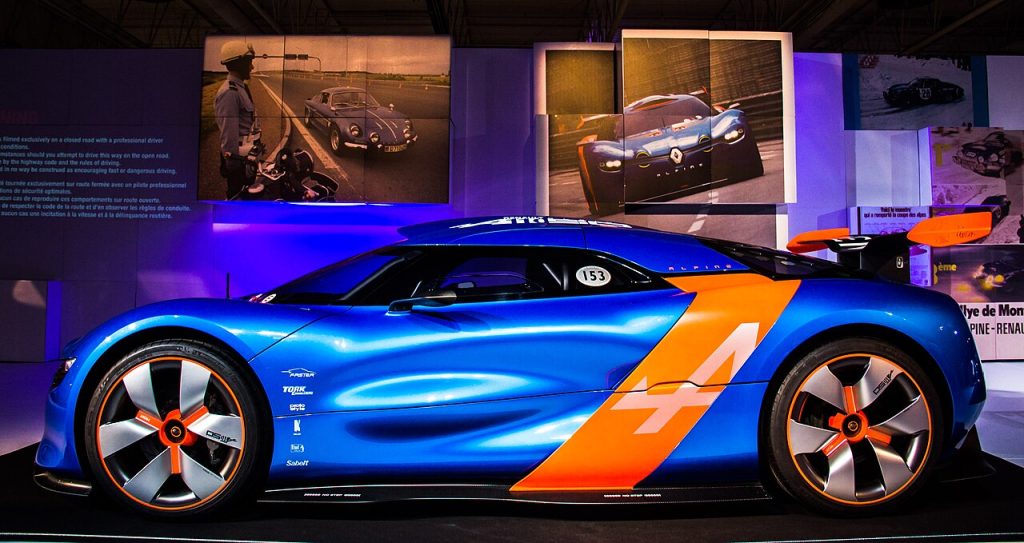
The supplied Paris photograph
The bundled photograph shows the A110-50 displayed at the 2012 Paris Motor Show. It is a credited contemporary exhibition image, separate from its Monaco premiere and Rotterdam demonstration. The photograph communicates the concept’s appearance and body treatment, while the linked manufacturer releases provide the technical and event history. No ownership, present running condition or hidden engine detail is inferred from the image. For an object-specific archival feature, additional views of the construction and identification records would complement the public-facing design photograph.
Frequently asked questions
Was the A110-50 a production road car?
The reviewed manufacturer material describes a concept and demonstration car. No customer-edition allocation or road homologation is established here.
Was it capable of running?
Yes. Renault documented public demonstration use, including Giedo van der Garde at City Racing Rotterdam in 2012.
How many were built?
Renault’s August 2012 report said only one had been built at that time. The date and concept scope are retained rather than turning that into an unqualified lifetime census.
Did its technical specification become the production A110?
This profile makes no such claim. The A110-50’s competition-based concept specification belongs to that project and must remain separate from later road models.
Explore related Alpine profiles
Sources
- Renault Netherlands: A110-50 demonstration and technical data, July 2012
- Renault Netherlands: A110-50 at City Racing Rotterdam, August 2012
- Renault Group: Alpine blue and the A110-50 concept
Historical statements follow the linked manufacturer, club, register and game-project records. Inspection and collecting guidance is editorial analysis. Individual catalogue claims remain attributed to the relevant car and source.
Photography and credit
Renault Alpine A110-50 concept displayed at the 2012 Paris Motor Show. Photo: Ben from LONDON, United Kingdom / Wikimedia Commons · CC BY-SA 2.0. Wikimedia thumbnail resized from the original; no cropping or colour changes.
Why this machine matters
The Renault Alpine A110-50 is the 2012 concept that marked the original Berlinette’s fiftieth anniversary and made Alpine’s revival visible. A running demonstration car based on Renault Sport competition know-how, it belongs in the concept archive rather than a customer-edition production list.
Built in limited numbers
Renault’s August 2012 Rotterdam report states that only one A110-50 had been built at that point. This is strong primary evidence for the concept’s contemporary one-car status. It is a dated statement, not a newly verified lifetime census of every styling model, spare body or later display object. The profile therefore records the statement in its production notes and keeps the generic completed-production field unset. There was no documented customer allocation in the reviewed material. Its rarity is the concept’s specific role and physical history, with the count’s date retained.
Gallery
Specifications
Factory specifications may vary by model year, market and configuration.
Identity & production
- Official model
- Renault Alpine A110-50
- Base model
- A110-50
Powertrain & performance
- Engine
- Mid-mounted competition-derived V6 — 2012 concept reference