Alpine Vision Gran Turismo
The Alpine Vision Gran Turismo is a 2015 virtual sports-car design realized as a full-size exhibition model. Its interest lies in the meeting of Alpine heritage, game simulation and physical design, with virtual performance kept separate from the photographed show object.
The Alpine Vision Gran Turismo is a 2015 virtual sports-car design realized as a full-size exhibition model. Its interest lies in the meeting of Alpine heritage, game simulation and physical design, with virtual performance kept separate from the photographed show object.
Alpine Vision Gran Turismo at a glance
| Manufacturer | Alpine |
|---|---|
| Model family | Vision Gran Turismo |
| Profile scope | Concept and digital archive |
| Inventory reference | ALP-059 |
A virtual Alpine with a physical presence
The Vision Gran Turismo was created for the Gran Turismo project and revealed in January 2015. Polyphony Digital’s official announcement describes a full-size model displayed at the Festival Automobile International in Paris, with Rétromobile following. This gives the entry two connected but distinct subjects: the virtual car and the physical exhibit. The design can be experienced in a game, while the full-scale object allows its surfaces and proportions to be seen in person. A useful archive profile explains both without pretending that a photographed show model automatically has the simulated car’s drivetrain.
Why the project fitted Alpine’s revival
The collaboration occurred during the revival of Alpine and its sixtieth-anniversary period. A virtual-car project allowed designers to explore ideas without the full constraints of a production road car. For a collection, the significance is the freedom of that design exercise and the decision to give it a physical presence. It belongs alongside the A110-50 and Celebration in the revival chronology, but it does not share their exact purpose. The concept also records how a historic sports-car marque chose to communicate with an audience beyond traditional showroom and motorsport settings.
Design authorship and heritage references
Polyphony Digital’s reveal account names Victor Sfiazof’s winning design and connects the barquette concept with Alpine’s endurance programme. Alpine’s later exhibition account identifies references to the A110 at the front and the A210 and A220 at the rear. These connections are part of the design explanation, not a claim that the car reuses period components. A visitor can compare the shapes directly while keeping the engineering history of each earlier model separate. The result is a new object that interprets Alpine heritage rather than a reproduction of one historic car.
Virtual technical data, clearly labelled
The official game reveal lists a 4,494 cc V8, 450 horsepower, a seven-speed sequential transmission, 900 kg and a 320 km/h top-speed reference. These figures describe the virtual concept specification. They are not evidence that the physical display model contains that engine or has completed a measured speed test. The generic engine and displacement metadata remain unset for the photographed object. This prevents a search result or vehicle card from presenting simulated figures as tested physical facts while retaining them in the article where the virtual context is explicit.
A full-size model is not a road homologation
Alpine’s 2020 exhibition description states that the Vision Gran Turismo was realized at 1:1 scale and intended for virtual driving. That supports its physical exhibit identity without establishing road legality, a working engine or a customer production programme. A show object can have immense design and historical value while serving a different function from a road car. When cataloguing it, distinguish external dimensions, visible details and documented construction from simulated technical data. A life-size object is evidence of scale; it is not proof of mechanical capability.
Production and rarity
The inventory’s single physical-show-car scope is treated as an archive description, not a completed road-car production total. The reviewed manufacturer and game records establish a full-scale exhibit but do not provide a comprehensive lifetime census of all display objects, bodies or models. The numeric production field therefore remains unset. Digital availability is also not a vehicle manufacturing count: many players can use the virtual design without more physical cars being built. Keep the concept project, individual physical object and game distribution as three separate counting questions.
The exhibition sequence
The 2015 reveal account connects the Festival Automobile International with Rétromobile, and Alpine later documented the Vision Gran Turismo in its 2020 exhibition programme. Build the appearance history from dated sources rather than assuming every public image shows an unchanged object. Where the physical exhibit is identified, record any changes to finish, support equipment or presentation. A later show confirms the design’s continuing heritage role, but it does not automatically establish that all material remains original to the January 2015 reveal. Exhibition and conservation records should be read together.
Vision Gran Turismo versus Alpine Vision
The 2015 Vision Gran Turismo and the 2016 Alpine Vision concept have similar names but distinct identities. The former is the virtual design with a full-scale exhibit; the latter belongs to the next road-car revival step. Captions, image filenames and model-family fields should retain the full names and dates. A cropped photograph or a shortened title can make the two easy to confuse. In a collection catalogue, separate pages are helpful because they let each project’s design intent, physical history and evidence remain clear.
Authenticating the physical exhibit
For a claimed original show object, request project documentation, workshop or fabrication records and a dated chain of institutional or event custody. Establish which parts were made for the reveal and which were changed later. Identification may rely on project records rather than a conventional production-car VIN. A replica, promotional model or later fabrication should be described according to its documented relationship with Alpine’s original project. Its appearance can support a comparison, but visual similarity alone cannot establish manufacturer origin or continuity with the first exhibition.
Conservation of a design model
A physical design model may include materials and finishes selected for display. Inspect the object with a conservation approach appropriate to those materials. Record surface damage, paint, fasteners, supports, interior fittings and any presentation equipment before intervention. Preserve evidence of fabrication where practical and document replacements. The goal may be to retain the reveal configuration or to conserve later exhibition history; either choice should be explicit. This gives future custodians a way to interpret the object without mistaking a fresh restoration for an untouched 2015 surface.
How to exhibit virtual and physical evidence
Pair a photograph of the exhibit with a clearly labelled explanation of the virtual project. If game footage or screenshots are used, obtain suitable rights for those materials independently of the photograph’s licence. Explain which specifications belong to the simulation and which observations concern the physical model. A display can compare heritage cues with the A110, A210 and A220 without overwhelming visitors with every virtual performance field. The useful story is how the project transformed Alpine ideas into an object and an interactive experience.
The supplied Rétromobile photograph
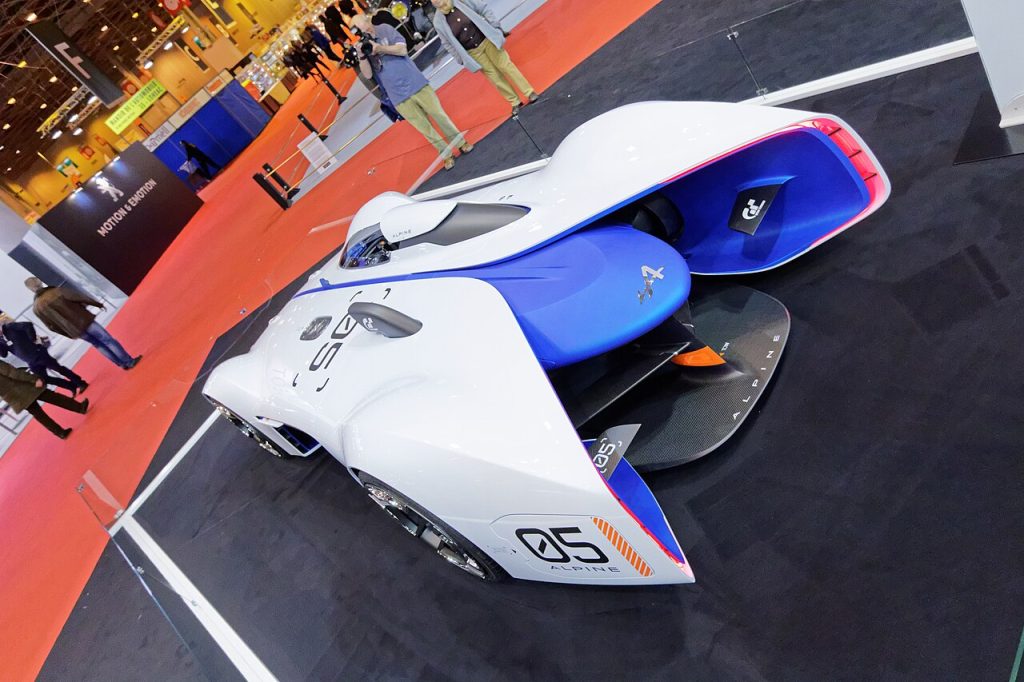
The bundled image shows the full-size Vision Gran Turismo model at Rétromobile in 2015. Its visible credit links the photographer, Commons source and licence. The image documents the external exhibition presentation; it does not prove a working V8, carbon monocoque or measured top speed in the physical object. Keep that boundary in any reused caption. Additional project or fabrication photographs could support a deeper study of the exhibit’s construction, while the credited public image remains a clear illustration of the design seen by visitors.
Frequently asked questions
Is the Vision Gran Turismo a real car?
A full-size physical exhibition model exists, while the drivable performance concept was created for the virtual Gran Turismo environment. Those scopes are kept separate.
Does the display model have the published V8 engine?
The reviewed evidence does not establish that. The 4,494 cc V8 specification belongs to the virtual concept and is not copied into physical-engine metadata.
Is this the 2016 Alpine Vision?
No. Vision Gran Turismo is the 2015 virtual-car project with a physical exhibit. Alpine Vision is a distinct later concept.
How many physical examples were built?
The sources establish a full-scale exhibit but do not provide a comprehensive lifetime object census. No exact completed-production field is entered.
Explore related Alpine profiles
Sources
- Polyphony Digital: Alpine Vision Gran Turismo revealed, January 2015
- Alpine: the physical Vision Gran Turismo exhibit, 2020
- Alpine: 60th anniversary celebrations in Dieppe, 2015
Historical statements follow the linked manufacturer, club, register and game-project records. Inspection and collecting guidance is editorial analysis. Individual catalogue claims remain attributed to the relevant car and source.
Photography and credit
Full-size Alpine Vision Gran Turismo display model at Rétromobile 2015; this physical exhibit does not verify virtual performance figures. Photo: Thesupermat / Wikimedia Commons · CC BY-SA 4.0. Wikimedia thumbnail resized from the original; no cropping or colour changes.
Why this machine matters
The Alpine Vision Gran Turismo is a 2015 virtual sports-car design realized as a full-size exhibition model. Its interest lies in the meeting of Alpine heritage, game simulation and physical design, with virtual performance kept separate from the photographed show object.
Built in limited numbers
The inventory’s single physical-show-car scope is treated as an archive description, not a completed road-car production total. The reviewed manufacturer and game records establish a full-scale exhibit but do not provide a comprehensive lifetime census of all display objects, bodies or models. The numeric production field therefore remains unset. Digital availability is also not a vehicle manufacturing count: many players can use the virtual design without more physical cars being built. Keep the concept project, individual physical object and game distribution as three separate counting questions.
Gallery
Specifications
Factory specifications may vary by model year, market and configuration.
Identity & production
- Official model
- Alpine Vision Gran Turismo
- Base model
- Vision Gran Turismo