Audi TT RS Coupe iconic edition
A 100-car European TT RS Coupe edition announced in 2022, pairing Nardo grey and a distinctive aero-and-cabin treatment with the established five-cylinder powertrain.
A 100-car European TT RS Coupe edition announced in 2022, pairing Nardo grey and a distinctive aero-and-cabin treatment with the established five-cylinder powertrain.
Audi TT RS Coupe iconic edition at a glance
| Manufacturer | Audi |
|---|---|
| Model / programme | TT |
| Profile scope | Limited road edition |
| Historical reference year | 2022 |
| Inventory reference | AUDI-082 |
| Engine reference | 2.5-litre turbocharged five-cylinder petrol |
| Published edition limit | 100 — European TT RS Coupe iconic edition allocation |
| Manufacturer power reference | 294 kW |
| Manufacturer power reference | 400 PS; concept rating where applicable |
| Manufacturer torque reference | 480 Nm; concept rating where applicable |
An anniversary edition with a clear identity
Audi announced the TT RS Coupe iconic edition in October 2022 ahead of the TT’s 25th-anniversary celebrations in 2023. Its purpose is to present a recognisable late TT specification rather than a completely new model family. The full designation matters because several markets received differently named TT specials and final editions. A search result saying “final TT” is therefore not enough to identify this 100-car programme. A useful profile starts with the exact name, body style, launch chronology and market scope, then connects the edition’s appearance to factory documentation for an individual example.
The 100-car European allocation
Audi’s 2022 quarterly material identifies a limit of 100 units in Europe, consistent with the contemporary Audi Australia article’s description of the European edition. The number should not be used as a count of all late TT RS cars or every TT anniversary special worldwide. This profile preserves it as the factory allocation for the named programme, not an independently audited survival register. A claim about the number supplied to a particular country or steering configuration needs its own dated evidence. Keep that regional question distinct from the programme’s overall limit so that a smaller reported subset does not quietly replace the scope of the original edition.
Nardo grey and the visual specification
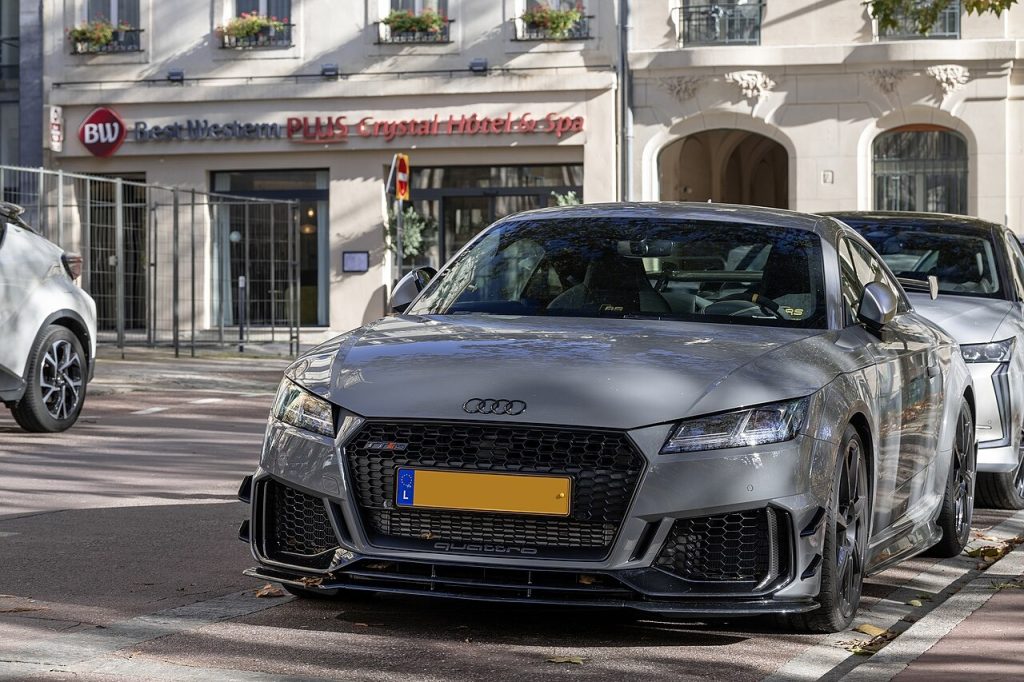
The period description places Nardo grey alongside a coordinated aerodynamic treatment, dark exterior details and distinctive interior accents. Those elements make an actual iconic edition easier to compare with launch material, but appearance remains supporting evidence. Similar trim can be fitted to another TT RS, while a genuine edition can be repainted or repaired. The bundled photograph is source-identified as an iconic edition and provides a full-car view. For a candidate offered for sale, ask for photographs of the relevant cabin details and numbered identification together with the factory order, rather than expecting a single exterior image to establish every part of the claim.
The published five-cylinder reference
Audi describes a 2.5 TFSI engine with 294 kW and 480 Nm, a seven-speed S tronic transmission and quattro drive. The anniversary identity does not on its own establish a separate power increase. Keep the factory reference distinct from tuning or later alterations to a particular car. A useful comparison with the RS 3 performance edition therefore considers both the named specification and the body, not only the shared five-cylinder theme. As with any collection vehicle, the model-level specification explains what Audi offered; the original order and current inspection explain the equipment and condition of the individual example.
Aero treatment and the TT’s original shape
The edition’s aero details alter how the compact TT form is read, especially around the front and rear. Compare a complete side view with front and rear views to see the relationship between the familiar roof arc and the added performance-oriented elements. That is a design comparison rather than a claim of independently measured downforce. For authenticity, establish which components were factory-installed and whether replacements match the original specification. A visually close replacement may be satisfactory for use while still deserving a note in the history. The file should be able to explain both the car’s identity and the present state of its trim.
Cabin details and numbering
Audi’s period account describes calendula-yellow accents and an individual number displayed on the selector, alongside the special seat treatment. Such details are helpful because the edition’s identity is expressed inside as well as outside. Photograph them clearly and match them to VIN-linked records. A removable numbered part is valuable corroboration, but it should not be the only authentication evidence. Keep invoices for replaced cabin components or repairs, and distinguish original delivery specification from restoration choices. This allows a future reader to understand a genuine car that has been maintained or repaired without being asked to assume that every surface is untouched.
2022 introduction and the 2023 celebration
The workbook’s 2022 reference records the introduction, while the anniversary itself belongs to 2023. Later photographs and registrations may carry yet another date. These can coexist without contradiction when the fields are labelled accurately. Avoid implying that the iconic edition is the final individual TT chassis: Audi’s later historical account identifies the final TT as a TTS, a different subject. The limited edition and the last-built car have separate reasons for interest. Preserving that distinction gives enthusiasts a clearer route through the end of the TT story than grouping every late special under an undifferentiated farewell label.
Comparing other limited TT and compact RS models
The iconic edition should be compared with other named specials by market, body style, purpose and allocation. A Heritage Edition, a national Final Edition and a quattro-anniversary edition can refer to different programmes even when their base cars look similar. The RS 3 performance edition is a useful adjacent comparison because it combines another compact five-cylinder form with a shared-body allocation. Neither page should borrow the other’s count or equipment. These comparisons help a reader interpret a seller’s exact claim, and they can also show how Audi expressed distinct collecting themes within a closely related performance-car period.
Condition review for a scarce specification
Inspect the standard mechanical systems and the edition-specific components together. Request servicing, repair evidence, diagnostic results and an account of suspension or software changes. Examine the aero parts, wheels, paint finish and cabin accents for damage or replacement, then connect the findings to dated invoices and photographs. These priorities do not imply that the edition has a universal defect. They recognise that a scarce specification includes removable and repairable parts whose history can affect completeness. A clear written assessment is more useful than a low-mileage claim by itself, especially when originality is a major part of a seller’s description.
The iconic edition’s place in the TT archive
The car provides a focused late-generation reference through its European allocation, special presentation and explicit anniversary role. It can be appreciated on those documented terms without speculation about future prices or a claim that every late TT is equivalent. A collector file should preserve the order, number, delivery photographs and continuing history so that the edition remains identifiable after ownership changes. Read the older TT concept profiles alongside it to explore the design’s evolution, while retaining each programme’s dates and object type. That creates a coherent archive route from a design study to a particular limited road edition.
Frequently asked questions
How many TT RS iconic editions were announced?
Audi identified a 100-car European allocation. The figure does not cover every national TT special or all TT RS production.
Is 2022 or 2023 the correct reference year?
The edition was announced in 2022 ahead of the TT’s 2023 anniversary. Build, delivery and registration dates are separate.
Was the iconic edition the final individual TT?
No. A limited edition programme is distinct from the final single chassis; Audi’s historical account identifies the final TT as a TTS.
What supports a genuine iconic edition claim?
VIN-linked factory records, original specification and delivery evidence, corroborated by the special trim and numbered identification. Exterior resemblance alone is insufficient.
Explore related vehicle profiles
Sources
- Audi Australia — Iconic, 7 October 2022
- Audi — Quarterly Update Q3 2022, European iconic edition scope
- Audi — The TT: an icon of brand history, 15 November 2024
History and published specifications follow the linked manufacturer records. Visual comparisons, documentation questions and inspection priorities are editorial analysis. Photographs retain their original subject descriptions and separate rights records.
Photography and credit
Source-identified Audi TT RS iconic edition, photographed by Alexandre Prevot. Photo: Alexandre Prevot from Nancy, France / Wikimedia Commons · CC BY-SA 2.0. Resized without cropping or color alteration.
Why this machine matters
A 100-car European TT RS Coupe edition announced in 2022, pairing Nardo grey and a distinctive aero-and-cabin treatment with the established five-cylinder powertrain.
Built in limited numbers
100 is the European iconic edition allocation. 2022 introduction distinguished from 2023 anniversary. Numbered trim supports but does not replace VIN-linked identity. Final TT chassis is a separate TTS subject.
Gallery
Specifications
Factory specifications may vary by model year, market and configuration.
Identity & production
- Official model
- Audi TT RS Coupe iconic edition
- Base model
- TT
Powertrain & performance
- Engine
- 2.5-litre turbocharged five-cylinder petrol