Audi RS 3 Sedan performance edition
The Sedan body style within Audi’s shared 300-car RS 3 performance edition programme, announced in 2022 with an uprated five-cylinder specification and distinctive factory equipment.
The Sedan body style within Audi’s shared 300-car RS 3 performance edition programme, announced in 2022 with an uprated five-cylinder specification and distinctive factory equipment.
Audi RS 3 Sedan performance edition at a glance
| Manufacturer | Audi |
|---|---|
| Model / programme | RS 3 |
| Profile scope | Limited road edition — shared body allocation |
| Historical reference year | 2022 |
| Inventory reference | AUDI-079 |
| Engine reference | 2.5-litre turbocharged five-cylinder petrol |
| Published edition limit | 300 — Combined RS 3 performance edition Sedan and Sportback; body split unresolved |
| Manufacturer power reference | 299 kW |
| Manufacturer power reference | 407 PS; concept rating where applicable |
| Manufacturer torque reference | 500 Nm; concept rating where applicable |
A limited performance edition in Sedan form
Audi introduced the RS 3 performance edition in October 2022, offering Sedan and Sportback versions within one limited programme. This page follows the Sedan body style while retaining that shared scope. The distinction matters for anyone comparing allocations or identifying an advertised car: a separate profile is useful for the body style, but it does not create a separate factory production limit. The Sedan’s collecting appeal is the way the named specification is presented in a conventional three-box shape. It should be examined through its factory order and equipment rather than assumed from an RS badge or an unusually vivid paint finish.
Why the Sedan does not have its own 300-car total
Audi says the programme is limited to 300 units and available as Sportback and Sedan. The reviewed announcement does not establish the body-style split. Both profiles therefore show the shared allocation, and neither claims 300 cars for itself. The same care applies to the “1 of 300” inscription: it denotes membership of the series, not necessarily a unique sequential number. A genuine Sedan needs a VIN-linked edition record, while a claim about how many Sedans exist needs further body-specific evidence. Keeping those questions separate stops two accurate body-style pages from accidentally doubling the underlying programme population.
The five-cylinder specification in context
Audi published 299 kW, 407 PS and 500 Nm for the performance edition, with a 300 km/h maximum-speed reference. These figures belong to the original edition’s manufacturer brief. A later regular RS 3, an aftermarket tune and a different market’s specification must be compared separately. The value of the specification table is clarity, not a claim that every photographed or advertised car still has its original software and components. If assessing an individual vehicle, request the factory order and a record of any engine or control-system alteration before using its present behaviour to draw conclusions about the named edition.
Factory equipment and the authentication question
The launch material identifies bucket seats, ceramic front brakes and adaptive suspension as part of the special model’s equipment. Such items are useful comparison points, but an equipment match remains corroboration rather than the final identity record. Components can be fitted later, and original components can be removed. A reader should ask whether the specification was installed at the factory and whether it remains complete. Date the evidence: a delivery photograph and a current photograph answer different questions. This makes a listing review more precise than a checklist that silently assumes every matching visible part proves original edition membership.
The Sedan silhouette as a collection choice
The Sedan gives the programme a different visual balance from the Sportback. Its roof, rear glass and separate boot change how the car is read from the side and rear, even where the edition’s mechanical brief is shared. That makes body style a legitimate focus for an individual profile without inventing a new edition. Compare full-car views from similar angles when judging proportions, and avoid letting a cropped hero image stand in for every aspect of the shape. Practical preferences and visual appeal can be described as choices rather than disguised as technical superiority or a claim that one version must be more collectible.
Shared technology, separate vehicle histories
The RS 3 performance edition’s torque-splitter technology forms part of the programme context. It does not tell us how any individual Sedan was driven, maintained or modified. A technical comparison should explain the factory system at the model level, then return to the specific car’s history for evidence of condition. That distinction is useful when sales descriptions emphasise driving modes or track use. The available mode is not a logbook. Ask for servicing, tyre and brake records, diagnostic results and a clear account of changes, so that an attractive specification does not become a substitute for the evidence needed to understand an actual example.
Documentation that carries the edition identity
A good file brings together the VIN, original factory specification, delivery paperwork and dated photographs of the interior and exterior. Look for a clear connection between the named performance edition and the identity record, not only between the VIN and a general RS 3 description. Preserve correspondence explaining replaced trim, seats, wheels or software. If a seller claims a particularly small Sedan sub-allocation, ask for the dated manufacturer source and its market scope. A local registration count, a dealer’s deliveries and a worldwide factory build total are different measures and should not be combined into a single rarity statement.
Condition review for a performance-oriented Sedan
Arrange a competent inspection that considers the drivetrain, suspension, brakes, tyres and repair quality alongside the edition-specific details. Record the current equipment and compare it with the delivered specification. For expensive or specialised components, a verbal assurance is less useful than a clear written assessment of condition and supporting workshop evidence. This does not presume a universal fault or condemn a car for having been enjoyed. It makes the vehicle’s actual state visible. A collection file should also distinguish scheduled maintenance, damage repair and elective modification, because each tells a different part of the car’s story.
Photographing the Sedan within the shared programme
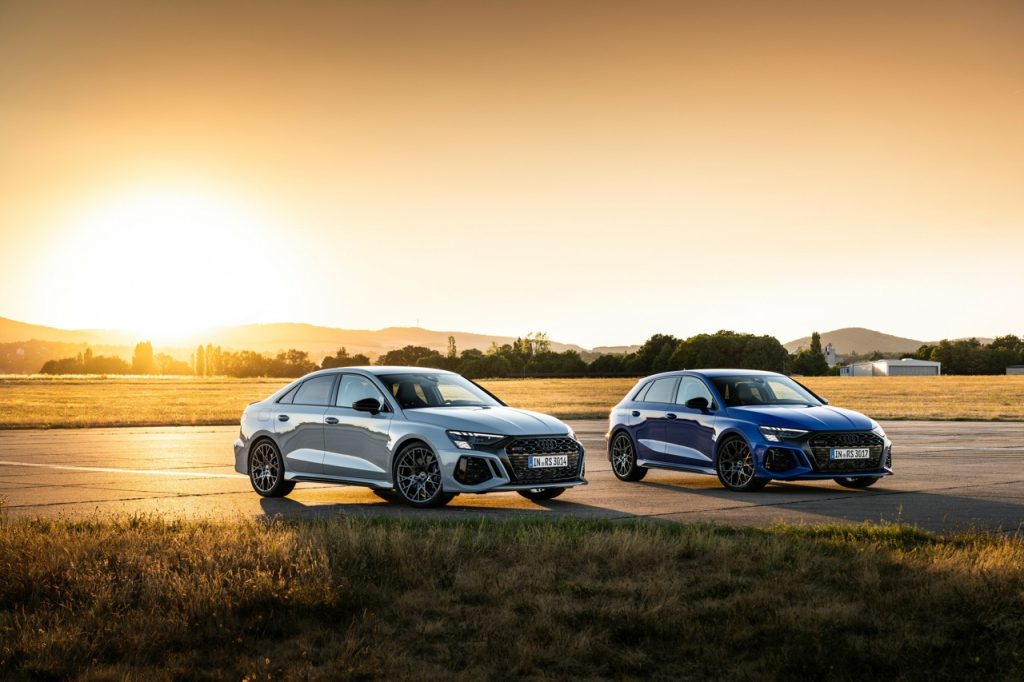
The bundled official Audi photograph shows the Arrow Gray Sedan together with the Nogaro Blue Sportback. Its caption names both bodies so that a reader can use it as a comparison rather than mistake the second car for another Sedan. The photograph documents the edition’s factory presentation, not an individual chassis’s provenance or current condition. Additional images for a particular car should cover the full body, the relevant cabin details and the documents that support identity. Keep the official image and seller photography clearly distinguished: they are valuable for different purposes and should not be allowed to imply the same evidence.
A focused place in the RS archive
The Sedan performance edition belongs in a route through Audi’s compact RS cars and its other named limited editions. Its shared allocation and body-specific identity make it particularly useful for teaching good rarity comparisons. A low count is meaningful only when its population is defined correctly. Its significance can be discussed through the five-cylinder specification, factory equipment and body style without promising a price trajectory. If later evidence establishes the Sedan split, add that figure with its source and date while preserving the original combined cap. Until then, an explicitly shared count gives readers a more dependable guide than an unsupported claim of 300 Sedans.
Frequently asked questions
Were 300 RS 3 performance edition Sedans announced?
No separate 300-Sedan allocation is established. Audi’s 300-car limit covers Sedan and Sportback together; the split is unresolved here.
What power did Audi specify?
Audi’s 2022 brief gives 299 kW, equivalent to 407 PS, and 500 Nm for the performance edition.
Is “1 of 300” a unique serial number?
The inscription indicates edition membership. This profile does not treat it as a distinct sequential number without supporting factory evidence.
How can the Sedan edition be verified?
Use VIN-linked factory records naming the performance edition, supported by the original order and delivery evidence. Seats, paint and badges alone are insufficient.
Explore related vehicle profiles
Sources
- Audi — RS 3 performance edition, 18 October 2022
- Audi Switzerland — RS 3 performance edition
- Audi — Performance is an attitude: special models, November 2022
History and published specifications follow the linked manufacturer records. Visual comparisons, documentation questions and inspection priorities are editorial analysis. Photographs retain their original subject descriptions and separate rights records.
Photography and credit
Audi RS 3 Sedan performance edition in Arrow Gray alongside the Sportback performance edition in Nogaro Blue; official photograph A225585. Photo: AUDI AG / Audi Media Center · Audi Media Center: editorial use free of charge. Resized without cropping or color alteration.
Why this machine matters
The Sedan body style within Audi’s shared 300-car RS 3 performance edition programme, announced in 2022 with an uprated five-cylinder specification and distinctive factory equipment.
Built in limited numbers
300 allocation shared with Sportback; no Sedan-only split established. Shared count group rs3-performance-2022 prevents programme double-counting. Launch 2022; deliveries announced from early 2023.
Gallery
Specifications
Factory specifications may vary by model year, market and configuration.
Identity & production
- Official model
- Audi RS 3 Sedan performance edition
- Base model
- RS 3
Powertrain & performance
- Engine
- 2.5-litre turbocharged five-cylinder petrol