Alpine A525 Formula One
The Alpine A525 is the works Formula One car for 2025, succeeding A524 and preceding the Mercedes-powered A526. Its season included a change in the race-driver pairing. A collector profile needs a documented chassis identity and configuration, rather than a livery or driver name alone.
The Alpine A525 is the works Formula One car for 2025, succeeding A524 and preceding the Mercedes-powered A526. Its season included a change in the race-driver pairing. A collector profile needs a documented chassis identity and configuration, rather than a livery or driver name alone.
Alpine A525 Formula One at a glance
| Manufacturer | Alpine |
|---|---|
| Model family | A525 |
| Profile scope | Competition archive |
| Inventory reference | ALP-110 |
| Propulsion | Hybrid competition programme |
| Engine reference | Renault hybrid-era Formula One programme — 2025; retired-object installation must be checked |
The 2025 livery launch
Alpine unveiled its A525 colours in London on 18 February 2025, with Pierre Gasly and Jack Doohan presented as the race pairing. The manufacturer describes A525 as an evolution of A524. Keep the livery event, the subsequent running car and each physical chassis as distinguishable records. A stage display can establish the team’s presentation without proving race use for the object displayed. The model guide belongs to the 2025 programme, while an individual collecting file must explain which machine survives and what evidence connects it to the team’s active season.
The driver pairing changed during the campaign
A May 2025 announcement introduced Franco Colapinto alongside Gasly for a stated initial five-race period. The December season-finale preview identifies Gasly and Colapinto as the race pairing at that point. This chronology prevents the launch line-up from being treated as the complete season account. For an individual chassis, a driver association needs an event-level link and the car’s factory record. The model could be used across several drivers and activities. A name on a display label is therefore context, not sufficient proof of who drove that particular physical structure.
Rarity: a season programme without a public census
The reviewed public sources do not reconcile the full A525 chassis register, including spares, replacements, test material and display objects. Two race entries do not establish two completed cars. This profile leaves production totals unset and uses competition-archive classification. A reliable factory account could later resolve the population or an individual chassis history. Until then, the guide can identify the programme and its collecting questions without pretending to know how many structures were made. The specific object’s identity, provenance and completeness remain more useful than an unsupported neat total.
The Renault power-unit farewell in context
Alpine’s December 2025 preview describes the Abu Dhabi race as the farewell for Renault power units in Formula One. The 2026 launch separately identifies Mercedes supply for the successor programme. That gives A525 a dated place in the transition, rather than make every retired chassis a complete surviving engine package. Establish what remains installed in an individual object and which configuration it represents. Programme significance and mechanical completeness are different questions. A chassis can be historically interesting while lacking systems that would be required to recreate its active-season operation.
Authentication begins with the physical chassis
Seek factory identification, team documents, transfers, a supported event chronology and a clear record of reconstruction or display conversion. Determine whether the object was race used, a spare, a test vehicle, an exhibition chassis or an associated replica. All can have an interpretive role, but should not carry the same description. Compare current components and bodywork with the period record. A convincing exterior needs documentary support. The strongest collecting account connects the present physical structure to its original identity and explains any changes that occurred before it reached its current custodian.
Race numbers and photographs as corroboration
Use period images to establish visible configuration, livery and context at a specific event. Keep photographer, date and location with the image, then compare them with the team’s records. A number can move between chassis, and bodywork may be exchanged or restored later. A side view rarely establishes a serial identity. Treat photographs as supporting evidence with limits, not as a complete chassis register. This helps an archive preserve compelling visual material while keeping claims about driver use, event participation and the continuity of an individual object at the level the documents support.
Condition after a modern racing season
A suitable specialist should inspect the structure and relevant assemblies with repair and operating records available. Review replacement components, documented damage and conservation work separately from cosmetic presentation. A freshly painted body can conceal a very different mechanical state from a car retained in running form. Ask what was removed or decommissioned and why. The catalogue should explain present completeness in concrete terms. This makes the collecting account useful even where the machine is intended for static display, and prevents a broad race-car description from implying capabilities that have not been assessed.
Hybrid-era systems and available support
Qualified personnel should establish the installed power-unit, electrical, cooling, transmission and control systems before operation or intervention. The hybrid classification does not guarantee an operational package in a retired object. Determine documentation, tooling, diagnostic access, spares and personnel available for its intended role. Static preservation and running demonstration require different preparation. A manufacturer’s public demonstration does not establish that an independently acquired chassis has equivalent support. Record the assessment and keep it with the vehicle so later custodians understand what can be conserved or operated without relying on assumptions from the original season.
Components with their own histories
Inventory bodywork, wheels, electronics, removed assemblies and supporting equipment with dates and identifying marks. Programme material can circulate among team cars and may need an individual component record. Do not combine all associated parts into one uninterrupted event history without support. Preserve labels, invoices and transfer information wherever possible. This gives a future custodian a practical way to understand the present configuration. It also helps separate authentic team material, later restoration parts and exhibition equipment, all of which may contribute to the object’s meaning without proving the same competition provenance.
Comparison with A524 and A526
The neighbouring guides explain continuity and the later supply change, while each season keeps its own physical and technical identity. Compare actual chassis files, retained configuration, condition and support rather than simply rank programme reputations. Shared blue-and-pink colours do not establish a model year, and a recurring driver does not merge the cars’ histories. The collecting question is which object can be documented and preserved for the intended purpose. A useful comparison makes those differences visible, so a reader can understand why similar-looking works cars may represent different technical stages and individual lives.
The period Imola photograph
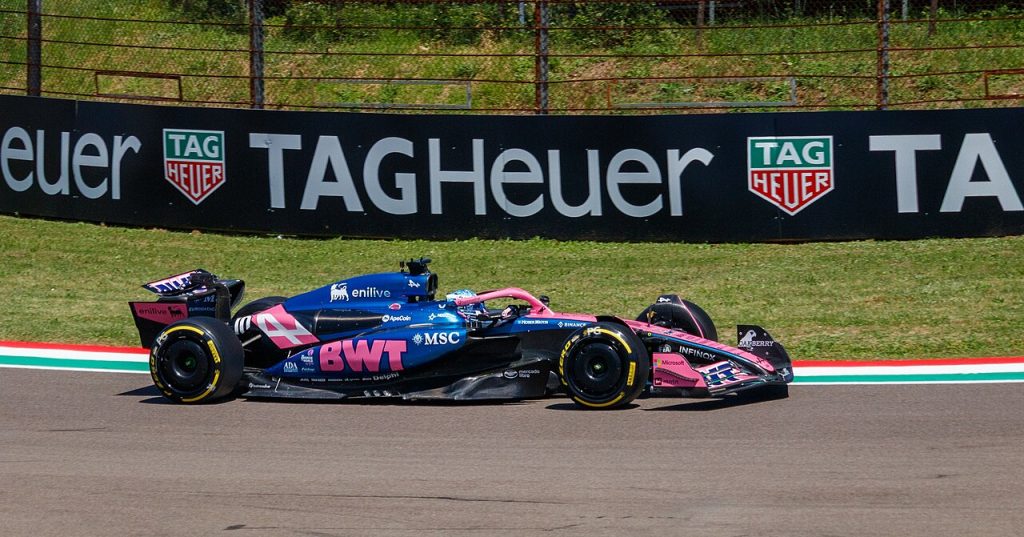
The bundled licensed image shows Gasly’s number 10 A525 at the 2025 Imola event. Its caption identifies the period and programme without assigning a monocoque serial. It does not prove a later season-finale configuration or a particular transfer history. Photographer, source, licence and resizing information remain visibly linked. An individual chassis feature should add authenticated identity and condition views under their own rights records. The model guide can then use genuine period photography for context while retaining the documentary standard needed for a more specific collecting or event claim.
Keeping the season and object histories separate
Maintain the programme chronology as context and the physical car’s chronology as its own evidence file. Add events, rebuilds, transfers and conservation work with dates and sources. If a factory clarification arrives, update the relevant finding without expanding every claim attached to the model. An archive should remain able to describe a significant season while withholding an unproved chassis association. That makes it useful to historians and collectors alike. The lasting record is a supported explanation of what survives, what it represents and what its documents actually establish.
Frequently asked questions
Which year does A525 belong to?
The 2025 works Formula One season.
Was the launch pairing the whole-season pairing?
No. The launch named Gasly and Doohan; later manufacturer records document Colapinto alongside Gasly.
Is A525 the Mercedes-supplied car?
The Mercedes supply transition is identified for the 2026 A526 successor; the 2025 finale marks Renault’s farewell.
Does the image establish a chassis serial?
No. It is a period Imola programme photograph with no individual serial inferred.
Explore related Alpine profiles
Sources
- Alpine: A525 livery and season launch, February 2025
- Alpine: Colapinto race-seat announcement, May 2025
- Alpine: A525 final-season preview and Renault power-unit farewell, December 2025
- Alpine: A526, Mercedes supply and 2026 launch, January 2026
Historical statements follow the linked manufacturer and competition-programme records. Inspection and collecting guidance is editorial analysis. Individual catalogue claims remain attributed to the relevant car and source.
Photography and credit
Pierre Gasly’s number 10 Alpine A525 at the 2025 Imola Formula One event; no individual chassis serial is inferred. Photo: Jen_ross83 / Wikimedia Commons · CC BY 4.0. Wikimedia thumbnail resized from the original; no cropping or colour changes.
Why this machine matters
The Alpine A525 is the works Formula One car for 2025, succeeding A524 and preceding the Mercedes-powered A526. Its season included a change in the race-driver pairing. A collector profile needs a documented chassis identity and configuration, rather than a livery or driver name alone.
Built in limited numbers
The reviewed public sources do not reconcile the full A525 chassis register, including spares, replacements, test material and display objects. Two race entries do not establish two completed cars. This profile leaves production totals unset and uses competition-archive classification. A reliable factory account could later resolve the population or an individual chassis history. Until then, the guide can identify the programme and its collecting questions without pretending to know how many structures were made. The specific object’s identity, provenance and completeness remain more useful than an unsupported neat total.
Gallery
Specifications
Factory specifications may vary by model year, market and configuration.
Identity & production
- Official model
- Alpine A525 Formula One
- Base model
- A525
Powertrain & performance
- Engine
- Renault hybrid-era Formula One programme — 2025; retired-object installation must be checked