Alpine A524 Formula One
The Alpine A524 is the works Formula One car for the 2024 season, launched with Esteban Ocon and Pierre Gasly. Its model history includes the team’s double podium at São Paulo. A collector record must identify the actual chassis and configuration rather than infer provenance from livery.
The Alpine A524 is the works Formula One car for the 2024 season, launched with Esteban Ocon and Pierre Gasly. Its model history includes the team’s double podium at São Paulo. A collector record must identify the actual chassis and configuration rather than infer provenance from livery.
Alpine A524 Formula One at a glance
| Manufacturer | Alpine |
|---|---|
| Model family | A524 |
| Profile scope | Competition archive |
| Inventory reference | ALP-097 |
| Propulsion | Hybrid competition programme |
| Engine reference | Formula One hybrid power-unit programme; no unreviewed output figure inserted |
The 2024 works car at Enstone
Alpine presented the A524 at its Enstone motorsport launch on 7 February 2024, alongside the A424 endurance programme. The announcement identifies Ocon and Gasly as the race pairing and describes a substantially revised design. This establishes the season and model identity without suggesting that every displayed object was a race-used chassis. For an archive, separate the launch presentation from the subsequent physical cars. A named programme can include development, race and display material, and a useful collecting account makes the relationship between those objects explicit from the beginning.
A season car is not one fixed configuration
Alpine’s later launch recap describes development through the 2024 campaign and the A525’s relationship to the A524. For an individual A524, record the date and scope of the bodywork, systems and specification it currently carries. A car conserved in an early configuration tells a different technical story from one assembled to reflect the end of the season. Both can be interesting when their histories are explained. Avoid using a single brochure-style specification to imply that every chassis ran exactly the same components and settings at every Grand Prix.
Rarity: a chassis-specific programme
No complete reconciled A524 chassis census is established by the reviewed public sources. Two drivers, two race numbers or two photographed cars do not prove the number of manufactured monocoques. Spares, replacements, tests and exhibition objects need separate treatment. This profile therefore leaves a completed-production total unset and directs individual-car claims toward factory records. It is a better basis for a rare-vehicle archive than entering a neat number simply because a championship normally fields two cars. The physical identity and its documented competition use matter more than an unsupported total.
The São Paulo double podium
Formula One’s official 2024 race result records Ocon second and Gasly third at São Paulo on the November race weekend. That result belongs to the A524 programme’s history. Assigning it to an individual chassis requires a separate link between the event and the serial object. The source should be a team or factory record, corroborated where possible by period evidence. A car wearing the relevant race number or a similar livery does not establish that connection. Keep the programme achievement prominent while maintaining a precise boundary around personal race provenance.
Authenticating an actual Formula One chassis
Seek original identification, team documentation, a supported event chronology and a clear account of later transfers. Establish whether the vehicle is a race-used monocoque, a spare, a test car, a rolling display or an associated replica. Ask which major systems are present and whether those systems are the ones documented in its active life. Legal title and technical identity are related but different questions. A strong file answers both, then explains the current configuration in language a future custodian can understand without relying on a familiar driver association.
The distinction between bodywork and provenance
A later repaint or rebuilt set of panels can recreate a striking race appearance. That does not automatically make the underlying object the chassis seen at the corresponding event. Record livery restoration as restoration, with dates and supporting photographs. Bodywork may also have circulated between team cars and deserve its own component history. An archive should be able to say that a machine is presented in a particular scheme while leaving its event identity to separate evidence. This distinction preserves the interest of authentic programme material without assigning it achievements it cannot substantiate.
Mechanical completeness and hybrid equipment
For a prospective acquisition or demonstration, have qualified specialists determine what is actually installed, decommissioned or missing. The hybrid-era classification does not guarantee a complete working power unit in a retired object. Review electronics, transmission, cooling, hydraulic systems and the supporting equipment required for its present role. A static chassis should be described as such even when it carries convincing exterior detail. An operating assessment must address the actual machine. This gives a collector a practical picture of preservation needs and avoids confusing a historically important object with a ready-to-run car.
What a supported demonstration requires
Establish the availability of technical personnel, documentation, starting equipment, diagnostic access and appropriate spares before planning operation. Keep written preparation and maintenance records with the chassis. The existence of a public demonstration by a manufacturer does not prove that an independently acquired object has the same support or configuration. Static exhibition and running preservation can serve different aims. A good catalogue explains which role is intended and what has been verified, allowing the car’s historical significance to be understood without promising capability that depends on unavailable systems or proprietary knowledge.
Inspecting the structure and its repair history
Use an appropriate specialist to examine the monocoque, suspension attachments and relevant repair evidence. Record replacement components and documented damage without assuming that a cosmetically fresh body explains the structure underneath. Competition condition is a history, not a single adjective. Dates, operating records and workshop information help interpret the findings. If the vehicle has been altered for display, preserve documentation of that conversion. This lets a future custodian distinguish period construction, later repairs and exhibition adaptations, which is essential when assessing both authenticity and the practical scope of preservation.
Comparison with A522 and A523
The neighbouring season guides provide context, while each model retains its own drivers, dates, specification evidence and race history. Compare the actual chassis files and the configurations offered rather than apply a simple ranking based on programme success. A less celebrated car with strong records can answer more collecting questions than a celebrated name attached to uncertain material. Keep year-specific photographs labelled accordingly. The comparison becomes useful when it explains continuity and change across the works programme without allowing shared sponsor colours or a recurring driver to merge separate cars.
The Austrian photograph in this guide
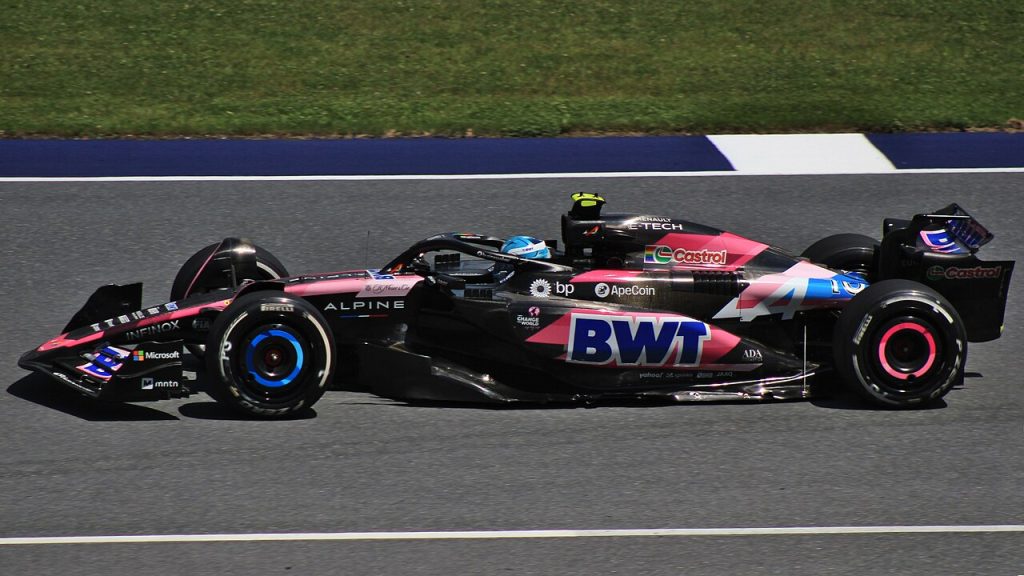
The bundled image shows Gasly’s number 10 at the 2024 Austrian Formula One event. It is a period A524 view, with the photographer and Creative Commons licence visibly linked. It does not illustrate São Paulo and does not identify a monocoque serial. A race photograph can document configuration and context, while an individual collecting feature needs its own identity and condition evidence. Preserve that division in the caption and gallery. The reader then receives a real period image without an unsupported implication that the pictured object carries the guide’s most notable result.
Maintaining a record beyond the season
Keep the factory file, transfers, photographs, component inventory and conservation work together. Explain changes of role as dated events rather than overwrite the earlier race configuration. When new event evidence becomes available, add it with its source and the degree of certainty it supports. This makes the archive useful over the long term, including when a vehicle changes hands or returns to a museum display. The model guide provides the broad history; the individual file must continue to establish which physical object survives and what can accurately be said about its life.
Frequently asked questions
Which season does A524 belong to?
The 2024 Formula One campaign, with Ocon and Gasly named in the original launch.
What was the São Paulo result?
The official 2024 result lists Ocon second and Gasly third.
Is the chassis total verified?
No complete public census was established; the completed-production fields remain unset.
Can race livery authenticate a podium chassis?
No. An individual event claim needs a documented link to the actual chassis.
Explore related Alpine profiles
Sources
- Alpine: joint A424 and A524 launch at Enstone, 7 February 2024
- Alpine: A524 2024 press kit
- Alpine: Renault E-Tech hybrid works-programme identity
- Formula 1: official 2024 São Paulo race result
- Alpine: 2025 launch recap of the A524 season and successor
Historical statements follow the linked manufacturer and competition-programme records. Inspection and collecting guidance is editorial analysis. Individual catalogue claims remain attributed to the relevant car and source.
Photography and credit
Pierre Gasly’s number 10 Alpine A524 at the 2024 Austrian Formula One event; not a photograph of the São Paulo podium. Photo: Lukas Raich / Wikimedia Commons · CC BY-SA 4.0. Wikimedia thumbnail resized from the original; no cropping or colour changes.
Why this machine matters
The Alpine A524 is the works Formula One car for the 2024 season, launched with Esteban Ocon and Pierre Gasly. Its model history includes the team’s double podium at São Paulo. A collector record must identify the actual chassis and configuration rather than infer provenance from livery.
Built in limited numbers
No complete reconciled A524 chassis census is established by the reviewed public sources. Two drivers, two race numbers or two photographed cars do not prove the number of manufactured monocoques. Spares, replacements, tests and exhibition objects need separate treatment. This profile therefore leaves a completed-production total unset and directs individual-car claims toward factory records. It is a better basis for a rare-vehicle archive than entering a neat number simply because a championship normally fields two cars. The physical identity and its documented competition use matter more than an unsupported total.
Gallery
Specifications
Factory specifications may vary by model year, market and configuration.
Identity & production
- Official model
- Alpine A524 Formula One
- Base model
- A524
Powertrain & performance
- Engine
- Formula One hybrid power-unit programme; no unreviewed output figure inserted