Alpine A110 San Remo 73
The Alpine A110 San Remo 73 is the 2023 numbered road edition celebrating fifty years since Alpine’s 1973 Sanremo victory and manufacturers’ world title. Its announced worldwide limit is 200, with a distinctive blue, red, black and white factory presentation.
The Alpine A110 San Remo 73 is the 2023 numbered road edition celebrating fifty years since Alpine’s 1973 Sanremo victory and manufacturers’ world title. Its announced worldwide limit is 200, with a distinctive blue, red, black and white factory presentation.
Alpine A110 San Remo 73 at a glance
| Manufacturer | Alpine |
|---|---|
| Model family | A110 II |
| Profile scope | Historic road-model variant |
| Inventory reference | ALP-085 |
| Announced edition limit | 200 worldwide; completed total unconfirmed |
| Engine reference | Contemporary turbocharged A110 four-cylinder — 300 bhp announcement reference |
A fiftieth-anniversary rally tribute
Alpine announced the San Remo 73 edition on 16 March 2023, with French ordering opening the following day. Its name recalls the 1973 Sanremo Rally and Alpine’s manufacturers’ championship achievement. The road car belongs to the modern A110 family, not to the original seventies works fleet. A catalogue should make that generation and date distinction immediately clear. The edition is a factory tribute with its own numbering and equipment; the historical competition result belongs to the period cars and must be documented separately in any individual race-car feature.
The victory and championship connection
The manufacturer’s historical account connects the original Sanremo win with the 1973 manufacturers’ title. That championship scope matters: a manufacturers’ title is not the same claim as a driver winning a modern drivers’ championship. The tribute can explain the achievement accurately without expanding it. If period photographs are added, identify the actual event, car and crew through their own records. The modern edition’s graphics and embroidered theme point toward the story; they do not provide a chassis link between a 2023 customer car and a 1973 competition object.
Rarity: a worldwide announced limit of 200
Alpine specifies 200 worldwide with numbered plaques. Its first-half 2023 sales account reports the allocation finding buyers within days. This confirms the defined offering and demand, while leaving the exact reconciled completed-build total unresolved in the reviewed material. The profile therefore stores an announced edition limit rather than a verified completed-production count. Keep those scopes visible in comparisons. A sold-out order allocation is not automatically a completed manufacturing census, and a broad modern A110 family total would answer a different question.
The blue body and red carbon roof
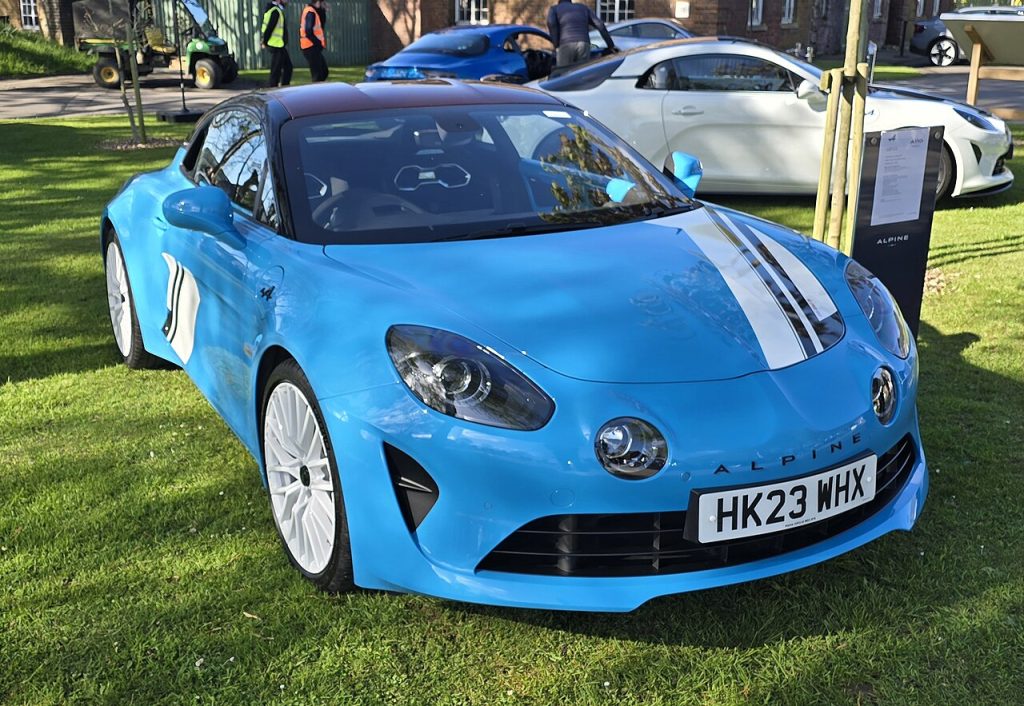
The reveal identifies Original Caddy Blue bodywork, black roof arches and a red carbon roof, with black-and-white graphics and a specific San Remo signature. White 18-inch Grand Prix wheels complete the period-inspired presentation. These details help readers recognize the factory theme while keeping the physical car contemporary. Inspect an offered example against its original specification, especially after repair or repainting. Similar graphics on another A110 do not establish edition identity, and a genuine edition’s replaced panel should be explained rather than concealed beneath a general originality claim.
The 300 bhp and cockpit reference
Alpine quotes a 300 bhp engine for the edition. The introductory cabin specification includes microfibre, grey stitching and Sabelt Racing seats carrying a championship-themed embroidery. These are period manufacturer references rather than a current inspection of every surviving car. Review what is actually installed and whether relevant trim or mechanical assemblies were later replaced. A themed cabin can be central to the edition’s appeal, but its presence should complement factory documents rather than substitute for them. Later A110 updates should retain their own dates and specification scopes.
The plaque in a complete authentication file
Inspect the numbered plaque in context and correlate it with the order, invoice, delivery specification and available build information. Keep dated photographs from early ownership where possible. Registration paperwork may identify the car legally without listing all edition details, so it should be read alongside the factory file. Resolve inconsistencies in dates and market descriptions with original records. A plaque carrying the right range is useful evidence, but cannot independently establish the entire manufacturing history or prove that all announced edition cars were completed.
Paint, graphics and material condition
Assess colour, graphics, roof finish and trim in consistent light, with repair records available for comparison. The coordinated presentation can make refinishing or replaced decoration visible, but differences should prompt investigation rather than an immediate authenticity conclusion. Document work and retain before-and-after photographs. A catalogue should explain which surfaces remain from delivery and which were renewed. This gives readers a concrete condition account and lets the factory identity survive ordinary maintenance or repair, instead of equating genuine edition status with a claim that every visible component is untouched.
Mechanical inspection of the actual car
Have an appropriate specialist assess the structure, cooling, transmission, braking, suspension and maintenance history. Review the fitted wheels and tyres for condition and configuration. The anniversary identity may be the reason to seek this car, but it does not answer how the example was used or prepared. Mileage should be considered with records and physical inspection rather than treated as a complete measure of condition. A well-supported report can describe road use, display periods or track activity without turning the heritage livery into evidence of a competition career.
Keeping the original presentation understandable
Retain factory delivery material and documentation for significant replacement or aftermarket components. If an owner changes seats, wheels, exhaust or suspension, identify the work separately from the original edition specification. Keep removed material where practical, especially where it helps explain the delivery presentation. A modification can suit current use while changing the collecting story. The record should make both facts understandable. This approach avoids a vague description such as fully upgraded that leaves a future custodian unable to reconstruct what the factory supplied and what happened later.
Comparison with Tour de Corse 75
The two modern heritage editions share a rally theme but commemorate different events and outcomes. Tour de Corse 75 refers to the 1975 Corsican performance; San Remo 73 celebrates a victory and manufacturers’ championship milestone. Their plaque ranges, colours and introduction years are also separate. A comparison should show those differences instead of treating every historic rally reference as the same limited car. The more persuasive individual collecting example depends on its documentation, condition and intended use, rather than a simple ranking of incompatible rarity claims or decorative features.
An exhibition story across generations
A modern San Remo 73 can sit alongside a documented original competition Berlinette and an A110 Rally R-GT to explain heritage, factory tribute and renewed customer competition. Each object should retain its actual technical identity and history. Use dated labels and precise event claims rather than relying on the repeated A110 name. This gives visitors a useful connection without suggesting that the modern road edition competed in the original rally. The comparison is strongest when physical differences and documentary evidence are explained as clearly as the shared visual theme.
The licensed 2023 edition photograph
The supplied image is identified as an A110 San Remo 73 and illustrates the modern edition. Its caption explicitly distinguishes it from a 1973 works rally car. The photograph does not establish a plaque number, ownership history or an individual link to a championship result. Photographer, source and licence remain visibly linked. An individual vehicle feature should add its own plaque, cabin and condition views with the supporting factory file. Any added period rally photograph would need a separate source, rights record and event-specific caption.
Frequently asked questions
What does San Remo 73 commemorate?
The edition celebrates fifty years since Alpine’s 1973 Sanremo victory and manufacturers’ world championship milestone.
How many were announced?
Alpine announced 200 worldwide, with numbered plaques. Sold-out allocation reports are not entered as a separate completed-build census.
Is the photographed car an original 1973 rally car?
No. The image illustrates the modern road edition introduced in 2023.
Does the special livery establish authenticity?
No. Correlate the physical specification and plaque with original factory ordering, build and delivery documentation.
Explore related Alpine profiles
Sources
- Alpine: A110 San Remo 73 launch and heritage context, March 2023
- Alpine: San Remo 73 and Le Mans allocations, first half of 2023
- Alpine: A110 Tour de Corse 75 reveal, June 2022
Historical statements follow the linked manufacturer and competition-programme records. Inspection and collecting guidance is editorial analysis. Individual catalogue claims remain attributed to the relevant car and source.
Photography and credit
Alpine A110 San Remo 73, the 2023 heritage road edition; distinct from the original 1973 rally cars. Photo: Calreyn88 / Wikimedia Commons · CC BY-SA 4.0. Wikimedia thumbnail resized from the original; no cropping or colour changes.
Why this machine matters
The Alpine A110 San Remo 73 is the 2023 numbered road edition celebrating fifty years since Alpine’s 1973 Sanremo victory and manufacturers’ world title. Its announced worldwide limit is 200, with a distinctive blue, red, black and white factory presentation.
Built in limited numbers
Alpine specifies 200 worldwide with numbered plaques. Its first-half 2023 sales account reports the allocation finding buyers within days. This confirms the defined offering and demand, while leaving the exact reconciled completed-build total unresolved in the reviewed material. The profile therefore stores an announced edition limit rather than a verified completed-production count. Keep those scopes visible in comparisons. A sold-out order allocation is not automatically a completed manufacturing census, and a broad modern A110 family total would answer a different question.
Gallery
Specifications
Factory specifications may vary by model year, market and configuration.
Identity & production
- Official model
- Alpine A110 San Remo 73
- Base model
- A110 II
- Country of manufacture
- France
Powertrain & performance
- Engine
- Contemporary turbocharged A110 four-cylinder — 300 bhp announcement reference