Alpine A110 1800 Group 4
The Alpine A110 1800 Group 4 represents a competition-development category rather than a numbered road edition. Its collector significance lies in engine preparation, the period represented by the car and the evidence linking an individual chassis to its claimed career.
The Alpine A110 1800 Group 4 represents a competition-development category rather than a numbered road edition. Its collector significance lies in engine preparation, the period represented by the car and the evidence linking an individual chassis to its claimed career.
Alpine A110 1800 Group 4 at a glance
| Manufacturer | Alpine |
|---|---|
| Model family | A110 |
| Profile scope | Competition archive |
| Inventory reference | ALP-029 |
Why the 1800 designation needs context
The 1800 name is a rounded competition description. It should be connected to the installed engine, its measured or documented capacity and the history of the chassis. It does not establish one horsepower figure, one build year or a works-team identity for every car so described. A useful profile records the preparation and its date. That makes it possible to distinguish an original competition configuration, a period upgrade and a recent historic-rally conversion without treating them as interchangeable.
The model in Alpine’s own heritage
Alpine’s 2015 heritage account recognizes the A110 1800 Groupe 4 as a competition Berlinette with the model’s largest engine category. A separate manufacturer exhibition account describes a 1972 works car that later received an 1800 engine. Together these records show why the supplied inventory’s 1973 date cannot be read as a universal construction date for every 1800 car. The identity of a chassis and the date of a mechanical evolution must remain separate.
A documented upgrade is part of the story
The exhibition account is useful because it explicitly describes development through a car’s life. A chassis can carry an earlier identity and a later engine without the two being contradictory. The profile should explain when and why the change occurred, what evidence supports it and which configuration the present restoration represents. Do not conceal an upgrade simply to make the story look tidier. A well-documented evolution can be more revealing than an unsupported assertion that the car has always been exactly as it appears now.
Group 4 and the relevant paperwork
Use the homologation record and its extensions to understand the period specification claimed for the car. Match those documents to the proposed date instead of borrowing an extension from another stage of development. FIA’s online records provide a research framework, not certification of an individual chassis. Event eligibility is a further question requiring the organizer’s current review and the applicable documentation. Keep the historic specification claim and the present entry requirements in separate parts of the dossier.
Works provenance is not a visual feature
A blue body, competition lights and familiar sponsor scheme can evoke the factory team, but they cannot prove membership of it. Look for a documented connection between chassis, entrant, crew and event. A customer car or later preparation can still be a valuable historic machine; it simply requires the correct description. If the car has been restored to resemble a famous works example, say whether that resemblance is a tribute or a reconstruction of its own recorded history.
Engine development: ask precise questions
Request the engine’s identity and the build record explaining its capacity, induction and internal specification. Ask who performed the work, when it was completed and how the car has been used since. A quoted output should be attached to a specific build and measurement, not copied from a different rally car. Discuss cooling, lubrication and gearbox compatibility with the maintainer. The practical significance of an engine preparation is inseparable from the way the rest of the vehicle supports it.
Rarity: avoid counting overlapping categories twice
The 1800 Group 4 entry and the 1973 works-car entry can overlap when an individual chassis belongs to both stories. They must not be added together as though each profile represented an independent numbered allocation. Likewise, an earlier chassis upgraded later should not automatically be counted as a newly constructed 1800 car. No complete production total is verified in this batch. The numeric fields remain blank and the profile is retained in the competition Archive with its counting scope made explicit.
Inspecting a historic rally Berlinette
A specialist should assess structure, repairs, reinforcement, suspension attachments and bodywork against the history file. Ask for photographs before repair and during restoration. Record the extent of replacement material, especially where the present finish conceals it. Inspect mounting details for competition equipment and the quality of electrical or fuel-system changes. The goal is to understand the actual machine and its preparation, not to judge the whole car from a famous badge or a successful engine start.
Historic use and mechanical condition
Determine whether the car is intended for display, demonstrations, regular road use or competitive events. That decision changes the inspection and maintenance brief. Review the dates of engine and gearbox work, current fuel-system condition, tires, braking equipment and safety installations. Ask the event organizer to evaluate the relevant documents and equipment before making plans. A significant competition history can coexist with substantial mechanical needs after storage; one does not cancel the other.
Choosing a restoration configuration
If the car has several documented period states, select one deliberately and explain why. Preserve photographs and notes for the chosen engine, body details, wheels and livery. Record later practical changes, including those made for maintenance or current activity. Avoid presenting a modern mixture as a single unchanged period specification. A transparent restoration account gives viewers a way to understand the car and provides future owners with evidence they can reassess.
How to use photography as evidence
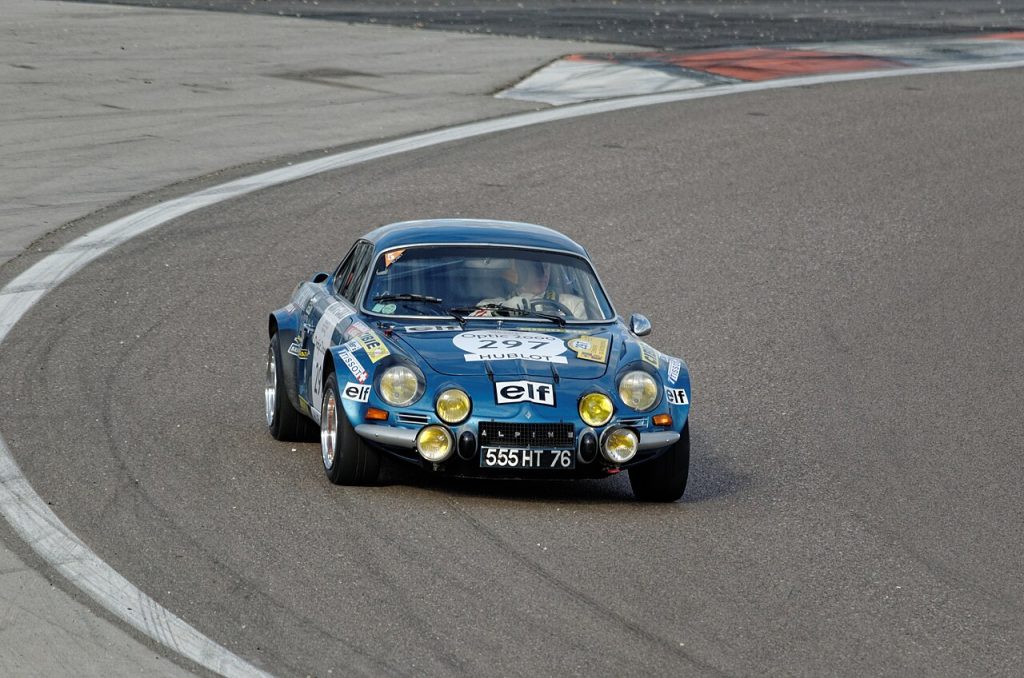
Modern historic-event images are useful for illustrating body form and present presentation. They are weaker evidence for original works identity. Period photographs can be more informative when the car is positively identified, but they still show only the visible configuration on that date. Use several views and relate them to documents. The included image is a licensed Tour Auto 2014 illustration of a source-described 1800 Group 4; it is not offered as proof of a 1973 works chassis.
The broader Alpine comparison
Compare the 1800 development category with the 1600 Group 4 framework and the 1973 championship programme. The roadgoing 1600 SC provides another nearby chapter, but its road-model identity should remain distinct from race preparation. These relationships help a reader understand the Berlinette’s development while preserving each car’s own history. The best collector narrative explains the connections without inflating a production count or transferring another car’s result.
Frequently asked questions
Was every 1800 Group 4 built in 1973?
No. The manufacturer documents at least one earlier works car which later received an 1800 engine.
Does the 1800 label establish exact displacement?
The installed engine and build record must establish the precise capacity.
Is there a verified completed-production total?
No. The category includes potential conversions and overlaps that require chassis-level counting.
Does the included photo prove works provenance?
No. It is a source-described modern historic-event illustration with explicit limits in its caption.
Explore related Alpine profiles
Sources
- Alpine: Celebrating 60 years of Alpine
- Alpine: International Automobile Festival heritage exhibition
- FIA Historic Database: A110 1600, form 3035 and extensions
Historical statements follow the linked manufacturer, club, homologation and vehicle records. Inspection and collecting guidance is editorial analysis. Individual catalogue claims remain attributed to the relevant car and source.
Photography and credit
Source-described Alpine A110 1800 Group 4 at Tour Auto 2014, Dijon-Prenois. Modern historic-event illustration; works-team provenance is not inferred. Photo: François de Dijon / Wikimedia Commons · CC BY-SA 3.0. Wikimedia display copy; no content retouching. WordPress may resize further and website layouts may crop the image.
Why this machine matters
The Alpine A110 1800 Group 4 represents a competition-development category rather than a numbered road edition. Its collector significance lies in engine preparation, the period represented by the car and the evidence linking an individual chassis to its claimed career.
Built in limited numbers
The 1800 Group 4 entry and the 1973 works-car entry can overlap when an individual chassis belongs to both stories. They must not be added together as though each profile represented an independent numbered allocation. Likewise, an earlier chassis upgraded later should not automatically be counted as a newly constructed 1800 car. No complete production total is verified in this batch. The numeric fields remain blank and the profile is retained in the competition Archive with its counting scope made explicit.
Gallery
Specifications
Factory specifications may vary by model year, market and configuration.
Identity & production
- Official model
- Alpine A110 1800 Group 4
- Base model
- A110
- Country of manufacture
- France