Alpine A110 1600 Group 4
The Alpine A110 1600 Group 4 is a competition specification whose significance depends on period, preparation and chassis identity. It belongs beside the roadgoing 1600 S, but its homologation history and racing configuration require a separate collector record.
The Alpine A110 1600 Group 4 is a competition specification whose significance depends on period, preparation and chassis identity. It belongs beside the roadgoing 1600 S, but its homologation history and racing configuration require a separate collector record.
Alpine A110 1600 Group 4 at a glance
| Manufacturer | Alpine |
|---|---|
| Model family | A110 |
| Profile scope | Competition archive |
| Inventory reference | ALP-026 |
Group 4 is a specification question
The Group 4 label is most useful when attached to a particular period and a supported vehicle identity. It should not be treated as a decorative suffix for any A110 with wide wheels or competition paint. Start by identifying the chassis and the homologation documents relevant to the proposed date. Then compare the actual car with that configuration. A present historic-rally preparation, an original customer competition car and a works car can look similar while carrying very different histories.
What FIA records establish
FIA’s Historic Database lists A110 1600 form 624 in Group 4, with a 1565 cc base capacity and rear-wheel drive. The database also has form 3035 and a series of extensions covering later changes. These records confirm a homologation framework; they do not authenticate a surviving car or count the number built in a particular preparation. The inventory’s 1971 date describes this collector entry. It is not used here to infer one universal configuration for every car carrying the Group 4 name.
Base form, extension and date
A homologation form is not a shopping list from which every permitted change can be combined without regard to time. Identify the base form, the extension and the period represented by the car. Ask which documents support the engine, suspension, braking and bodywork as a set. Keep that information in the dossier. If the car has been prepared for a current event, record that purpose separately from its original construction. This helps prevent a modern legal configuration from being mistaken for proof of a specific period race history.
Works, customer and later preparation
A works-team identity is a claim about the car’s history, not just its parts. A customer competition car can be important without having belonged to the factory team. A later preparation can be well executed without being a period competition example. Use those descriptions accurately. Request dated ownership records, entry documentation, driver correspondence and photographs where available. A specialist’s conclusion should explain the evidence linking the claimed career to the actual chassis rather than simply endorsing a familiar race number.
Engine identity and capacity
Record the engine installed today and the evidence for the original unit. A displacement measurement, an engine number and a catalogue description answer different questions. Review invoices for block work, capacity changes and induction modifications. Keep claimed output tied to the actual build and test record, rather than borrowing a headline figure from another A110. A competition car’s mechanical character can change substantially through its life; a clear account of those changes is more useful than one idealized specification.
Why appearance can mislead
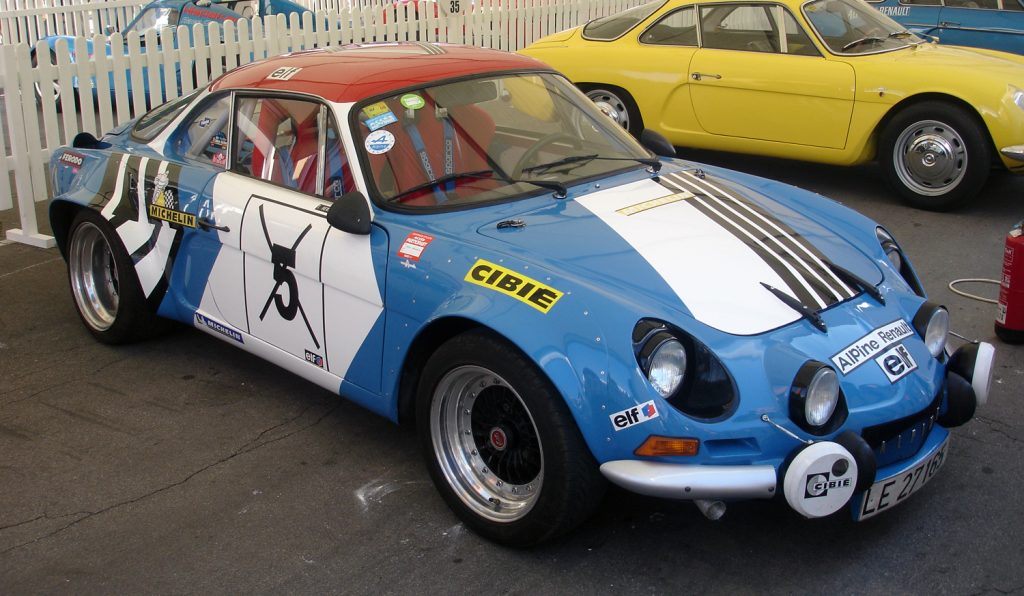
Rally paint schemes, auxiliary lights, wide arches and sponsor markings are easy to recognize and comparatively easy to reproduce. They can represent a restoration choice, a tribute or a documented original presentation. The caption and history file should explain which. Examine dated photographs for body details and their sequence of changes. If the current car represents one selected event, name the event and explain the reconstruction. A modern photograph of the right-looking car does not verify a factory team connection.
Rarity and counting scope
This entry has no verified Group 4 production total. The scope may include differently prepared customer cars, works cars or later conversions, and those categories must not be counted together by default. A homologation quantity for a base model is also not necessarily the number completed in the final competition specification. The profile remains an Archive record with blank numeric production and survivor fields. A defensible total needs a defined population and a chassis list, not an inference from eligibility paperwork.
Inspection: structure and event history
Have the structure assessed by someone familiar with the A110’s construction and competition use. Review repair locations, reinforcement work, suspension attachments and evidence of changes to the body. Compare visible areas with photographs taken before and during restoration. Ask whether a serious accident, replacement section or rebody is documented. These questions do not diminish a competition car’s appeal; they establish what has survived and how the present machine relates to its claimed career.
Preparation for present use
A provenance review should be followed by a separate assessment of current mechanical and safety condition. Discuss fuel-system age, brake service, steering components, bearings and electrical work with the maintainer. Check the documents and equipment required by the intended event with its organizers. FIA’s online database is expressly for consultation; it is not the certified paperwork required to enter an event. Build the preparation plan around the current activity rather than assuming that historic recognition guarantees operational readiness.
A practical dossier structure
Use four sections: construction identity, period competition, post-period changes and current preparation. Place each supporting document in the relevant section, with dates and the source of the claim. Keep uncertain links visible. Record the difference between the car’s original driver and the driver associated with the livery now displayed. This makes it possible for a reviewer to follow the evidence without having to untangle a narrative assembled from several generations of sale descriptions.
Comparing related A110 competition entries
The 1600 Group 4 profile answers a specification question. The 1800 Group 4 profile follows another engine-development category. The 1973 championship works-car profile answers a programme and provenance question. These categories overlap in the history of some individual cars, but they are not automatically separate production allocations. Use the links to navigate the relationships while keeping the counting scopes and chassis evidence distinct.
Frequently asked questions
Does Group 4 prove works-team ownership?
No. Factory provenance must be documented for the individual car.
What is homologation form 624?
The reviewed FIA database entry identifies an A110 1600 Group 4 homologation with a 1565 cc base capacity.
Can I use the online form as event paperwork?
FIA labels the online database for consultation; event documentation needs the required certified copy and current organizer review.
Is the photo a verified 1971 factory car?
No. It is a clearly labelled representative A110 competition image from a 2007 display.
Explore related Alpine profiles
Sources
- FIA Historic Database: A110 1600, Group 4 form 624
- FIA Historic Database: A110 1600, form 3035 and extensions
- Alpine: International Automobile Festival heritage exhibition
Historical statements follow the linked manufacturer, club, homologation and vehicle records. Inspection and collecting guidance is editorial analysis. Individual catalogue claims remain attributed to the relevant car and source.
Photography and credit
A110 1600 in rally presentation at Martini Legends, October 2007. A representative competition image; factory Group 4 identity and a 1971 chassis are not established by the photograph. Photo: Mutari / Wikimedia Commons · Public domain — photographer release. Original file supplied without content retouching. WordPress may resize display copies and website layouts may crop them.
Why this machine matters
The Alpine A110 1600 Group 4 is a competition specification whose significance depends on period, preparation and chassis identity. It belongs beside the roadgoing 1600 S, but its homologation history and racing configuration require a separate collector record.
Built in limited numbers
This entry has no verified Group 4 production total. The scope may include differently prepared customer cars, works cars or later conversions, and those categories must not be counted together by default. A homologation quantity for a base model is also not necessarily the number completed in the final competition specification. The profile remains an Archive record with blank numeric production and survivor fields. A defensible total needs a defined population and a chassis list, not an inference from eligibility paperwork.
Gallery
Specifications
Factory specifications may vary by model year, market and configuration.
Identity & production
- Official model
- Alpine A110 1600 Group 4
- Base model
- A110
- Country of manufacture
- France