Audi R8 V10 RWS Coupé
The Audi R8 V10 RWS Coupe introduced the limited Rear Wheel Series in 2017, with a 999-car allocation shared by Coupe and Spyder. Audi paired the rear-drive layout with a 397 kW naturally aspirated V10. This profile covers the original limited RWS Coupe, distinct from later R8 RWD models in the regular range.
The Audi R8 V10 RWS Coupe introduced the limited Rear Wheel Series in 2017, with a 999-car allocation shared by Coupe and Spyder. Audi paired the rear-drive layout with a 397 kW naturally aspirated V10. This profile covers the original limited RWS Coupe, distinct from later R8 RWD models in the regular range.
Audi R8 V10 RWS Coupé at a glance
| Manufacturer | Audi |
|---|---|
| Model / programme | R8 |
| Profile scope | Limited road edition |
| Historical reference year | 2017 |
| Inventory reference | AUDI-055 |
| Engine reference | 5.2-litre naturally aspirated V10 FSI |
| Published edition limit | 999 — Original RWS programme shared by Coupe and Spyder; Coupe-only split unresolved |
| Manufacturer power reference | 397 kW |
| Manufacturer power reference | 540 PS; concept rating where applicable |
| Manufacturer torque reference | 540 Nm; concept rating where applicable |
What RWS means in the R8 story
Audi’s September 2017 launch identifies RWS as Rear Wheel Series and describes a limited road-car programme available in Coupe and Spyder forms. Its 5.2-litre naturally aspirated V10 is quoted at 397 kW or 540 PS and 540 Nm. The significance is a change in drivetrain layout within the R8 family, rather than a new claim of maximum power. A collector profile should establish the exact factory edition before describing that change. The RWS name connects the engineering brief with a defined series; it should not be used casually for every R8 that now sends power to the rear wheels.
Rarity: 999 shared across both body styles
The 999 figure is the combined factory allocation for the original RWS programme, covering Coupe and Spyder together. This profile does not assign 999 to each body style, and it does not invent a Coupe-only split. The shared limit is stored with its scope so two related profiles cannot silently double the worldwide allocation. The source describes a dashboard emblem reading 1 of 999; that wording identifies membership in the series rather than proving a unique sequential chassis number. Build records should establish an individual car’s identity. Surviving population and country allocations remain separate questions requiring their own evidence.
2017 announcement and later deliveries
The profile uses 2017 for the public introduction. Delivery or registration in a later year does not make the car a different edition, and an advertisement’s model-year label may describe a market convention rather than the announcement date. Preserve the actual build and first-registration dates in an individual collection file. This helps explain why a 2018 car can belong to a programme announced the year before. Do not fill production start and end fields from registration examples alone. A narrow, documented historical reference is more reliable than an inferred manufacturing chronology built from a handful of listings.
The later RWD is a separate model-range story
Audi’s November 2019 Netherlands announcement explicitly describes the rear-drive R8 as moving from a special series into the regular model range, with a revised presentation. That distinction is essential for rarity: a later RWD car does not automatically belong to the original 999 allocation. Some photographs and seller descriptions use RWS and RWD loosely, so check the date, factory model identity and visible generation details together. A rear-drive conversion also needs an accurate description of the original car and the work performed. The actual layout and the factory edition membership are related questions, but they are not the same question.
Published weight and performance references
The launch gives the Coupe a 1,509 kg weight reference, a 50 kg reduction against its stated quattro comparison, 3.7 seconds from zero to 100 km/h and a 320 km/h maximum. These are period factory figures for the announced configuration. They are not a present-condition assessment or a guaranteed result for any offered car. An actual measurement needs its own date, method and configuration. The weight-saving statement also needs its comparison model attached. Keeping the historical specification precise allows the article to explain the rear-drive brief without turning a general figure into a promise about a specific used example.
Recognising an RWS without relying on a stripe
The period description includes a two-tone sideblade arrangement and an optional red stripe for the Coupe. An optional graphic cannot serve as a universal authentication test: its absence is not automatically evidence against the model, while its presence can be reproduced. Match the visible details with factory build data and the original delivery record. A model badge or dashboard emblem should corroborate that record rather than substitute for it. The same approach applies to wheel and cabin changes. An accurate description should distinguish the factory car, optional equipment and later owner choices instead of compressing them into a single originality label.
The documentation needed for a limited RWS Coupe
Ask for VIN-linked factory specification, delivery documents and a service chronology. Check that the stated body style, drivetrain identity and edition designation agree. Add invoices and photographs for any changes, particularly if the car has been modified for track use or converted from another configuration. Record replacement components plainly rather than treating maintenance as a reason to hide the history. These are documentation priorities, not allegations about a particular offered car. A complete file allows the collector to understand what was built, what was changed and which rarity claim is supported by the manufacturer’s original programme.
A dated launch-show photograph is the right reference
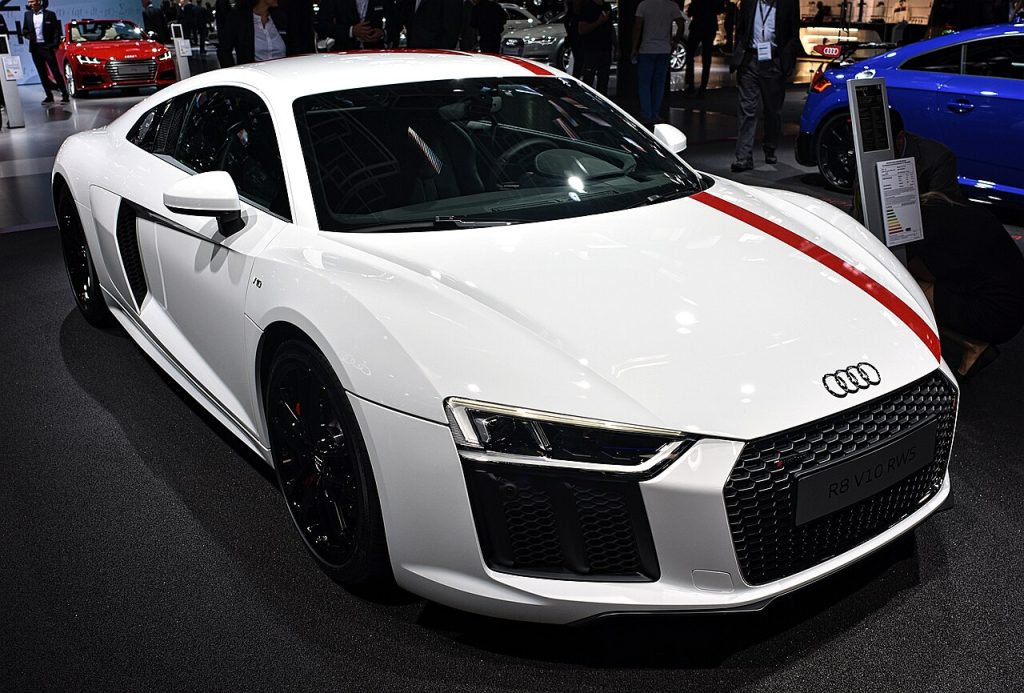
The bundled image is source-identified as the R8 V10 RWS at the 2017 Frankfurt IAA. That dated presentation is useful because the later regular RWD can be confused with the original special series. The picture documents the visible launch-show subject; it does not prove a particular retail VIN or an individual car’s current configuration. Keep Nicolas Völcker’s photographer credit, source and licence linked. If a replacement photograph is supplied, verify its exact subject and year before using it. The photo should help clarify the edition identity instead of introducing the ambiguity the text is trying to resolve.
Ownership questions should follow the intended use
A collector considering road touring, display or occasional circuit use should assess the actual car against that purpose. Obtain a specialist condition report covering structure, mechanical equipment, service history and the quality of modifications. Rear-drive layout is not a substitute for a direct evaluation of tyres, brakes or the installed control systems. Nor does an edition cap predict how the car will feel to a particular driver. Keep the original manufacturer specification available, then document present condition separately. That produces a useful ownership file without pretending this article is a personal test drive of the photographed show car.
Why the original RWS is historically distinctive
The limited RWS gives readers a defined point at which rear-wheel drive became a factory road-car proposition within the R8 story. Its interest can be compared with the first GT’s lightweight package, the Decennium’s V10 anniversary brief and the R8 LMS competition programme. These links explain different kinds of rarity and development rather than presenting a power ranking. The 999 allocation is important, but the exact scope is what makes it usable. A well-documented RWS Coupe carries a more precise collector story than a generic rear-drive R8 description, particularly once later regular RWD cars enter the comparison.
Frequently asked questions
Were 999 RWS Coupes and 999 Spyders allocated?
No. The original 999-car allocation covers Coupe and Spyder together. A verified body-style split is not supplied here.
Does 1 of 999 prove a unique sequential number?
No. The wording identifies the series. Authenticate an individual car with factory build records and its VIN-linked history.
Is every R8 RWD part of the RWS edition?
No. Audi later added RWD models to the regular range. They are separate from the original limited RWS programme.
Why is the profile dated 2017?
Audi publicly introduced the RWS in September 2017. Later delivery or registration dates should be recorded separately.
Explore related vehicle profiles
Sources
- Audi Netherlands — R8 V10 RWS launch and shared allocation, September 2017
- Audi Netherlands — later R8 RWD joins regular model range, November 2019
History and published specifications follow the linked manufacturer records. Visual comparisons, documentation questions and inspection priorities are editorial analysis. Photographs retain their original subject descriptions and separate rights records.
Photography and credit
Audi R8 V10 RWS Coupe at the 2017 Frankfurt IAA, as identified by the photographer. The 999 allocation covers Coupe and Spyder together; this photograph does not establish the body-style split. Photo: Nicolas Völcker / Wikimedia Commons · CC BY-SA 4.0. Wikimedia thumbnail resized from original; no cropping or color changes.
Why this machine matters
The Audi R8 V10 RWS Coupe introduced the limited Rear Wheel Series in 2017, with a 999-car allocation shared by Coupe and Spyder. Audi paired the rear-drive layout with a 397 kW naturally aspirated V10. This profile covers the original limited RWS Coupe, distinct from later R8 RWD models in the regular range.
Built in limited numbers
The 999 figure is the combined factory allocation for the original RWS programme, covering Coupe and Spyder together. This profile does not assign 999 to each body style, and it does not invent a Coupe-only split. The shared limit is stored with its scope so two related profiles cannot silently double the worldwide allocation. The source describes a dashboard emblem reading 1 of 999; that wording identifies membership in the series rather than proving a unique sequential chassis number. Build records should establish an individual car’s identity. Surviving population and country allocations remain separate questions requiring their own evidence.
Gallery
Specifications
Factory specifications may vary by model year, market and configuration.
Identity & production
- Official model
- Audi R8 V10 RWS Coupé
- Base model
- R8
Powertrain & performance
- Engine
- 5.2-litre naturally aspirated V10 FSI