BMW M3 Evolution II (E30, 1988)
Explore the 1988 BMW M3 Evolution II: its 500-car production run, homologation history, specifications, FAQs and authentic credited photos.
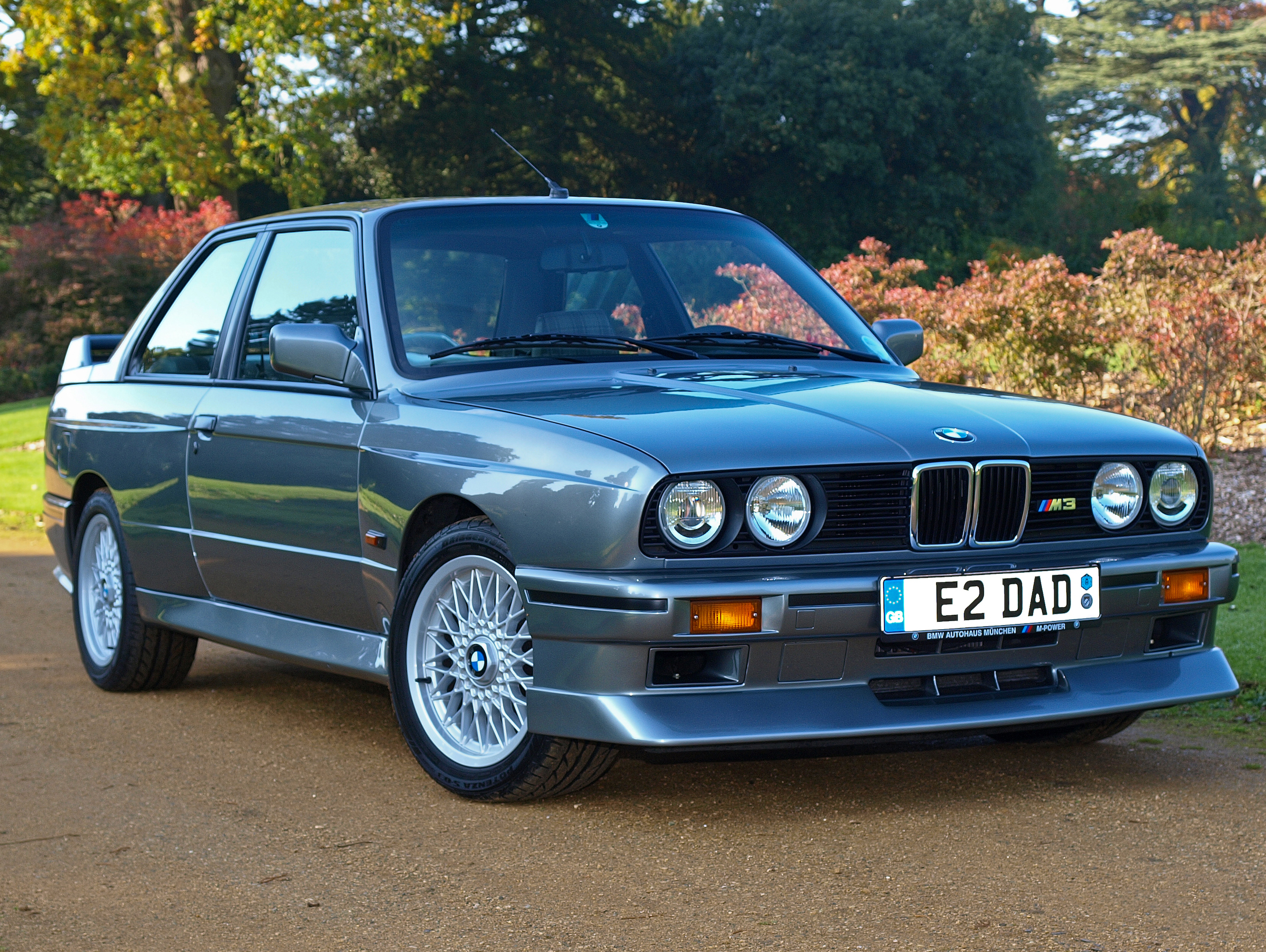
The 1988 BMW M3 Evolution II is a 500-car E30 homologation edition with a more focused factory specification and a lasting place in the first M3’s development story.
BMW M3 Evolution II specifications and production
| Item | Factory reference / scope |
|---|---|
| Model | BMW M3 Evolution II |
| Inventory reference | BMW-027 |
| Platform / year | E30 / 1988 |
| Production window | April–June 1988 |
| Production scope | 500 Evolution II road cars; excludes other M3 editions |
| Purpose | Homologation of motorsport developments |
| Engine | 2,302 cc inline four-cylinder |
| Factory output | 162 kW / 220 PS (BMW labels 220 hp), at 6,750 rpm |
| Factory top speed | 243 km/h / 151 mph |
| Exterior finishes | Macao Blue; Misano Red; Nogaro Silver |
The BMW M3 Evolution II: a sharper chapter in the E30 story
The 1988 BMW M3 Evolution II brings the first-generation M3’s competition purpose into unusually clear focus. It is a limited road-car evolution whose significance lies in the relationship between production hardware and touring-car development. For a collector, the appeal is the opportunity to study that relationship in an identifiable factory variant rather than through an open-ended collection of later modifications.
Its place in a collection is consequently easy to explain: this is an E30 M3 with a specific identity, a defined production scope and a reason for existing beyond an anniversary badge. That combination makes it a rewarding subject for anyone interested in how manufacturers translated competition requirements into cars customers could own. The story is best read through its period and factory context, with modern photographs treated as illustrations of surviving cars.
Why BMW built a homologation evolution
BMW M’s account traces the original M3 to Group A competition, where road production established eligibility for racing. The original programme required 5,000 road-legal cars within twelve months. The Evolution II belongs to the subsequent development of that established platform; its limited series should not be confused with the initial requirement for the whole M3 programme.
BMW Group Classic describes this variant as a way of homologating new motorsport components. The distinction matters. A homologation evolution connects a road-car specification with the development of the competition platform. It does not mean every customer car was raced, or that every feature seen on a later racing chassis was delivered on the road version. Any competition history claimed for a particular survivor still needs evidence tied to that chassis.
This is also why the car deserves its own profile. A broad history of the M3 can explain the success of the family, but a variant profile can identify the exact subject and keep its production run separate. That precision is especially valuable when a collection contains several closely related editions.
Factory reference: BMW M: E30 M3 history and model chronology.
Engine development: more than a badge
BMW’s special-edition history records changes to the valves, pistons, cylinder head and camshaft, alongside weight-saving work on the body and window glass. These were changes to the car’s substance as well as its presentation. Its 2.3-litre four-cylinder engine remained central to the concept, rather than being replaced by the larger engine of the later Sport Evolution.
Viewed as engineering history, this is an instructive form of development: improve the existing package while preserving the identity of the platform. The attraction is not simply a higher headline output. It is the way engine work, weight reduction and aerodynamics form a coherent specification. That is the editorial reason to discuss those areas together instead of reducing the car to a single performance number.
For an individual example, present-day performance is a separate subject. An engine rebuild, replacement components or subsequent tuning may alter what a surviving car produces. The factory reference describes the original variant; a measured result describes the car tested, under the conditions of that test. A good vehicle record can preserve both without treating them as interchangeable.
Factory reference: BMW: history of M3 special editions, 2016, page 2.
Recognising the Evolution II
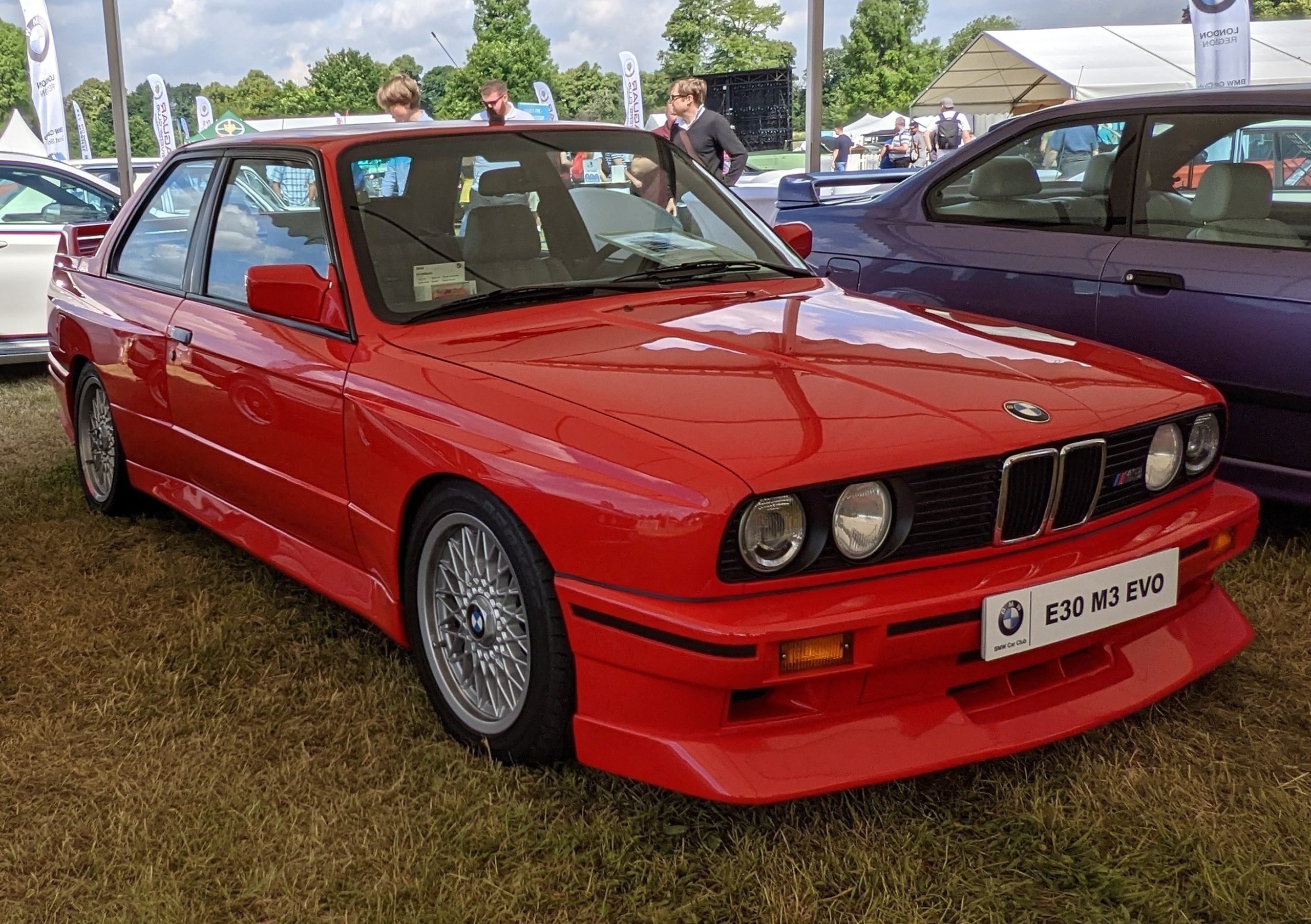
The factory identifies revised spoilers and front brake-cooling inlets occupying the position of the fog lamps. It also records motorsport-colour treatment on the valve cover and air collector. The three listed exterior finishes are Macao Blue, Misano Red and Nogaro Silver. These details provide a useful starting point for understanding how the variant presents itself.
Visual recognition is only the beginning of identification. A spoiler, paint finish or engine-bay detail can be changed. A convincing record should bring the visible car, its chassis identity and its factory documentation into agreement. Where an owner has retained original parts after a reversible modification, that distinction can be recorded rather than hidden.
Photography is particularly helpful here. A clear front-quarter view explains the relationship between the apron and cooling openings much faster than a long description. A second view can reveal proportions, wheels and body surfaces. Neither view can establish the originality of unseen mechanical components or authenticate an entire chassis history.
Factory reference: BMW Group Classic: M3 Evolution II model record.
Evolution II versus Sport Evolution
BMW’s chronology lists the 1988 Evolution II at 162 kW and the 1990 Sport Evolution at 175 kW. The latter moved to 2.5 litres and a separate 600-car series. They are distinct entries in the development of the same M3 generation, with different specifications and production scopes.
For collectors, the useful question is how each car represents its own moment in that development. Treating the names as interchangeable obscures that story. It also creates practical errors in captions, searches and production totals. A photograph carrying an Evolution label still needs to be checked against the model it actually shows.
The same discipline applies to the earlier evolution stage and to other E30 special editions. Similar bodywork does not make their records identical. This profile uses the full Evolution II name so a reader arriving from a search can understand which version is being discussed before moving into the wider family history.
Factory reference: BMW: M3 history and model table, 2007, pages 10–12 and 32.
Rarity, originality and the individual survivor
The 500-car figure is a factory production reference for this edition. It is not a present-day survival count, a count of cars in one country, or a guarantee that any given example remains in its original condition. Those are separate research questions, and a useful registry should distinguish them.
The collector interpretation is that a small, clearly defined variant rewards careful documentation. Original records, a traceable restoration and an honest account of replacement parts can make a car easier to understand. A polished presentation alone cannot answer those questions. Equally, a well-documented repair need not be erased from the history simply because a more romantic story would sound better.
When recording a survivor, distinguish its manufacture date from later registration or import dates. Keep chassis-specific documents with the chassis-specific entry, and use the edition profile to explain the factory reference. This makes the record useful to future readers who may encounter the car under a different owner or in another country.
The value of that approach is cumulative. Each clearly attributed photograph and dated document adds a small piece of evidence. Over time, an organised record becomes more informative than a succession of unsupported descriptions copied from one listing to another.
What the photographs show
The featured photograph is Calreyn88’s red E30 M3 EVO, photographed on 26 June 2021 and catalogued on Wikimedia Commons under Evolution II. It provides a clear front view of the apron and spoiler arrangement. The second image is Darren’s grey example, photographed on 12 October 2008 and catalogued in the same variant category. These are modern photographs of displayed cars, not images taken during the 1988 production period.
The photos illustrate the model’s appearance; this profile does not claim a particular chassis number, an original paint history or a factory build certificate for either photographed car. The photographer names, source pages and individual Creative Commons licences remain visible beside the images. The downloaded files are retained without further local alteration.
Keeping that context attached to the gallery helps a reader interpret what they are seeing. A credit identifies the person responsible for the photograph, while a caption identifies the subject and the limits of what the image documents. Those two pieces of information serve different purposes and both belong in a vehicle profile.
Collector significance
The Evolution II earns its place through a combination of identifiable factory specification and a direct connection to the development of a competition platform. Its interest does not depend on predicting a future sale price. It can be appreciated as an engineering object, a historical document and a distinctive member of the first M3 generation.
For a collection organised around rarity, it also demonstrates why production scope matters. The meaningful unit is the particular edition, not every car sharing the M3 badge. For a collection organised around motorsport, it shows how the road-car programme and racing development informed one another. Those perspectives make the profile useful well beyond a list of numbers.
An enduring record should make those relationships easy to follow. Accurate naming, a compact specification table, authentic credited photographs and links to the factory references give readers a path from first impression to deeper research.
BMW M3 Evolution II FAQs
How many BMW M3 Evolution II cars were built?
BMW’s model record and special-edition history give 500 for this variant. That figure describes production, not surviving cars.
When was the Evolution II produced?
BMW Group Classic lists April to June 1988. Manufacture and later registration dates should be recorded separately.
What engine does the M3 Evolution II have?
The factory reference is a 2,302 cc inline four-cylinder engine, rated at 162 kW at 6,750 rpm.
How fast was the Evolution II?
BMW Group Classic gives a factory top-speed reference of 243 km/h, or 151 mph.
Which colours were offered?
BMW lists Macao Blue, Misano Red and Nogaro Silver. A photographed finish alone does not establish a car’s original build specification.
Is the Evolution II the same as the Sport Evolution?
They are separate factory variants. The later Sport Evolution used a larger engine and had its own production series.
Does an Evolution badge prove authenticity?
A badge or body component is an identification clue. A chassis-specific record should corroborate the car’s identity with factory documentation and its history.
Are these period factory photographs?
No. The supplied images were taken in 2021 and 2008. Each carries its photographer credit, source link and licence; neither is presented as a 1988 photograph.
Explore related verified BMW profiles
- BMW M3 Art Car — Michael Jagamara Nelson, 1989
- BMW M3 Art Car — Ken Done, 1989
- BMW M3 Pickup E30 — The 1986 Workshop One-Off
Sources and photo credits
- BMW Group Classic: M3 Evolution II model record
- BMW M: E30 M3 history and model chronology
- BMW: history of M3 special editions, 2016, page 2
- BMW: M3 history and model table, 2007, pages 10–12 and 32
Photo: Calreyn88 / Wikimedia Commons · CC BY-SA 4.0. Downloaded Commons version retained without further local alteration.
Photo: Darren / Wikimedia Commons · CC BY 2.0. Downloaded Commons version retained without further local alteration. Commons file history records an earlier removal of watermark/border by Biker Biker.
Why this machine matters
The Evolution II earns its place through a combination of identifiable factory specification and a direct connection to the development of a competition platform. Its interest does not depend on predicting a future sale price. It can be appreciated as an engineering object, a historical document and a distinctive member of the first M3 generation.
For a collection organised around rarity, it also demonstrates why production scope matters. The meaningful unit is the particular edition, not every car sharing the M3 badge. For a collection organised around motorsport, it shows how the road-car programme and racing development informed one another. Those perspectives make the profile useful well beyond a list of numbers.
An enduring record should make those relationships easy to follow. Accurate naming, a compact specification table, authentic credited photographs and links to the factory references give readers a path from first impression to deeper research.
Built in limited numbers
Edition production total; survivor count unknown.
Gallery
Specifications
Factory specifications may vary by model year, market and configuration.
Identity & production
- Official model
- BMW M3 Evolution II (E30, 1988)
- Base model
- M3
- Worldwide production
- 500
Powertrain & performance
- Engine
- 2,302 cc inline four-cylinder