BMW M3 Art Car — Michael Jagamara Nelson, 1989
Discover BMW M3 Art Car Michael Jagamara Nelson history, specifications and rarity, with sourced details, FAQs and authentic photographs with visible credits.
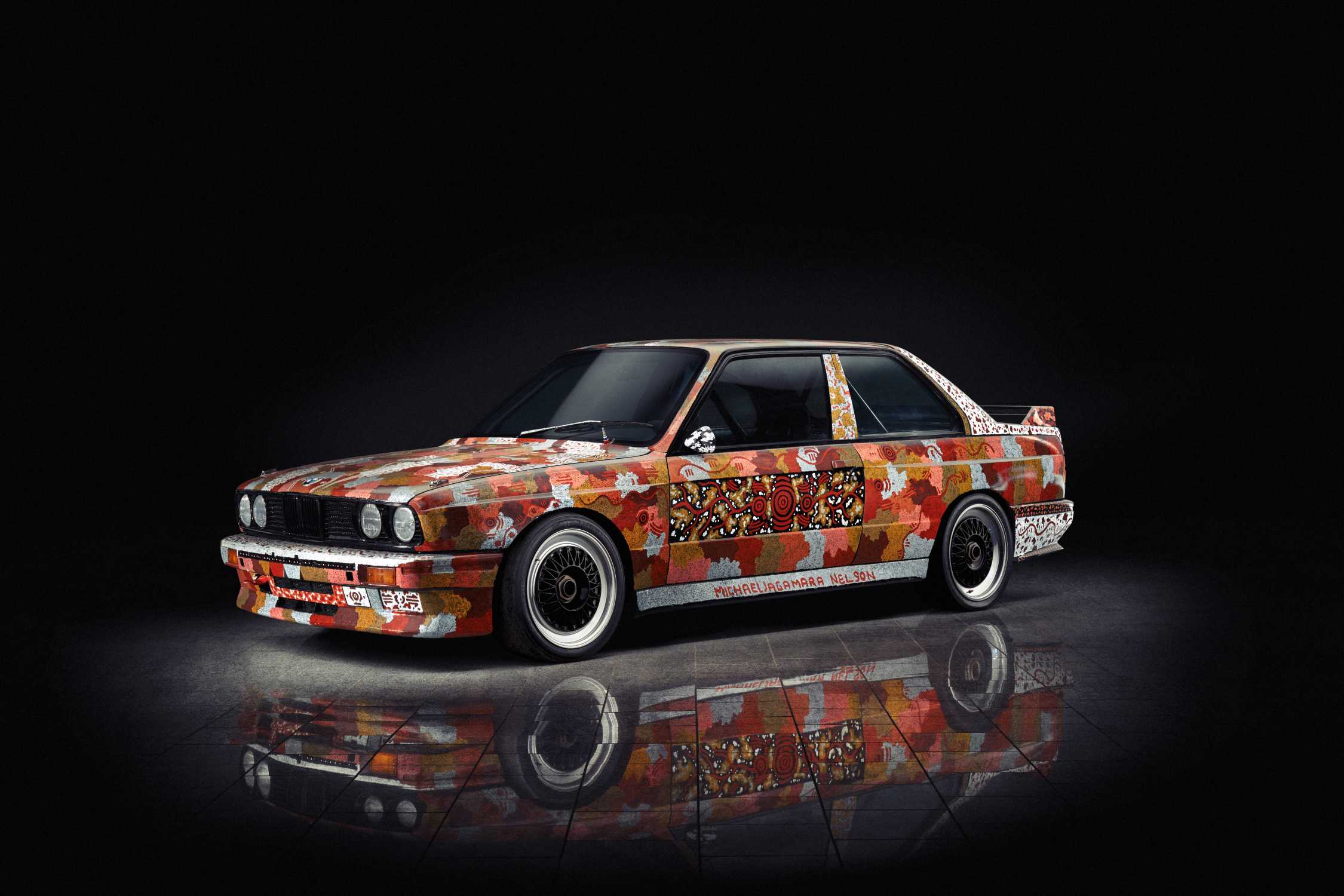
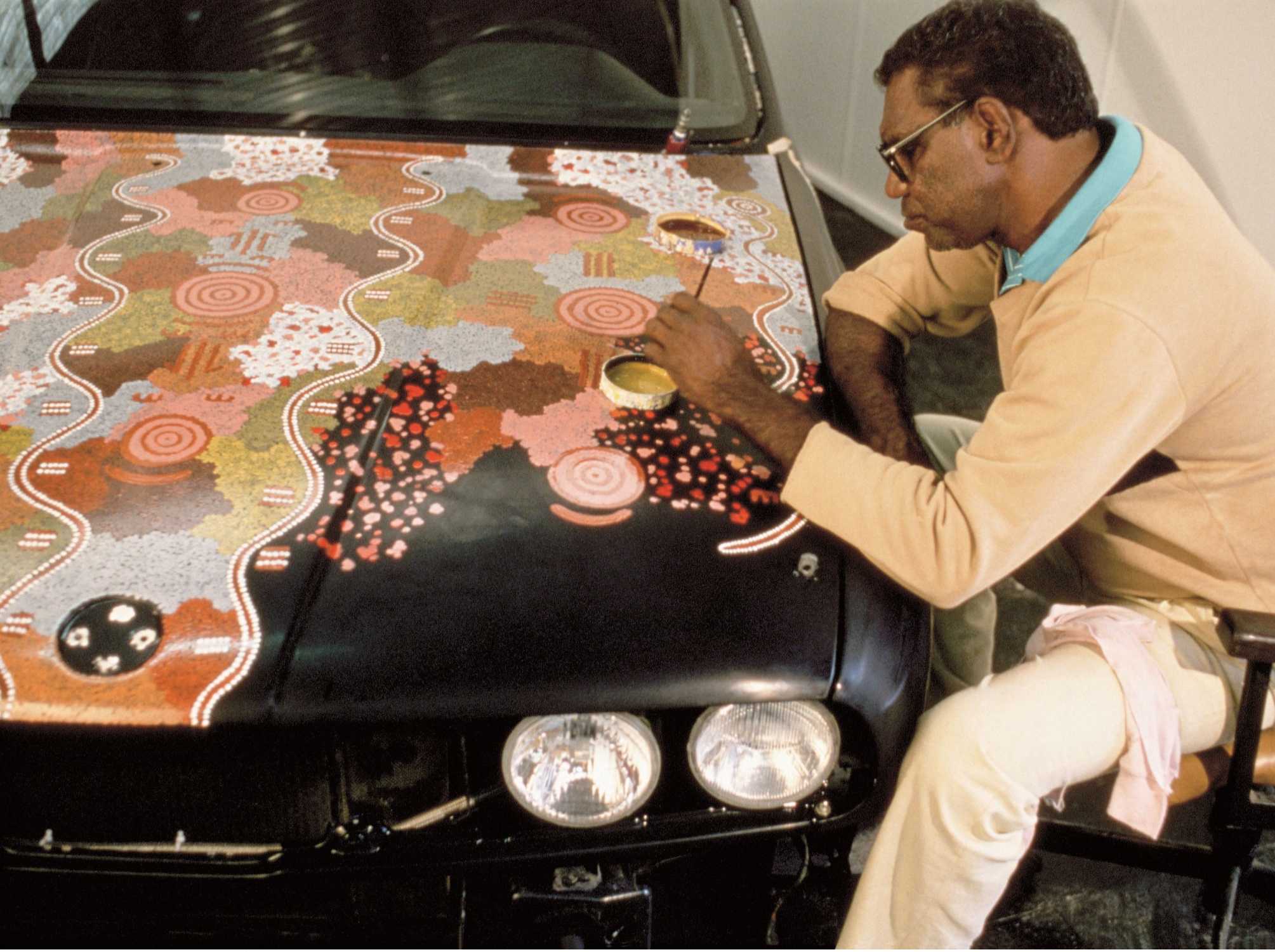
Michael Jagamara Nelson created the seventh BMW Art Car in 1989 on an E30-generation M3 Group A racing car. The vehicle brings together an Australian competition background and an individual work of art grounded in the artist’s cultural practice. Both are necessary to explain why it has its own record.
Record: BMW-017 · Individual BMW Art Car · Germany · 1989.
Specifications and rarity
| Item | Documented reference and scope |
|---|---|
| Art Car number | 7 |
| Artist / creation year | Michael Jagamara Nelson, 1989 |
| Vehicle | BMW M3 Group A racing version, E30 |
| Historical engine reference | 2,332 cc inline-four; four valves per cylinder; twin overhead camshafts |
| Factory catalogue reference | 300 bhp; 281 km/h |
| Painting process | Seven days in the factory account |
| Earlier racing identity | BMW Australia racing car associated with Tony Longhurst and Peter Brock before its Art Car transformation |
| Count scope | One original individual artwork; not a 635 CSi edition |
Michael Jagamara Nelson’s M3 joins two distinct histories
The workbook assigns the artist a 635 CSi and a 1983 year. BMW’s catalogue instead identifies an M3 and 1989. This profile preserves BMW-017 as the inventory reference while correcting the model, chassis and creation year. The correction also prevents the article from inheriting the specifications of an unrelated six-cylinder coupé.
The artwork is more than an abstract racing livery
The factory account describes the work through Papunya painting and the artist’s Warlpiri background. It relates the apparent geometry to meaningful figures and a landscape-like view. That context is essential: the pattern should not be reduced to a generic decorative wrap or described as if every symbol were freely interchangeable.
The supplied images show dense, connected marks distributed across the car. The bonnet and wings offer large areas for the design, but the painting also follows smaller changes in the racing body. From a distance, the vehicle reads as a unified patterned form; close up, the viewer can study relationships between marks and surfaces.
This profile does not invent interpretations of individual sacred symbols. It follows the artist context documented by BMW and confines additional visual commentary to what can be observed in the photographs. That allows the car’s cultural significance to remain visible without pretending an image alone supplies a complete interpretation.
Competition history before the 1989 painting
BMW’s catalogue connects the car with BMW Australia’s racing operation under Frank Gardner. It records a 1987 AMSCAR title with Tony Longhurst and use by the Mobil 1 team with Peter Brock in 1988. Those events precede the Art Car’s creation and should be dated accordingly.
That sequence matters when interpreting race photographs. A vehicle can have an important competition biography before receiving the surface by which it later becomes famous. The painting year is not the build year of every mechanical component, nor does it mean the car won its earlier championship while wearing the finished 1989 artwork.
The profile therefore distinguishes the racing platform’s prior use from the artistic transformation. This is more precise than compressing driver, championship and artwork into one undated sentence that invites readers to assume they occurred together.
Group A M3 specifications are not 635 CSi specifications
The historical catalogue lists a 2,332 cc four-cylinder with four valves per cylinder and twin overhead camshafts. Its published reference is 300 bhp and 281 km/h. These figures belong to the racing M3 entry, not to the 635 CSi mistakenly named in the workbook.
The physical distinction is visible in the photographs: the compact E30 shape and racing body treatment differ from the long E24 coupé. The model correction therefore affects more than a label. It changes which engineering architecture, competition category and related vehicles make sense in the profile.
The table retains the catalogue’s historical scope. It does not certify the car’s current operating output, and it does not treat the figure as a universal specification for every production E30 M3.
Rarity and comparison with Ken Done’s M3
The original individual artwork is the rarity scope. It is separate from the population of E30 M3 road cars, from Australian Group A chassis generally and from Ken Done’s different Art Car created in the same year. Shared model, region and creation year do not make the two objects duplicates.
Comparing the two M3s is particularly revealing. Both use a compact racing car as a surface, but their artistic sources and visual organization differ. The comparison works best when the artists’ identities remain explicit and the cars’ earlier racing histories are not casually exchanged.
The BMW images carry the factory image credit alongside Nelson’s artwork credit. That visible attribution helps a reader keep the source photograph, the painted object and the artist’s authorship distinct.
Frequently asked questions
What model did Michael Jagamara Nelson paint?
A BMW M3 Group A racing version based on the E30, not a 635 CSi.
When was the Art Car created?
1989, correcting the workbook’s 1983 entry.
Which Art Car number is it?
Number 7.
Was the car raced before it became an Art Car?
BMW records Australian racing use in 1987 and 1988 before the 1989 artistic transformation.
Is its pattern just a generic geometric livery?
BMW places it in the context of the artist’s Papunya painting and Warlpiri cultural background.
Is it the same car as Ken Done’s Art Car?
No. They are separate original M3 Art Cars by different artists, both created in 1989.
Explore related verified BMW profiles
- BMW M3 Art Car — Ken Done, 1989
- BMW M3 Pickup E30 — The 1986 Workshop One-Off
- BMW 320i Art Car — Roy Lichtenstein, 1977
Sources and photo credits
Michael Jagamara Nelson’s 1989 BMW M3 Art Car, photographed by Enes Kucevic for BMW; published in June 2025. Photo: Enes Kucevic / BMW Group PressClub · Press/editorial use only. Clean source photograph supplied without local alterations. © BMW AG. BMW PressClub press/editorial-use terms apply. Artwork: Michael Jagamara Nelson, 1989.
Michael Jagamara Nelson painting his BMW M3 Art Car, in BMW’s historical project photograph supplied in March 2025. Photo: BMW AG / BMW Group PressClub · Press/editorial use only. Clean source photograph supplied without local alterations. © BMW AG. BMW PressClub press/editorial-use terms apply. Artwork: Michael Jagamara Nelson, 1989.
Why this machine matters
The BMW images carry the factory image credit alongside Nelson’s artwork credit. That visible attribution helps a reader keep the source photograph, the painted object and the artist’s authorship distinct.
Built in limited numbers
One original individual artwork; not a 635 CSi edition
Gallery
Specifications
Factory specifications may vary by model year, market and configuration.
Identity & production
- Official model
- BMW M3 Art Car — Michael Jagamara Nelson, 1989
- Base model
- M3 E30
- Worldwide production
- 1
Powertrain & performance
- Engine
- 2,332 cc inline-four; four valves per cylinder; twin overhead camshafts