BMW M1 E26 — Road Supercar and Procar Foundation
Explore the BMW M1 E26’s mid-engine design, road specifications, Procar story and conflicting factory production totals, with credited photos.
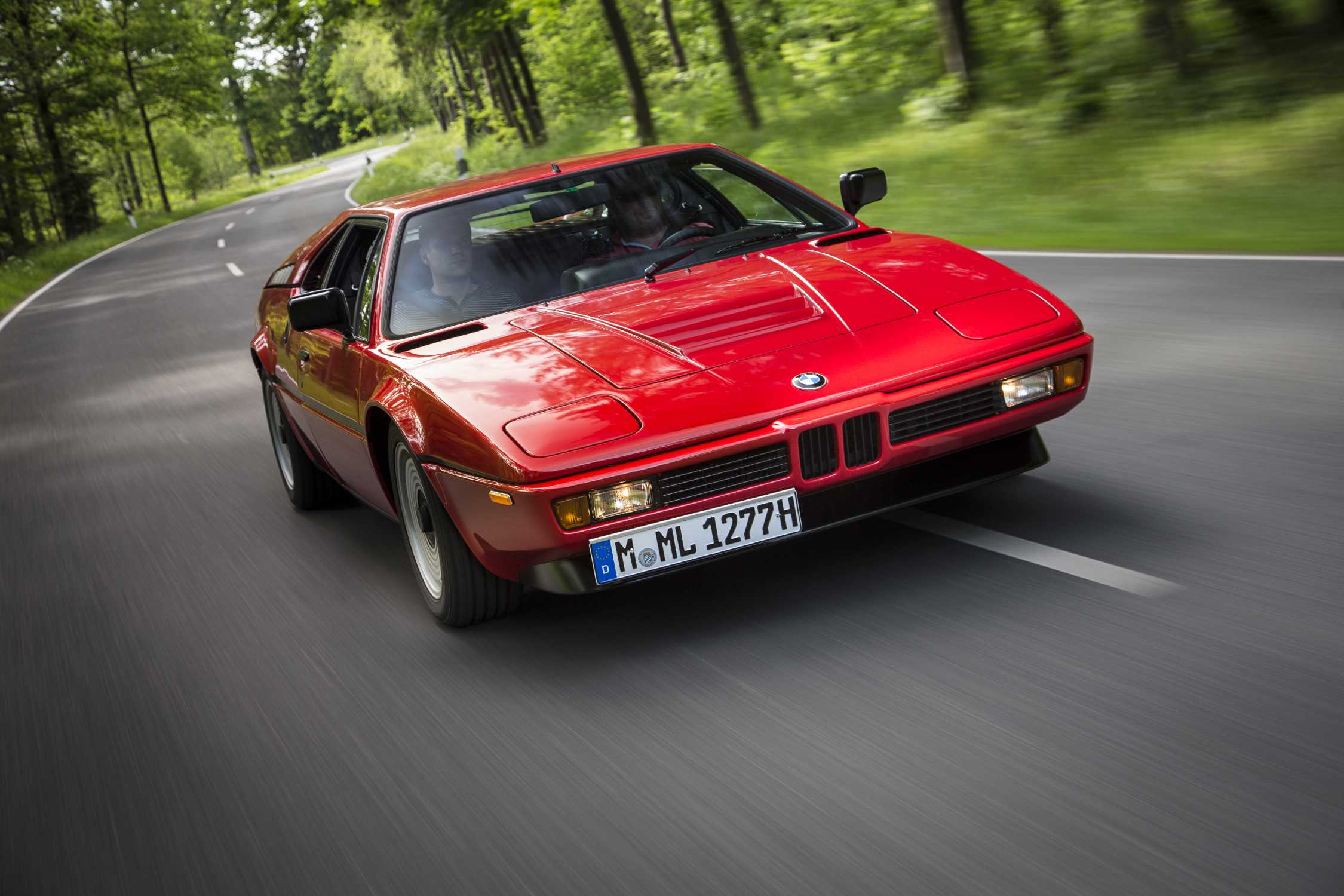
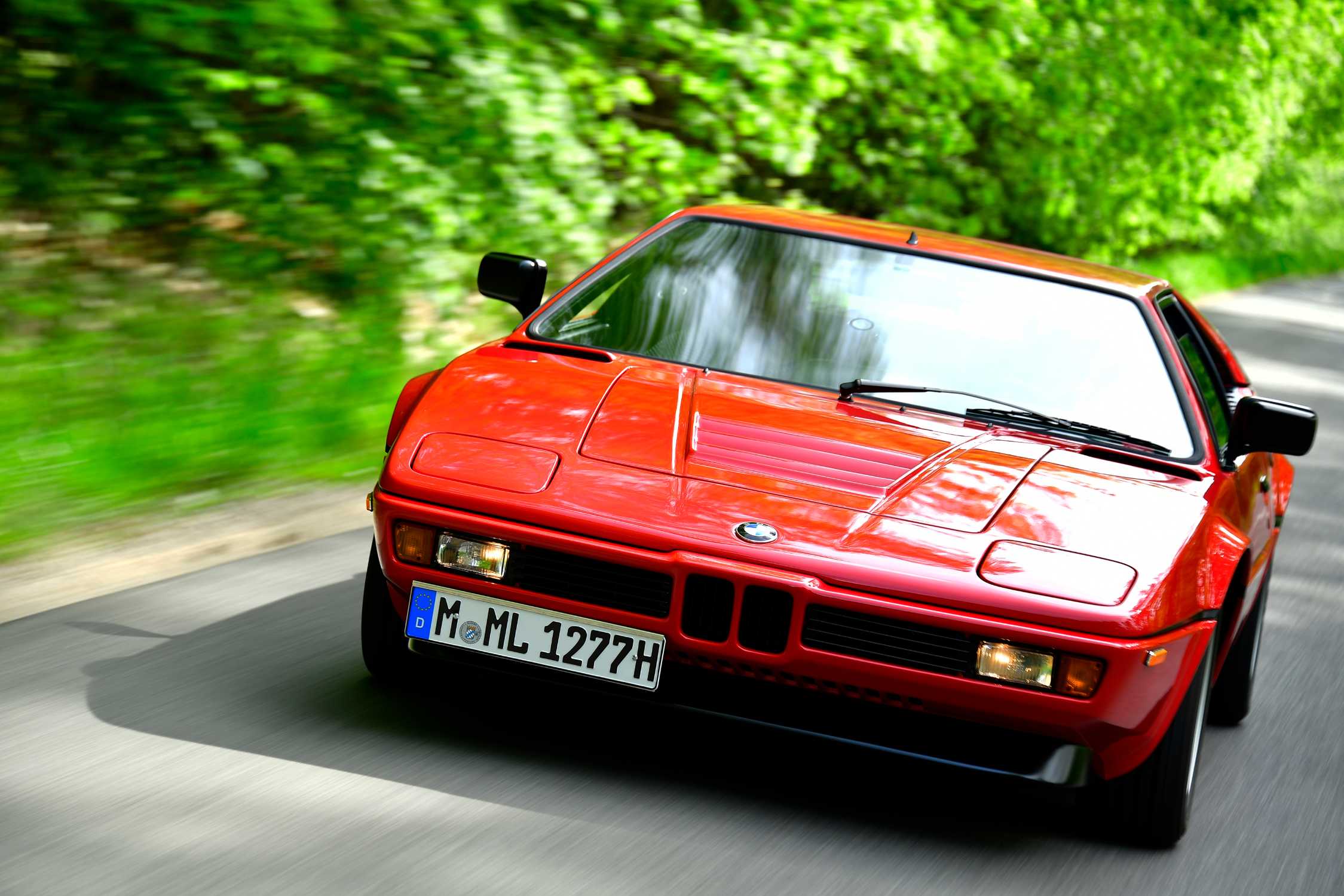
The BMW M1 E26 is the mid-engined sports car at the foundation of BMW Motorsport’s supercar story. Its low Giugiaro body, six-cylinder engine and small-scale production separate it sharply from the saloons and coupés with which the brand was better known. The model connects road-car construction with a demanding homologation ambition.
Record: BMW-013 · Finite-production homologation model · Germany · 1978.
BMW M1 E26 specifications and rarity
| Item | Documented reference and scope |
|---|---|
| Public debut | Paris motor show, autumn 1978; workbook reference year is 1979 |
| Production end | 1981 in BMW’s historical account |
| Designer | Giorgetto Giugiaro / Italdesign |
| Road engine | 3,453 cc M88 inline-six; 24 valves; dry-sump lubrication |
| Road output reference | 204 kW |
| Road torque | 330 Nm |
| Layout / transmission | Longitudinal mid-engine, rear-wheel drive; ZF five-speed manual |
| Construction | Spaceframe with glass-fibre-reinforced plastic body |
| Total-count issue | Later BMW accounts give 453 combined road/race cars; the 2008 factory history gives 445, split 399 road / 46 Procar |
The BMW M1 is more than an unusual BMW silhouette
The workbook uses 1979 as its reference year. BMW’s historical account places the public debut at the Paris motor show in autumn 1978. This profile therefore uses 1978 for debut and retains the workbook year in the research record. A model’s introduction, racing season and individual car’s registration date are different pieces of chronology.
Giugiaro design and a complicated production chain
BMW’s account describes a programme initially involving Lamborghini, then a reorganized production process. Marchesi made the spaceframe, T.I.R. the glass-fibre-reinforced plastic body, Italdesign combined those elements and supplied the interior, and Baur in Stuttgart installed the mechanical systems. The finished car resulted from a network of specialist work rather than a simple high-volume assembly story.
That production chain helps explain why the M1’s identity deserves more than a badge-based description. Its design, body materials and build organization were shaped by the project’s unusual goals and constraints. For a reader comparing BMW heritage models, the M1 offers a distinct example of how a manufacturer can develop a specialist vehicle outside its familiar production pattern.
The road M1’s M88 six-cylinder
The road-car reference is a 3,453 cc longitudinal inline-six with four valves per cylinder, twin overhead camshafts and dry-sump lubrication. BMW publishes 204 kW and 330 Nm, with a ZF five-speed manual transmission. The engine sits behind the two-seat cockpit and drives the rear wheels.
Dry-sump lubrication is particularly relevant to the sports-car context because oil control matters when a vehicle experiences sustained cornering loads. The technical description also makes a useful distinction from the earlier Turbo E25. Both explored mid-engine sports-car packaging, but the M1’s six-cylinder arrangement was not the E25’s transverse four-cylinder installation.
Homologation and the Procar series
Delays complicated the original racing plans, and the Procar series gave the M1 a highly visible competitive setting in 1979 and 1980. Road cars and Procar racers share a programme connection, but the competition versions have their own preparation and power references. This profile’s specification table describes the road configuration unless a row says otherwise.
The distinction matters in photographs as well. A Procar image can illustrate the racing branch of the story, but it should not silently stand in for a standard road car. The images selected for this entry are factory-identified M1 material, with captions preserving the pictured configuration instead of transferring racing claims to every chassis.
Why the M1 production total needs a source note
The workbook and later BMW publicity use 453 for the combined road-and-race total. BMW’s 2008 retrospective gives a different figure: 445, divided into 399 road cars and 46 in Procar trim. The checked sources do not explain how those totals reconcile. It would be misleading to present 453 as an independently settled count of road cars alone.
For this batch, the exact production-total field remains empty and the published discrepancy is preserved in the article and metadata. The model’s finite-production identity is well documented; the unresolved issue is the precise census scope. This keeps a useful profile available while ensuring that future count research can correct a specific open question rather than unwind an invented certainty.
Understanding the M1’s place among these ten BMWs
The M1 completes a revealing sequence of engineering approaches. The pre-war 328 coupés explored lightweight aerodynamics, the electric 1602 evaluated a new propulsion task, the Turbo E25 tested design and safety ideas, and the CSL programme joined road homologation with racing development. The M1 brought specialist sports-car construction and a new competition format into the same historical picture.
That relationship is useful for readers, but it does not make the vehicles interchangeable. Each profile has its own count scope, configuration and chronology. The M1’s importance is strongest when its real production challenges and racing context are explained directly, with the road car, Procar and individual artist-painted examples kept as distinct records.
BMW M1 E26 frequently asked questions
When did the BMW M1 debut?
BMW’s historical account identifies the Paris motor show in autumn 1978. The workbook’s 1979 reference relates to the later programme period.
What engine does a road M1 use?
A 3,453 cc M88 inline-six with 24 valves and dry-sump lubrication; BMW gives 204 kW and 330 Nm.
Is the M1 engine mounted like the Turbo E25’s?
No. The M1 uses a longitudinal six-cylinder; the earlier E25 concept used a transverse turbocharged four-cylinder.
How many BMW M1s were built?
Later BMW accounts give 453 combined road/race cars, while a 2008 factory history gives 445. This profile preserves the discrepancy and leaves an exact total unset.
Does 453 mean 453 road cars?
No. The later figure is presented as a combined road-and-race programme total.
What was Procar?
It was the M1 racing series held in 1979 and 1980, giving the car a prominent competition role.
Who designed the M1 body?
Giorgetto Giugiaro and Italdesign are associated with its design; the construction involved multiple specialist suppliers.
Explore related verified BMW profiles
- BMW Turbo E25 — Paul Bracq’s Running Concept
- BMW 3.0 CSL E9 — Lightweight Homologation Legend
- BMW 320i Art Car — Roy Lichtenstein, 1977
Factory sources and photo credits
Technical references and historical claims are tied to the source scope shown above. The inventory’s Verified label establishes eligibility for this batch; unresolved counts remain labelled.
Images: © BMW AG / BMW Group PressClub. Supplied for press and editorial use under BMW PressClub terms.
Why this machine matters
That relationship is useful for readers, but it does not make the vehicles interchangeable. Each profile has its own count scope, configuration and chronology. The M1’s importance is strongest when its real production challenges and racing context are explained directly, with the road car, Procar and individual artist-painted examples kept as distinct records.
Built in limited numbers
1981 in BMW’s historical account; Later BMW accounts give 453 combined road/race cars; the 2008 factory history gives 445, split 399 road / 46 Procar
Gallery
Specifications
Factory specifications may vary by model year, market and configuration.
Identity & production
- Official model
- BMW M1 E26 — Road Supercar and Procar Foundation
- Base model
- M1 E26
Powertrain & performance
- Engine
- 3,453 cc M88 inline-six; 24 valves; dry-sump lubrication
- Transmission
- Longitudinal mid-engine, rear-wheel drive; ZF five-speed manual