BMW 3.0 CSL Art Car — Frank Stella, 1976
Explore Frank Stella’s 1976 BMW 3.0 CSL Art Car, its grid design, racing specification and competition history, with image and artwork credits.
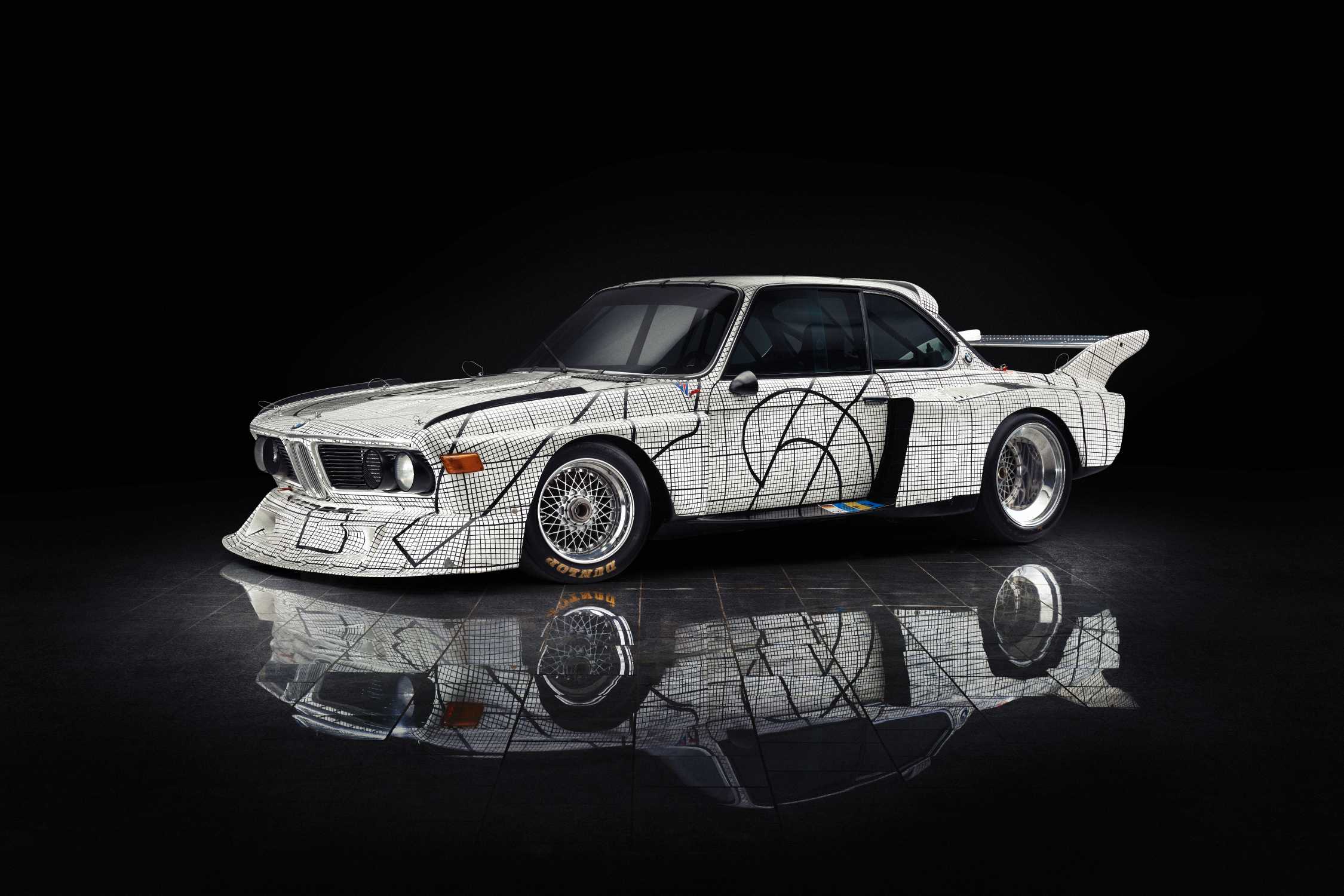
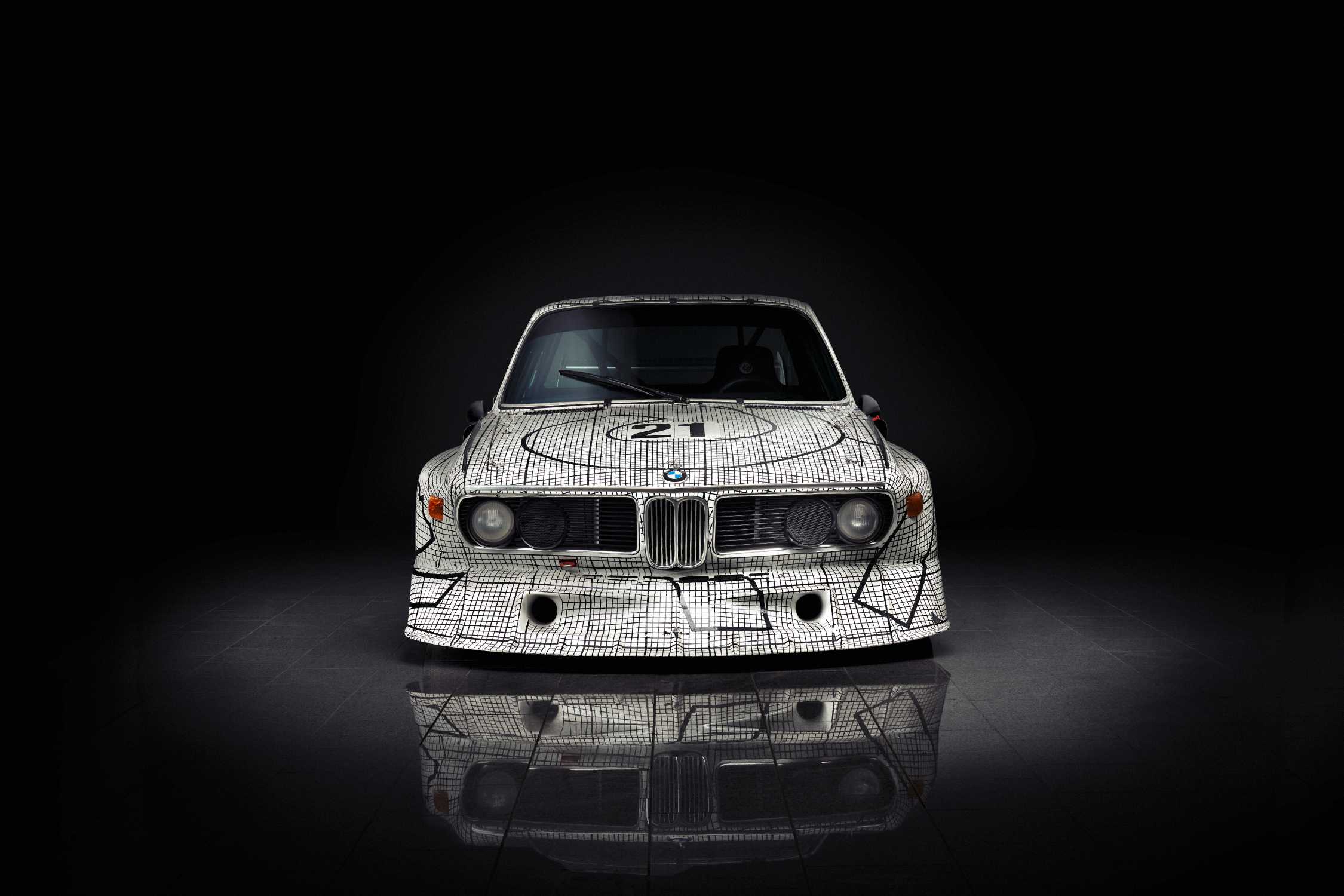
The 1976 BMW 3.0 CSL Art Car by Frank Stella takes a very different approach from Calder’s first example. Instead of large contrasting color fields, Stella’s design uses a black-and-white grid and drawing-like lines to emphasize the competition body. It is the second car in BMW’s Art Car sequence.
Record: BMW-011 · Individual BMW Art Car · Germany · 1976.
BMW 3.0 CSL Art Car specifications and rarity
| Item | Documented reference and scope |
|---|---|
| Art Car sequence | Second BMW Art Car |
| Artist / year | Frank Stella, 1976 |
| Base identity | BMW 3.0 CSL competition car |
| Artwork | Black-and-white grid and technical drawing-like treatment |
| Factory engine reference | 3,210 cc inline-six; four valves per cylinder; twin overhead camshafts |
| Factory output / speed reference | 750 bhp; 341 km/h, as published in the Art Car kit |
| Competition record | 1976 Le Mans and Dijon appearances; no placing due to technical problems in BMW’s account |
| Count scope | One original individual Art Car |
Frank Stella’s BMW CSL turns the body into a drawing
The result invites close inspection. Where a conventional racing livery might organize sponsors and team identity, the grid encourages the viewer to notice curvature, depth and changes of surface. This is a specific artistic intervention on an individual car, not a factory color option offered across the CSL range.
Seeing the grid on a three-dimensional object
A flat grid becomes visually unstable when it crosses a wing, a bonnet edge or a recessed area. On Stella’s car, that relationship between an orderly pattern and an irregular racing body is central to the viewing experience. The artwork gives the eye a reference against which the car’s shape can be read.
The two supplied factory photographs offer complementary views of the same design. Readers can follow lines across panels rather than relying on a single frontal image. The retained composition is useful because the artwork extends over the body; cropping it to a small detail could obscure the relationship between pattern and full vehicle form.
Race-car power rather than showroom specification
BMW’s Art Car press kit gives a 3,210 cc inline-six, four valves per cylinder and twin overhead camshafts. It lists 750 bhp and a maximum-speed reference of 341 km/h. These figures are tied to the individual competition car’s technical description, not to all E9 CSLs or even to every CSL Art Car.
The substantial difference from Calder’s published output illustrates why shared model names are not sufficient technical identification. Racing development can change from one season and configuration to another. This profile uses the factory’s historical reference as stated, without assuming the car’s present museum condition is identical to every race-day setup.
Competition appearances in 1976
The factory history records the Stella car at the 1976 24 Hours of Le Mans and at the 500-kilometre Dijon race on 5 September. BMW attributes the absence of a placing to technical problems. These appearances establish the work’s motorsport context even though they did not produce a winning result.
That context matters because the car’s graph-paper character can make it look like a purely analytical display piece. It was also a competition vehicle. The art did not erase its mechanical demands, and the technical setbacks belong to its biography. An accurate profile can celebrate the design while preserving the less glamorous racing facts.
Keeping the Stella Art Car identity precise
One original individual Art Car is the count used here. The number does not refer to a limited run of black-and-white CSL road cars, miniatures or printed images. The E9 road-model programme and the Calder car have their own records so the reader can compare related objects without merging them.
The photographs carry a BMW PressClub image credit and a separate Frank Stella artwork rights credit. A vehicle image may contain copyright interests beyond the person or organization taking the photograph. For an Art Car, that distinction is part of documenting the subject correctly, just as the artist’s name and creation year are part of its identity.
BMW 3.0 CSL Art Car frequently asked questions
Which BMW Art Car is Frank Stella’s CSL?
It is the second BMW Art Car, created in 1976.
What makes its artwork recognizable?
Its black-and-white grid and technical drawing-like treatment follow the racing body’s surfaces.
Is it another Calder Art Car?
No. It is a separate vehicle and artwork by Frank Stella, with its own 1976 history.
How much power does the factory kit list?
BMW’s historical Art Car kit lists 750 bhp for this race-car reference, not for the road-going CSL.
Did it achieve a Le Mans placing?
BMW’s account records technical problems and no placing at the 1976 event.
Does the one-car count include miniature models?
No. It applies to the original individual artwork/car, not reproductions or merchandise.
Explore related verified BMW profiles
- BMW 3.0 CSL E9 — Lightweight Homologation Legend
- BMW 3.0 CSL Art Car — Alexander Calder, 1975
- BMW 320i Art Car — Roy Lichtenstein, 1977
Factory sources and photo credits
Technical references and historical claims are tied to the source scope shown above. The inventory’s Verified label establishes eligibility for this batch; unresolved counts remain labelled.
Images: © BMW AG / BMW Group PressClub. Supplied for press and editorial use under BMW PressClub terms. Artwork: Frank Stella, BMW Art Car © VG Bild-Kunst, Bonn.
Why this machine matters
The photographs carry a BMW PressClub image credit and a separate Frank Stella artwork rights credit. A vehicle image may contain copyright interests beyond the person or organization taking the photograph. For an Art Car, that distinction is part of documenting the subject correctly, just as the artist’s name and creation year are part of its identity.
Built in limited numbers
One original individual Art Car
Gallery
Specifications
Factory specifications may vary by model year, market and configuration.
Identity & production
- Official model
- BMW 3.0 CSL Art Car — Frank Stella, 1976
- Base model
- E9 Coupé
- Worldwide production
- 1
Powertrain & performance
- Engine
- 3,210 cc inline-six; four valves per cylinder; twin overhead camshafts