Audi Le Mans quattro
The Audi Le Mans quattro is the 2003 concept that most directly previewed the production R8. Its mid-engine form connected a high-performance proposal with everyday usability. This guide distinguishes the physical study, its manufacturer-described technology and the later road R8, with a credited photograph of the concept rather than a substitute production car.
The Audi Le Mans quattro is the 2003 concept that most directly previewed the production R8. Its mid-engine form connected a high-performance proposal with everyday usability. This guide distinguishes the physical study, its manufacturer-described technology and the later road R8, with a credited photograph of the concept rather than a substitute production car.
Audi Le Mans quattro at a glance
| Manufacturer | Audi |
|---|---|
| Model / programme | Le Mans quattro |
| Profile scope | Physical concept archive |
| Historical reference year | 2003 |
| Inventory reference | AUDI-025 |
| Engine reference | Manufacturer-described 5.0-liter twin-turbo V10 concept specification |
| Exact original object count | Unresolved; no numeric production badge populated |
| Manufacturer power reference | 610 PS; concept rating where applicable |
| Manufacturer torque reference | 750 Nm; concept rating where applicable |
| Object scope | 2003 study; no customer production series |
A concept with a documented destination
Audi’s R8 history identifies Le Mans quattro as a 2003 IAA study and a preview of its later supercar. The same account describes Gallardo-based technical foundations, a twin-turbo 5.0-liter V10 rated at 610 PS and 750 Nm, and several proposed technology features. Those are manufacturer descriptions of the study. They are not specifications for the original production R8, which used a different engine. The connection is direct enough to be historically useful, but the two subjects still need separate entries.
The name does not turn it into a race winner
Le Mans quattro refers to a road-oriented concept, not the Audi R8 endurance prototype that won at Le Mans. A reader searching either name can easily cross between the race car, study and production supercar. This profile keeps the qualifier quattro and the 2003 date visible. Its rarity classification concerns the concept object. Race results belong to the relevant competition car and programme. The naming relationship is worth explaining, but it must not become a statement that this photographed study completed or won the 24-hour race.
The design’s usefulness as an R8 comparison
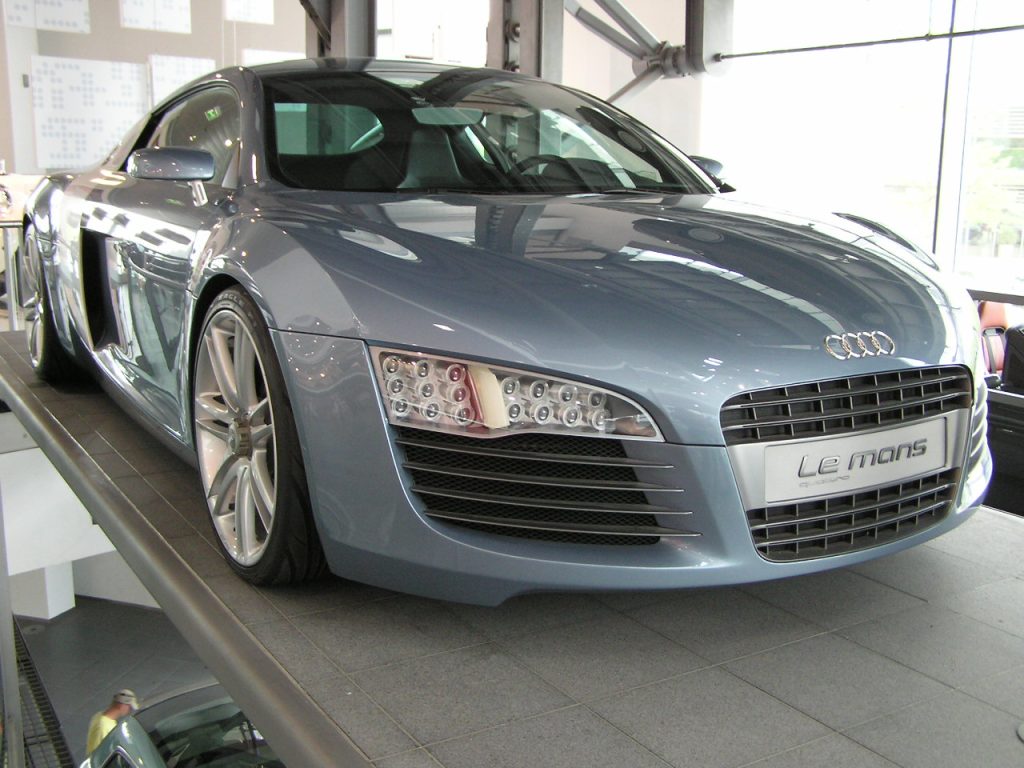
Compare the concept image with a first-generation road R8 from a similar angle. Look at the passenger compartment, side treatment and the relation of the cabin to the rear body. That exercise explains how a recognizable idea can survive into production while its details change. It is editorial visual analysis, not evidence that all body panels or dimensions are shared. A close resemblance does not establish identical construction. Dated photographs and factory development accounts provide a better comparison than treating the concept as an early customer car.
Concept technology versus installed equipment
Audi’s retrospective discusses lighting, structure, cockpit display and adaptive damping as parts of the concept story. A catalogue should retain the manufacturer’s context when describing those ideas. It should not imply that every display feature was already a production-ready component or that every technology appeared unchanged in the first R8. For the physical study’s exact current equipment, an object record is needed. Museum preservation, mechanical maintenance and demonstration arrangements can be separate from a concept’s original published intention.
The 610 PS figure needs its own label
The manufacturer-described 610 PS is attached to the concept’s twin-turbo V10 proposal. It should not be compared directly with a wheel-power measurement, or copied into a road R8 profile as if the cars used the same engine. Retain the original unit and identify the source. This guide does not provide a new acceleration test or current operational assessment. A historical specification can explain the ambition behind a design without establishing the output of the preserved object on the day a modern photograph was taken.
Rarity and the prototype census
The workbook lists one car, but the reviewed factory history does not enumerate every full-size development object. No exact completed total is assigned. This remains a physical concept archive profile. The absence of a customer series makes it distinct from the later mass-produced R8, whose overall production cannot be used as the concept count. A clay model, a display buck and a functional prototype are not automatically three cars. Any future census should state which categories it includes and which object identifiers support it.
Le Mans quattro versus Nuvolari quattro
Both studies appeared in Audi’s 2003 design programme, but they posed different packaging questions. Le Mans quattro is the mid-engine sports-car subject; Nuvolari is a GT proposal. A useful comparison addresses occupants, cabin placement and intended use before looking at published output. Closely sized headline numbers can obscure very different briefs. In this collection, the two profiles are linked so a visitor can compare the proposals without mistaking one for a variation of the other. Their photographs, specifications and historical references remain attached to the correct name.
What the supplied photograph can show
The source identifies this image as the Audi Le Mans quattro, with a 2003 subject label. It is a modern record of the physical study, not a production R8 photo and not an endurance-racing image. The caption preserves that distinction. To identify a future image, compare its source description and design details before using an attractive filename as proof. The linked photographer and license let readers trace the picture. Its reuse permission does not establish the concept’s mechanical state or authenticate a chassis number.
Research priorities for a complete object file
Seek dated launch photographs, the original press dossier, object identifiers and any later conservation or demonstration records. Where two accounts use different engine descriptions or output figures, retain their dates rather than silently choosing the larger number. These are research steps, not findings about a particular mechanical change. A strong record can explain which specifications were announced, which parts were installed and which demonstrations were documented. That makes the concept more interesting to engineering readers without overstating the evidence.
The lasting importance of the study
Le Mans quattro rewards attention because it bridges a striking public proposal and a recognizable customer product. The interesting story is not simply that it was rare. It is how a brand’s sports-car ambition became easier to visualize through a physical object. Follow Avus for the earlier idea, Nuvolari for the contemporary GT direction and the R8 V12 TDI for a later alternative powertrain experiment. Together they form a useful route through Audi’s concepts while preserving the identity of each study.
Frequently asked questions
When was Audi Le Mans quattro shown?
Audi dates the concept to the 2003 IAA.
Was it an R8 Le Mans race car?
No. It was a road-oriented concept, distinct from the endurance-racing R8 prototype.
What engine did Audi describe?
Audi’s retrospective gives a twin-turbo 5.0-liter V10, 610 PS and 750 Nm as the study specification.
Did the production R8 keep that exact engine?
No. Audi distinguishes the original road R8’s naturally aspirated V8 from the concept’s twin-turbo V10.
Explore related vehicle profiles
Sources
- Audi — R8 retrospective, Le Mans quattro and RSQ histories
- Audi — A sports car icon is born
- Audi Tradition — Forty years of quattro, historical show-car section
History and published specifications follow the linked manufacturer records. Visual comparisons, documentation questions and inspection priorities are editorial analysis. Photographs retain their original subject descriptions and separate rights records.
Photography and credit
Source-identified Audi Le Mans quattro concept. This is the study, not a production Audi R8 or Le Mans-winning race car. Photo: L.Kenzel / Wikimedia Commons · CC BY-SA 3.0. Original image supplied without visual changes.
Why this machine matters
The Audi Le Mans quattro is the 2003 concept that most directly previewed the production R8. Its mid-engine form connected a high-performance proposal with everyday usability. This guide distinguishes the physical study, its manufacturer-described technology and the later road R8, with a credited photograph of the concept rather than a substitute production car.
Built in limited numbers
The workbook lists one car, but the reviewed factory history does not enumerate every full-size development object. No exact completed total is assigned. This remains a physical concept archive profile. The absence of a customer series makes it distinct from the later mass-produced R8, whose overall production cannot be used as the concept count. A clay model, a display buck and a functional prototype are not automatically three cars. Any future census should state which categories it includes and which object identifiers support it.
Gallery
Specifications
Factory specifications may vary by model year, market and configuration.
Identity & production
- Official model
- Audi Le Mans quattro
- Base model
- Le Mans quattro
Powertrain & performance
- Engine
- Manufacturer-described 5.0-liter twin-turbo V10 concept specification