Audi Avus quattro
The Audi Avus quattro is a 1991 aluminum supercar design study that brought the visual language of the Silver Arrows into a modern Audi concept. Its polished body and dramatic proportions make it an important heritage object. The proposed W12 belongs to the concept specification; the show car must not be presented as a proven 509 PS production vehicle.
The Audi Avus quattro is a 1991 aluminum supercar design study that brought the visual language of the Silver Arrows into a modern Audi concept. Its polished body and dramatic proportions make it an important heritage object. The proposed W12 belongs to the concept specification; the show car must not be presented as a proven 509 PS production vehicle.
Audi Avus quattro at a glance
| Manufacturer | Audi |
|---|---|
| Model / programme | Avus quattro |
| Profile scope | Physical concept archive |
| Historical reference year | 1991 |
| Inventory reference | AUDI-015 |
| Engine reference | Proposed W12; functioning installation not confirmed |
| Exact original object count | Unresolved; no numeric production badge populated |
| Object scope | Physical design study; no customer production series |
What is the Audi Avus quattro?
The Avus belongs in an archive of physical Audi design studies. Audi identifies the car with 1991 and the Tokyo Motor Show, while its later museum records retain that original date. There was no customer production series. Reading the Avus as a proposal makes its significance clearer: the object gave designers a way to explore a much more dramatic sports-car identity than a normal road-car development brief would allow. Its polished surface, low passenger compartment and exposed mechanical themes invite attention before a viewer has read any specification.
The W12 proposal and the physical exhibit
Audi’s historical account describes a proposed longitudinal W12 ahead of the rear axle, rated at 374 kW or 509 PS. The wording concerns an intended installation. It does not establish that the photographed exhibition object delivered that output. This guide therefore leaves measured performance and running-condition fields empty. A displayed engine shape, a transparent cover or a period specification sheet can each communicate a design intention without proving a functioning powertrain. For a concept archive, that distinction should be visible beside the image rather than buried in an obscure footnote.
Why the aluminum finish matters
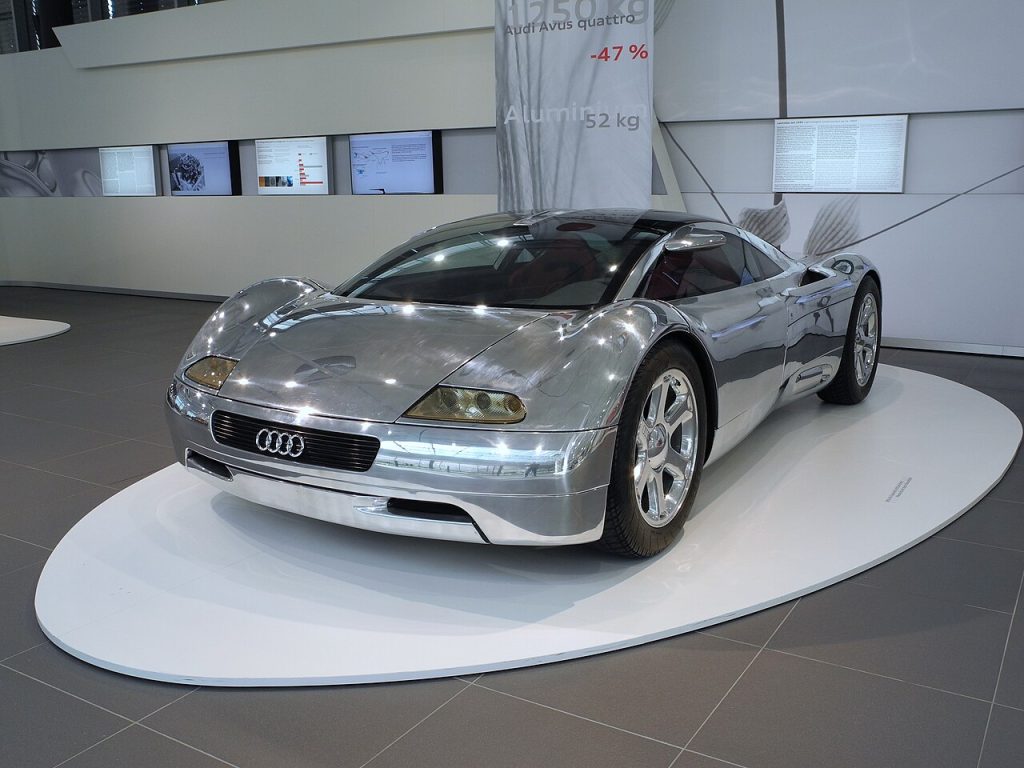
The Avus can be studied visually without inventing a road test. Its metallic surface makes reflections part of the body’s presentation: the surrounding room traces changes in curvature, and broad surfaces become easier to compare. A painted car could conceal or soften some of those transitions. In an editorial photograph, this means the lighting and camera angle can change a reader’s perception of the design substantially. A front three-quarter view explains the relationship between nose and cabin; a side view gives a more useful reading of the wheelbase and the placement of the occupants.
A concept in the Silver Arrow tradition
The Avus name and its historical styling invite comparison with Auto Union’s competition heritage, but visual homage is not race provenance. A useful comparison asks which ideas are carried forward: a low silhouette, a strong relationship between mechanical layout and body form, and a conspicuous metallic finish. Those observations belong to design analysis. They do not transfer a prewar car’s engine, victories or build count to the 1991 exhibit. The Auto Union Type C and Streamliner profiles offer the historical side of that comparison, with their own carefully separated object identities.
Avus quattro versus quattro Spyder
Audi treats both 1991 studies as part of its sports-car history. They are distinct archive subjects, not two names for the same prototype. Looking at them together is more informative than ranking them by speculative top speed. The Spyder offers a different scale and visual approach, while the Avus emphasizes an overt supercar statement. A reader should compare the photographs, published design objectives and packaging before comparing numbers. Shared corporate ambition does not mean that the two physical objects had interchangeable equipment or the same development path.
Where it fits before the R8
Audi’s R8 origin account places the 1991 concepts in the wider history of its mid-engine ambitions. The later Le Mans quattro makes a useful next step because the link to the production R8 is much more immediate. That sequence is best read as an evolving design conversation. It is not evidence that the Avus chassis became the R8 or that every proposed Avus technology survived unchanged. Keeping the stages separate helps a visitor understand why an early concept can matter even when it never becomes a saleable car.
Rarity and the one-off question
The workbook calls the Avus a one-off. The primary material reviewed here establishes a physical study and no retail series, but it does not provide a complete census of development objects, models and chassis. The exact production badge remains blank. This is an archive profile under the rare-concept category, not a production edition with a numbered allocation. A scale model, styling buck and full-size exhibit should not be added together as cars. If an object-specific inventory becomes available, its definition must accompany the number.
How to identify a photograph responsibly
The bundled photograph is source-identified as the Avus. It records the design’s appearance; it does not establish engine operation or a new chassis. Cataloguing multiple exhibition photos as different cars would create a misleading count. Compare distinctive body details and documented exhibition records, while remembering that transport, lighting and background changes are ordinary. The visible credit links back to the photograph’s source, allowing readers to check its description. A future replacement image should retain the same distinction between what the picture shows and what a factory archive establishes.
What an object record should contain
For a museum or collection file, preserve the original title, presentation date, dimensions where documented, construction description, movement history and condition report. Mechanical descriptions should identify whether a component is functional, a representation or absent. Record conservation work before calling a finish original. These are suggested documentation steps, not findings about the pictured car. A concept’s historical integrity can involve bodywork, cabin fittings and display features that a normal used-car inspection would overlook. The record should explain how those pieces support the object’s documented identity.
Why the Avus deserves attention
The strongest reason to study the Avus is the question it posed about Audi’s future. A heritage object does not need a retail price or a timed lap to reveal a turning point in a brand’s visual ambition. Compare it with the Rosemeyer for another approach to historical reference, then with Le Mans quattro for a later production-facing proposal. Together they give visitors a route through the collection that connects design, engineering intention and eventual road-car development. The Avus remains most compelling when those relationships are explained plainly.
Frequently asked questions
Was the Audi Avus quattro a production car?
No. It was a 1991 design study, not a retail supercar series.
Did the show car have a proven 509 PS W12?
Audi describes the intended W12 and its proposed rating. This profile does not claim that the exhibited object produced that output.
How many Avus quattro cars were made?
The inventory says one, but a complete primary object census was not established. The exact production field is left unset.
Is the Avus the same as the Audi R8?
No. It is an earlier concept in Audi’s sports-car history; the later Le Mans quattro has the more direct documented R8 connection.
Explore related vehicle profiles
Sources
- Audi Tradition — Forty years of quattro, historical show-car section
- Audi Tradition — Design Legends exhibition and dated concepts
- Audi — A sports car icon is born
History and published specifications follow the linked manufacturer records. Visual comparisons, documentation questions and inspection priorities are editorial analysis. Photographs retain their original subject descriptions and separate rights records.
Photography and credit
Audi Avus quattro design study, source-identified museum photograph. Displayed engine appearance does not establish a working W12. Photo: Hubert Berberich (HubiB) / Wikimedia Commons · Public domain (photographer release recorded on Commons). Wikimedia thumbnail resized from original; no cropping or color changes.
Why this machine matters
The Audi Avus quattro is a 1991 aluminum supercar design study that brought the visual language of the Silver Arrows into a modern Audi concept. Its polished body and dramatic proportions make it an important heritage object. The proposed W12 belongs to the concept specification; the show car must not be presented as a proven 509 PS production vehicle.
Built in limited numbers
The workbook calls the Avus a one-off. The primary material reviewed here establishes a physical study and no retail series, but it does not provide a complete census of development objects, models and chassis. The exact production badge remains blank. This is an archive profile under the rare-concept category, not a production edition with a numbered allocation. A scale model, styling buck and full-size exhibit should not be added together as cars. If an object-specific inventory becomes available, its definition must accompany the number.
Gallery
Specifications
Factory specifications may vary by model year, market and configuration.
Identity & production
- Official model
- Audi Avus quattro
- Base model
- Avus quattro
Powertrain & performance
- Engine
- Proposed W12; functioning installation not confirmed