Audi grandsphere concept
A 2021 electric luxury-sedan concept that puts the front-seat lounge at the centre of its design, with published dual-motor specifications and a Level 4 automated-driving vision.
A 2021 electric luxury-sedan concept that puts the front-seat lounge at the centre of its design, with published dual-motor specifications and a Level 4 automated-driving vision.
Audi grandsphere concept at a glance
| Manufacturer | Audi |
|---|---|
| Model / programme | grandsphere |
| Profile scope | Physical concept archive |
| Historical reference year | 2021 |
| Inventory reference | AUDI-071 |
| Engine reference | Published dual-motor electric concept architecture |
| Exact original object count | Unresolved; no numeric production badge populated |
| Manufacturer power reference | 530 kW |
| Manufacturer torque reference | 960 Nm; concept rating where applicable |
| Object scope | Source-identified physical concept exhibit; complete development-object census unresolved |
A luxury concept designed around the occupants
Audi introduced grandsphere at IAA 2021 as the second sphere study after skysphere. The proposition is unusually clear: redesign a luxury car around the time and space available to its occupants, rather than simply enlarge a conventional dashboard. That makes grandsphere useful to readers tracing Audi’s electric design thinking as well as to concept-car collectors. It is a physical study with a documented presentation history. It should be viewed in that context, with the manufacturer’s intended future functions kept separate from proof that an individual display vehicle could perform every described task in ordinary road traffic.
Proportions and the front-row lounge
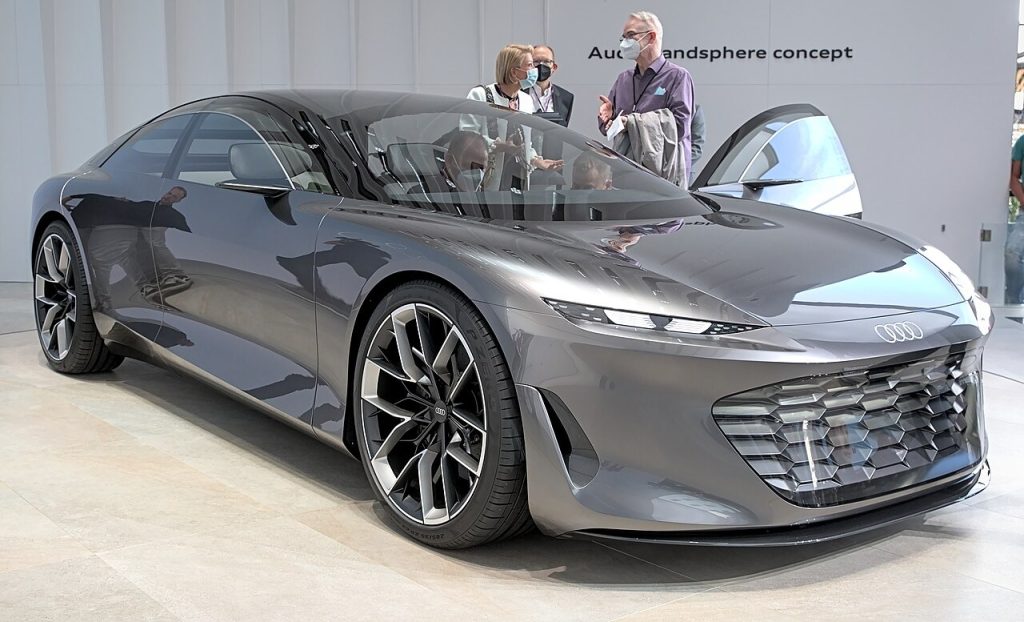
Audi’s published dimensions describe a 5.35-metre car with a 3.19-metre wheelbase and a 2+2 seating layout. The cabin proposal makes the front seats the principal relaxation area. The visual interest is the relationship between a long, low exterior and the space presented inside. Examine the side profile and open-door view together to see how much of the design argument depends on access and cabin continuity. A specification table explains the scale, but it cannot communicate whether a visitor finds the space inviting. The concept’s presentation photography therefore adds information that a list of measurements alone cannot supply.
Electric architecture: what the figures mean
Audi described a PPE-based layout, a battery around 120 kWh, two motors with a combined 530 kW and 960 Nm, and 800-volt charging technology. These are published concept references. They are useful for understanding the intended package, but they are not a current inspection certificate for the photographed exhibit. Nor should a later production Audi automatically receive these figures because it shares a platform name. An accurate technical record states the source and date of the concept specification, then treats installed equipment, demonstrated operation and homologated customer-model performance as separate questions requiring their own evidence.
Automated driving as a design premise
Level 4 automation is part of grandsphere’s design vision, including a cabin arrangement in which the steering wheel and pedals can recede from the occupants’ space. Describing that vision is different from stating that the car had validated unrestricted autonomous operation. A reader can still learn from the design experiment: if driving controls cease to dominate a trip, seating, sightlines and entertainment surfaces can be rearranged. The concept allows that question to be explored visibly. Keep the proposed operating scenario alongside the description so that a demonstration of cabin movement is not mistaken for a complete demonstration of autonomous driving capability.
The exterior and interior tell one story
Grandsphere’s long roofline and restrained surfaces encourage a reading of the car as a complete volume rather than a collection of aggressive styling pieces. In the cabin, the corresponding question is how technology can be present without making every surface resemble a screen. The most useful comparison is between the car at rest and the cabin in its different presentation states. Look at what remains visible, where controls would be reached and how the seats relate to the windows. These are editorial design observations, not a prediction that every element would pass unchanged into a showroom model or satisfy every user’s preference.
How rare is a physical concept?
The scarcity here concerns an identifiable concept programme and its physical exhibit, not a saleable customer edition. The reviewed manufacturer material does not establish a complete census of development bodies, static displays and running objects. Numeric customer-production fields therefore remain empty. The photograph confirms the source-identified grandsphere display at IAA 2021, but the number of photographs or appearances cannot be counted as the number of cars. A stronger object record would connect factory identifiers to build photographs and subsequent exhibitions. This distinction protects both the history and the meaning of rarity: a unique-looking study need not be assigned an unsupported production total to deserve an archive entry.
Grandsphere versus skysphere and urbansphere
The three names belong to a related design discussion, but they do not describe one body style in different trim levels. Skysphere focuses on a changing roadster experience, grandsphere presents a low luxury sedan and urbansphere explores a larger passenger environment. Compare the intended use, access, seating and exterior proportions before comparing the power figures. That approach reveals why the studies are complementary. It also prevents features from migrating between profiles, such as assigning skysphere’s variable wheelbase to grandsphere simply because both use the sphere name. Each concept needs its own dated technical and visual record.
Following the exhibit through the archive
An IAA photograph gives this profile a definite event reference. Later appearances should be added as later appearances, not treated as evidence of a new launch or a second car without supporting records. Preserve event dates, captions, photographer details and any changes in display configuration. If the same concept appears with doors or seats in a different position, explain the presentation state before assuming structural alteration. Such a timeline is valuable for researchers because concepts can be transported, reconfigured and re-photographed over several years. The archive should distinguish what the photograph shows from what only a workshop or custodial record could establish.
What to ask when researching a concept object
For a specific physical vehicle, request factory archive identification, custody history, engineering descriptions and a clear explanation of which systems operate. Ask whether its battery, controls or mechanical assemblies are original, replaced or display-only, and document the source of the answer. These questions are particularly important when an event description uses future-tense promises beside present-tense photographs. Ownership, availability, road-use approval and safe demonstration procedures cannot be inferred from a published power number. The profile supplies historical context; an object-level dossier would need the people responsible for the vehicle and the records that connect them to it.
Why grandsphere remains a useful Audi reference
The study provides a dated snapshot of Audi’s thinking about electric luxury, cabin space and the relationship between driving and being driven. Its value to the archive is that these ideas are embodied in a recognisable physical form that can be compared with earlier and later work. Read it alongside Audi’s concept heritage rather than announcing an inevitable production successor. If a later model shows similar details, explain the resemblance as an observation unless Audi confirms a direct development relationship. This allows the profile to remain useful even when product plans change, because its central subject is a documented design experiment from 2021.
Frequently asked questions
When did the Audi grandsphere debut?
Audi presented the electric luxury-sedan concept at IAA 2021, following the skysphere roadster study.
What power did Audi publish for grandsphere?
The concept description specifies two motors with 530 kW combined output and 960 Nm. These are concept references, not a current certification of the display object.
Was grandsphere a production model?
No customer production series is established by the cited concept records. Exact development-object counts remain unresolved.
Does the Level 4 description prove autonomous road capability?
No. It describes the intended design scenario. Verified operation, installed systems and road-use approval require separate evidence.
Explore related vehicle profiles
Sources
- Audi South Africa — First class toward the future
- Audi Japan — grandsphere concept launch, September 2021
History and published specifications follow the linked manufacturer records. Visual comparisons, documentation questions and inspection priorities are editorial analysis. Photographs retain their original subject descriptions and separate rights records.
Photography and credit
Audi grandsphere concept at IAA 2021. Photo: Alexander Migl / Wikimedia Commons · CC BY-SA 4.0. Resized without cropping or color alteration.
Why this machine matters
A 2021 electric luxury-sedan concept that puts the front-seat lounge at the centre of its design, with published dual-motor specifications and a Level 4 automated-driving vision.
Built in limited numbers
Physical 2021 concept retained as archive subject. Published battery, power and automated-driving descriptions are design references; no numeric production census or validated autonomy claim populated.
Gallery
Specifications
Factory specifications may vary by model year, market and configuration.
Identity & production
- Official model
- Audi grandsphere concept
- Base model
- grandsphere
Powertrain & performance
- Engine
- Published dual-motor electric concept architecture