Alpine Vision Concept
The Alpine Vision is the 2016 concept that brought Alpine’s road-car revival close to production. Revealed in Monaco, it translated Berlinette-inspired design into a modern mid-engined coupé and previewed the A110 launched the following year.
The Alpine Vision is the 2016 concept that brought Alpine’s road-car revival close to production. Revealed in Monaco, it translated Berlinette-inspired design into a modern mid-engined coupé and previewed the A110 launched the following year.
Alpine Vision Concept at a glance
| Manufacturer | Alpine |
|---|---|
| Model family | Vision |
| Profile scope | Concept archive |
| Inventory reference | ALP-060 |
| Engine reference | Turbocharged four-cylinder — 2016 concept announcement |
The concept between revival and production
The Alpine Vision occupies a specific point in the marque’s revival: later than the anniversary-led A110-50 and Celebration projects, but earlier than the production Première Edition. Renault Group unveiled it in Monaco on 16 February 2016. Its importance is the narrowing of the proposal toward a road car. In a collection, it helps explain how a revived brand moves from an evocative name and design exercise to a vehicle intended for customers. That role is more informative than describing it simply as another rare Alpine with a familiar blue badge.
Monaco and the Alpine setting
The reveal connected the concept with Monte Carlo and the Col de Turini, locations closely associated with Alpine’s rally identity. The setting communicated a relationship with the original Berlinette without making the Vision a historic rally car. A dated reveal account is useful because it distinguishes the concept’s public debut from its later exhibition appearances. For an archive display, pair that date with the project’s official name. The location adds context; it does not establish that the concept took part in a rally or earned a competition result.
How close was Vision to the road car?
Alpine’s July 2016 Le Mans Classic account described Vision as representing about 80 percent of the planned production car. This is a manufacturer description of design maturity, not a parts interchangeability measurement. It should not be read as proof that four-fifths of the displayed object’s components were production-ready. The useful conclusion is that Vision was a near-production preview. A comparison with the eventual A110 can show where the design carried through and where production requirements changed details, while retaining separate identities for the concept and customer cars.
The powertrain and performance target
The February reveal described a turbocharged four-cylinder engine developed through Renault Sport and a sub-4.5-second 0–100 km/h objective for the future production model. The target belongs to the announcement, rather than a independently verified test of the photographed exhibit. This profile therefore avoids importing later A110 displacement, power and acceleration figures as though they automatically describe Vision. A concept’s installed engine specification needs its own documentation. Keeping the target in the article and leaving unsupported physical specification fields blank preserves that distinction.
Reading the design as a collector
The Vision invites comparison through proportions, lamp treatment, glass area, roofline and the relationship between the cabin and engine compartment. These are visible design observations, not evidence of hidden construction. Compare the concept with the preceding Celebration and the production Première Edition rather than judging it only against an original A110. The sequence shows changing priorities as the proposal approached manufacture. A collector interested in design development can find significance in a small altered detail, particularly when dated project material explains why the change was made.
Production and rarity
The inventory lists one Vision concept, but the reviewed public presentation records do not supply a complete census of physical models, running objects or related development bodies. The generic completed-production field is therefore unset. Vision remains a concept archive profile with a verified project identity. An exact one-off claim should be supported by an object-level account that defines what was counted. This avoids confusing a named show car with every anonymous prototype used to develop the production A110, which belongs to a much wider engineering programme.
Vision is not Vision Gran Turismo
The names are similar, but the projects are different. Alpine Vision is the 2016 coupé preview connected with a future road car. Vision Gran Turismo is the earlier virtual-car project represented by a full-size display model. Their shape, purpose and evidence should remain separate. A shortened caption saying only Alpine Vision can cause a photograph or a technical claim to migrate between them. Use the full project name and year in a catalogue, especially where both appear in the same revival timeline or website collection.
Building a physical-object history
For a claimed original Vision object, assemble project records, fabrication information, event custody documents and restoration or display work records. Establish how the physical object is identified between appearances. A public photograph proves a presentation at a particular place and time, but does not prove continuity of every hidden component. Where an object changed for running demonstrations or exhibition use, document the change. A coherent history can explain an evolving concept honestly without assuming that every later appearance shows an untouched February 2016 object.
What to preserve during conservation
Record the body finish, lights, glazing, cabin, controls and supporting structure before undertaking work. Concept components may have been made for presentation rather than long-term customer use. Their material and fabrication history can be worth preserving even when they differ from the production A110. Establish whether the conservation objective is to retain the reveal presentation, a later event configuration or evidence of the project’s use over time. Keep photographs and removed material where practical, so that future custodians can understand which design evidence survives.
A useful exhibition comparison
Display Vision with the original Berlinette, Celebration and Première Edition to connect heritage, exploration, near-production preview and customer launch. Use dated photographs and a few precise labels to explain the sequence. A visitor should be able to understand why the concept mattered without assuming that it shares all the later road car’s specifications. The comparison also prevents numerical rarity from becoming the only story. Vision is valuable as an identifiable design milestone, even while a lifetime physical-object count remains unresolved.
The photograph supplied here
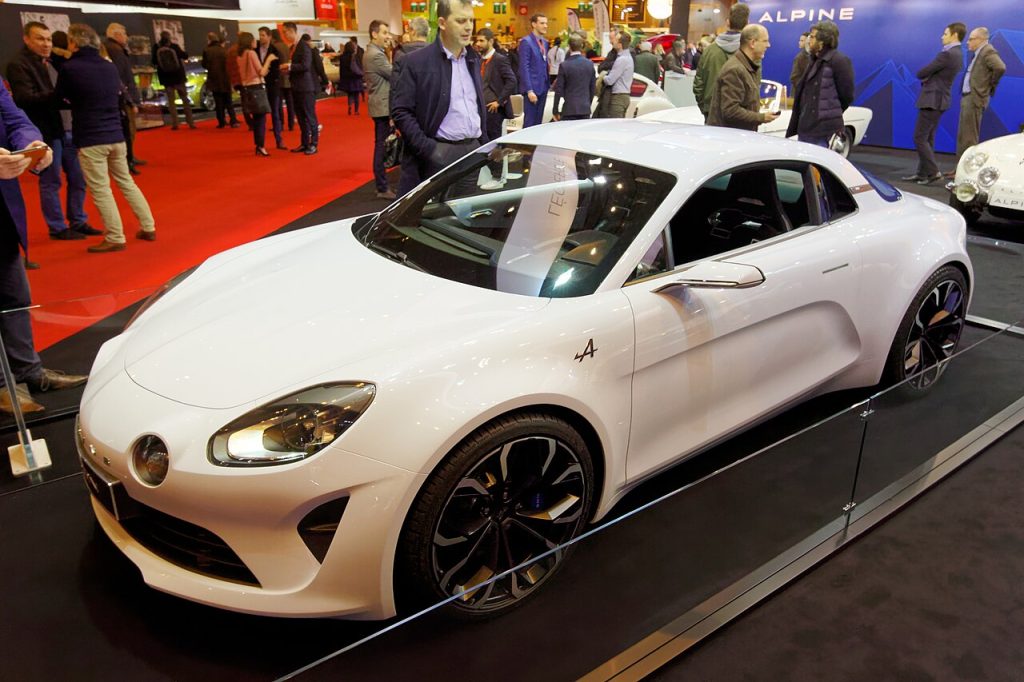
The bundled image shows the 2016 Vision concept displayed at Rétromobile in 2017. The later exhibition date is retained in the caption. It does not move the reveal year forward or identify the exhibit as a production Première Edition. The source record, photographer and licence are linked visibly. For a detailed object history, additional views of identification and fabrication evidence would complement this public-facing photograph. Its purpose here is to show the near-production concept’s appearance, without making an unsupported claim about its running condition or internal hardware.
Frequently asked questions
When was the Alpine Vision revealed?
Renault Group unveiled the Alpine Vision in Monaco on 16 February 2016. The supplied photograph records a later Rétromobile appearance.
Is Vision the same as Vision Gran Turismo?
No. Vision is the 2016 road-car preview; Vision Gran Turismo is the 2015 virtual-car project with a full-size exhibit.
Was the concept 80 percent identical to the production A110?
Alpine described it as representing about 80 percent of the planned production car. That is a design-development statement, not a verified component-sharing ratio.
How many physical Vision objects existed?
The reviewed sources do not establish a comprehensive physical-object census. The inventory’s one-off label is not entered as an unqualified completed-production total.
Explore related Alpine profiles
Sources
- Renault Group: Alpine Vision revealed in Monaco, February 2016
- Alpine: Vision at Le Mans Classic, July 2016
- Alpine: Vision at Goodwood, June 2016
Historical statements follow the linked manufacturer and competition-programme records. Inspection and collecting guidance is editorial analysis. Individual catalogue claims remain attributed to the relevant car and source.
Photography and credit
Alpine Vision concept displayed at Rétromobile in 2017; the 2016 road-car preview, distinct from Vision Gran Turismo. Photo: Thesupermat / Wikimedia Commons · CC BY-SA 4.0. Wikimedia thumbnail resized from the original; no cropping or colour changes.
Why this machine matters
The Alpine Vision is the 2016 concept that brought Alpine’s road-car revival close to production. Revealed in Monaco, it translated Berlinette-inspired design into a modern mid-engined coupé and previewed the A110 launched the following year.
Built in limited numbers
The inventory lists one Vision concept, but the reviewed public presentation records do not supply a complete census of physical models, running objects or related development bodies. The generic completed-production field is therefore unset. Vision remains a concept archive profile with a verified project identity. An exact one-off claim should be supported by an object-level account that defines what was counted. This avoids confusing a named show car with every anonymous prototype used to develop the production A110, which belongs to a much wider engineering programme.
Gallery
Specifications
Factory specifications may vary by model year, market and configuration.
Identity & production
- Official model
- Alpine Vision Concept
- Base model
- Vision
Powertrain & performance
- Engine
- Turbocharged four-cylinder — 2016 concept announcement