Alpine A480
The Alpine A480 brought Alpine into the FIA World Endurance Championship’s Hypercar category in 2021. Its Oreca-developed chassis and Gibson V8 belong to a competition programme spanning 2021 and 2022, with a history that must be distinguished from later Alpine prototypes.
The Alpine A480 brought Alpine into the FIA World Endurance Championship’s Hypercar category in 2021. Its Oreca-developed chassis and Gibson V8 belong to a competition programme spanning 2021 and 2022, with a history that must be distinguished from later Alpine prototypes.
Alpine A480 at a glance
| Manufacturer | Alpine |
|---|---|
| Model family | A480 |
| Profile scope | Competition archive |
| Inventory reference | ALP-072 |
| Engine reference | Gibson Technology 4.5-litre V8 — 2021 programme reference |
A new category and a distinct Alpine chapter
Alpine revealed the A480 for its 2021 World Endurance Championship campaign. The car carried Alpine into the new Hypercar category, following the marque’s preceding endurance programme. Category terminology is essential here: competing in Hypercar does not make the A480 a road-going hypercar or establish that it was designed to the same construction rules as every rival in the class. This is a competition archive profile. Its significance is the identifiable programme and its place in Alpine’s endurance chronology, rather than a customer road-car production run.
The chassis and powertrain reference
Alpine’s launch describes an Oreca-developed chassis powered by a 4.5-litre V8 supplied by Gibson Technology, with Michelin tyres. These details identify the programme’s principal technical architecture. They should not be replaced by specifications from the later A424 or by assumptions based on the appearance of another Alpine prototype. A racing specification also needs its date and regulatory context. The launch reference is not a permanent horsepower guarantee for every session, because technical regulations and event preparation can affect the configuration used in competition.
The 2021 team identity
The launch names Nicolas Lapierre, André Negrão and Matthieu Vaxiviere as the driver line-up under the Alpine Elf Matmut Endurance Team identity, with Philippe Sinault leading the programme. Team names and sponsor presentation help date photographs, but they do not establish a unique chassis identity by themselves. An individual vehicle history needs build records and entry documentation linked to the physical car. Preserve the programme-level story in the model profile, then attach particular results only where that additional identity evidence is available.
An early Hypercar-class podium
Alpine recorded an A480 podium at the opening Spa round in May 2021. This provides a dated competition milestone after the reveal, rather than merely an intention to race. A result belongs to its event and class. When describing an individual surviving chassis, connect it to the event through the appropriate records instead of assigning the team’s entire season to any car wearing the same livery. A carefully scoped milestone is still meaningful: it shows the programme operating competitively in the new category.
The programme through 2022
Alpine’s November 2022 Bahrain preview recalls the 2021 Le Mans podium and the 2022 victories at Sebring and Monza. It places the A480 near the end of its premier-category programme, before a transitional season and a later new prototype. These dated achievements give the model a clear competition narrative across two years. They do not establish that every body, tub or display vehicle associated with the programme competed in all those events. Preserve the distinction between the A480’s collective history and the documented career of a particular physical car.
Production and chassis counting
The reviewed releases do not establish a reconciled lifetime census of A480 chassis, spare structures, rebuilt cars and exhibition objects. A single race entry does not mean a single physical chassis existed. Conversely, a spare body or display assembly is not automatically a separately manufactured racing car. The completed-production field is therefore unset. A meaningful census would define what counts as an A480 and trace identity through repairs and replacements. The model remains a verified competition programme while its exact physical-object total requires further evidence.
An identity file for an endurance prototype
Begin with constructor identification, team custody, technical logs, event entries and repair records. Tie dated photographs to configuration and chassis identity where possible. A reused number or familiar livery can make different objects appear continuous, so neither should serve as the sole identifier. Ask for a clear account of replacements affecting the structure and major assemblies. The resulting history should allow another specialist to understand which evidence belongs to the original racing tub, which belongs to later components and which records remain unavailable.
Configuration should be dated
Endurance cars evolve through testing, race preparation and regulation changes. Record the installed aerodynamic package, engine and transmission assemblies, electronics, safety equipment and relevant body work at a stated date. A car preserved in its final racing presentation may differ from the reveal configuration while remaining historically meaningful. Avoid describing an unspecified restoration as original specification. Define whether the chosen display represents an actual event, the last competitive state or an earlier milestone, and retain the records that support that choice.
Structure and mechanical condition
A prototype requires inspection by specialists who understand its structure and service requirements. Review repair documentation, component service history, operating records and the condition of major assemblies. Cosmetic preparation can conceal how much work remains before operation. A stationary display, a controlled demonstration and competitive running require different levels of preparation and support. Establish the intended role before assessing readiness. A valuable competition history does not itself certify current mechanical condition, and a rebuilt car’s capability does not prove an advertised historic result.
Preservation of the competition record
Keep technical logs, race documentation, photographs and removed parts together where possible. These can explain engineering changes and make a restoration more legible. If historic material cannot remain installed for an intended activity, record why it was replaced and retain the connection to the car. A competition object carries information beyond its exterior livery. Marks of use, repair choices and dated assemblies can help interpret its working life when documented carefully. Preservation should support that interpretation rather than erase every trace in pursuit of a generic fresh appearance.
Comparing A480 with earlier Alpine endurance cars
A collection spanning the A441, A442 family and A480 can show distinct approaches to Alpine endurance competition. Compare period purpose, technical architecture and documented results, rather than treating the A480 as a direct continuation of every earlier chassis detail. Its modern category context needs its own explanation. The historical connection is the marque’s endurance ambition, while the physical cars belong to different regulations and programmes. That relationship makes the A480 useful in an exhibition without collapsing several decades of engineering into a single specification.
The Bahrain race photograph
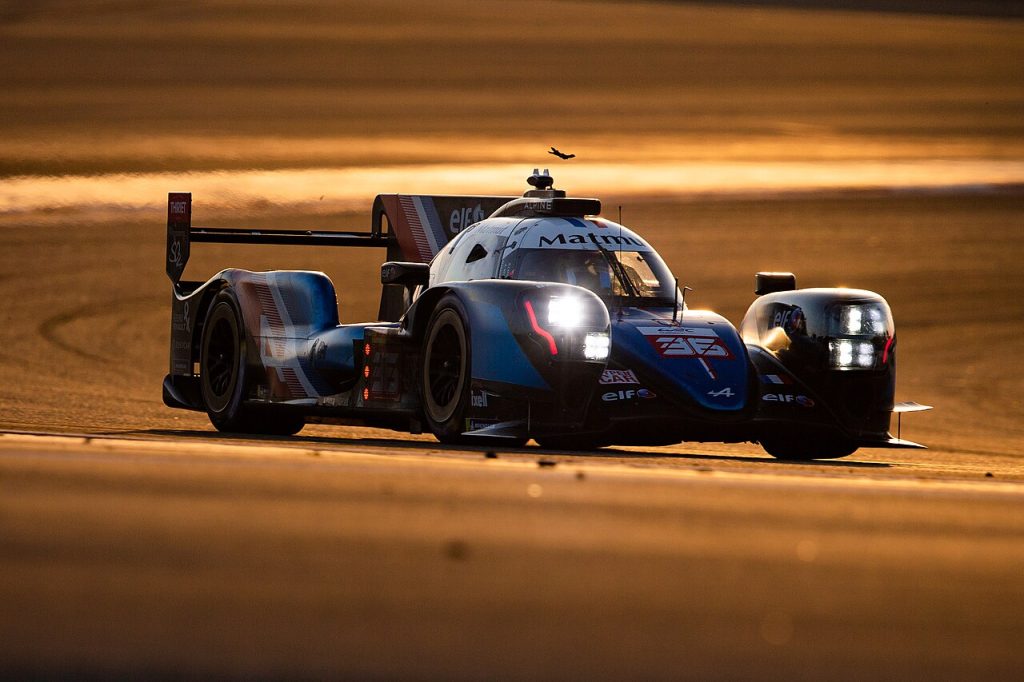
The bundled licensed image records an A480 of Alpine Elf Matmut at the 2021 FIA WEC 8 Hours of Bahrain. Its event and year are kept in the caption, so it is not mistaken for the following season’s Bahrain finale or a Sebring-winning appearance. The photograph illustrates the actual competition model. It does not supply a chassis number or establish that a later offered object is the same car. Linked photographer and licence information accompanies the image visibly in the profile and its media record.
Frequently asked questions
Was the A480 a road car?
No. It was an endurance competition prototype entered in the FIA WEC Hypercar category.
What engine does the launch source describe?
The official reference is a Gibson Technology 4.5-litre V8 in an Oreca-developed chassis.
Did the A480 compete only in 2021?
No. Alpine’s 2022 records describe its continued programme and wins at Sebring and Monza that season.
Does one team entry prove only one chassis existed?
No. Entries, spare structures, repaired cars and display objects require a defined physical census. No exact total is asserted here.
Explore related Alpine profiles
Sources
- Alpine: A480 revealed for the 2021 FIA WEC season
- Alpine: A480 first Hypercar-class podium at Spa, May 2021
- Alpine: A480 championship context, Bahrain 2022
Historical statements follow the linked manufacturer and competition-programme records. Inspection and collecting guidance is editorial analysis. Individual catalogue claims remain attributed to the relevant car and source.
Photography and credit
Alpine A480 of Alpine Elf Matmut at the 2021 WEC 8 Hours of Bahrain; competition photograph, not a chassis build census. Photo: Kobokem2021 / Wikimedia Commons · CC BY-SA 4.0. Wikimedia thumbnail resized from the original; no cropping or colour changes.
Why this machine matters
The Alpine A480 brought Alpine into the FIA World Endurance Championship’s Hypercar category in 2021. Its Oreca-developed chassis and Gibson V8 belong to a competition programme spanning 2021 and 2022, with a history that must be distinguished from later Alpine prototypes.
Built in limited numbers
The reviewed releases do not establish a reconciled lifetime census of A480 chassis, spare structures, rebuilt cars and exhibition objects. A single race entry does not mean a single physical chassis existed. Conversely, a spare body or display assembly is not automatically a separately manufactured racing car. The completed-production field is therefore unset. A meaningful census would define what counts as an A480 and trace identity through repairs and replacements. The model remains a verified competition programme while its exact physical-object total requires further evidence.
Gallery
Specifications
Factory specifications may vary by model year, market and configuration.
Identity & production
- Official model
- Alpine A480
- Base model
- A480
Powertrain & performance
- Engine
- Gibson Technology 4.5-litre V8 — 2021 programme reference