Alpine A110 GT4
The Alpine A110 GT4 took the revived A110 into customer racing against other manufacturers. Revealed in 2018 and developed by Signatech, it has a history that must distinguish original GT4 cars, Cup conversions and the later GT4 Evo.
The Alpine A110 GT4 took the revived A110 into customer racing against other manufacturers. Revealed in 2018 and developed by Signatech, it has a history that must distinguish original GT4 cars, Cup conversions and the later GT4 Evo.
Alpine A110 GT4 at a glance
| Manufacturer | Alpine |
|---|---|
| Model family | A110 II |
| Profile scope | Competition archive |
| Inventory reference | ALP-064 |
| Engine reference | Competition turbocharged four-cylinder; specification depends on configuration |
The second racing branch of the modern A110
Alpine unveiled the A110 GT4 at Geneva in March 2018 after announcing the Cup the previous year. The distinction is sporting as well as mechanical. Cup supported a one-make championship; GT4 placed the Alpine in a category shared with other manufacturers. A collection can use the two cars to explain how the road A110’s architecture supported different competition objectives. A GT4 therefore deserves its own identity rather than being catalogued as a road A110 with a large wing or as a generic Cup upgrade without documentation.
The original introduction and early racing
The 2018 manufacturer announcement planned limited racing appearances during the second half of that year, followed by production ahead of the 2019 season. Alpine subsequently documented the GT4’s French Championship debut in July 2018. Keep these milestones separate: public reveal, first appearances and customer production are different dates. For a particular chassis, its build and first race may fall later than the model’s introduction. A 2018 inventory year identifies the programme’s origin, not necessarily the year of manufacture of every surviving car.
How GT4 differed from the Cup
Alpine described the GT4 as having more engine power and aerodynamic downforce than the Cup, with development and support from Signatech. That comparison establishes the direction of the changes without providing a universal output for every configuration. GT4 eligibility and performance depend on the applicable technical framework and specification. Use the correct dated documents when describing an individual car. A headline power figure from a later update should not be copied backwards into the original 2018 car or assumed to apply unchanged at every event.
Cup conversion is part of the history
The launch proposition included a kit to upgrade an A110 Cup to GT4 specification. A car may therefore have a Cup build identity, a conversion record and a subsequent GT4 career. Those chapters belong in one coherent history file. The conversion does not automatically create another newly manufactured chassis. Ask which components were changed, when the work took place and which documents support the current specification. This matters for both authenticity and production arithmetic, especially if a proposed census mixes model labels without tracking the underlying cars.
Production and rarity
The reviewed sources do not establish a completed global total for A110 GT4 manufacture. Race grids, customer deliveries reported for one period and Cup conversions answer different questions. No exact production or survivor field is filled here. The model is retained as a competition archive entry with verified identity and documented programme significance. A stronger numerical claim would require a chassis census separating new GT4 builds from converted Cups and recording how later Evo changes are counted. Until then, precise configuration history is more useful than an unsupported global number.
Original GT4 versus GT4 Evo
Alpine’s December 2024 account dates the GT4 Evo launch to 2022 and identifies updates to the gearbox, turbo and engine. That creates a clear boundary for a collector catalogue. A 2018 car later upgraded to Evo should have both stages recorded; a photograph of an Evo should not be used silently as an original-specification illustration. The development history may add interest when it is traceable. It becomes confusing when later performance and results are assigned to every earlier car without identifying the configuration that achieved them.
Results that need the right scope
The manufacturer’s 2024 account records the model’s 2018 GT4 International Cup success, a 2023 French FFSA GT Am title and a 2024 European Am Cup title for an Evo. These are useful programme achievements with distinct dates and categories. They do not prove that every GT4 chassis shares those results. A specific car’s claims need matching entrant, driver and chassis evidence. Preserve class labels rather than turning an Am-category title into an unrestricted overall championship claim. Accurate scope makes the achievements more credible.
Authentication and the technical file
Start with build identification, technical records and the chain of ownership or team custody. Link race appearances to dated liveries and documented configuration changes. Ask for repair and conversion records, including work that affected the structure or major mechanical assemblies. A current race number is not a permanent identifier. If an advertised history contains a famous result, establish which records connect it to the offered chassis. The file should let a reader follow the car through its racing career rather than presenting disconnected photographs as a complete provenance.
Inspection after competition use
Have a specialist assess the aluminium structure, cage, suspension mountings and recorded repairs. Review whether work was completed to the relevant constructor and technical requirements. Photographs taken during repair can be more informative than the finished paint surface. Mechanical inspection should consider engine, turbo, gearbox, differential, cooling and brakes against the installed configuration. Record operating hours where available and ask how they were tracked. A race car’s cosmetic condition and mechanical readiness can differ substantially, so each needs a separate assessment.
Eligibility and operating support
A historic or club event, a demonstration and a contemporary GT4 championship may impose different requirements. Confirm the car’s eligibility and safety preparation with the intended organizer and the specialists responsible for its support. The original announcement does not establish continuing approval years later. Keep current technical documentation, component service records and safety-equipment information together. A car preserved for display may not need the same preparation as one intended for racing, but its catalogue should make the chosen role clear.
Collecting a GT4 with a coherent story
Choose an example for the history you can document and the activity you intend, rather than treating every upgraded part as a reason to prefer it. An original early configuration, a well-recorded Cup conversion and a later Evo can each tell a worthwhile story. Their comparison depends on identity, completeness and the quality of evidence. Preserve original components where practical when a car changes specification. A careful development file allows the technical evolution to be understood without making the earliest configuration disappear from the record.
The licensed model photograph
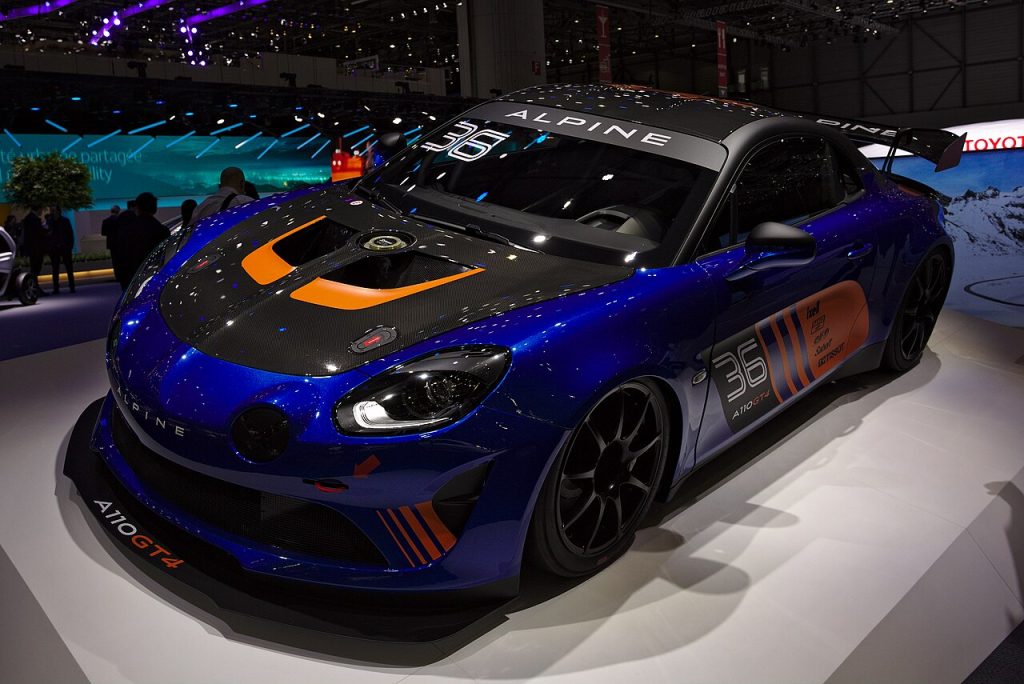
The supplied image is identified as an Alpine A110 GT4 in its source. The caption records the event or display date rather than implying a title-winning chassis identity. It provides a clear illustration of the GT4 subject, while the manufacturer sources establish the programme history. For a feature about an individual competition car, add build-identification views and documentation of its repairs and upgrades. The general image and a chassis history serve related but different purposes; neither should be allowed to stand in for the other.
Frequently asked questions
When was the A110 GT4 introduced?
Alpine revealed it at Geneva in March 2018, with early racing appearances later that year and customer production planned ahead of 2019.
Can an A110 Cup have a GT4 history?
Yes. Alpine announced a Cup-to-GT4 conversion kit. The original build and conversion should be documented as one chassis history.
Is the GT4 Evo the original 2018 specification?
No. Alpine dates the Evo launch to 2022 and identifies gearbox, turbo and engine updates.
How many GT4s were manufactured?
A reconciled new-build and conversion census is not established here. No race-grid count is entered as completed production.
Explore related Alpine profiles
Sources
- Alpine: Pure, Légende and GT4 reveal, March 2018
- Alpine: A110 GT4 French Championship debut, July 2018
- Alpine: GT4 European Series title and Evo development, December 2024
- Alpine: A110 Cup launch and technical specification, October 2017
Historical statements follow the linked manufacturer and competition-programme records. Inspection and collecting guidance is editorial analysis. Individual catalogue claims remain attributed to the relevant car and source.
Photography and credit
Alpine A110 GT4 displayed at Geneva in 2018; contemporary model presentation, not proof of an individual racing history. Photo: Alexander Migl / Wikimedia Commons · CC BY-SA 4.0. Wikimedia thumbnail resized from the original; no cropping or colour changes.
Why this machine matters
The Alpine A110 GT4 took the revived A110 into customer racing against other manufacturers. Revealed in 2018 and developed by Signatech, it has a history that must distinguish original GT4 cars, Cup conversions and the later GT4 Evo.
Built in limited numbers
The reviewed sources do not establish a completed global total for A110 GT4 manufacture. Race grids, customer deliveries reported for one period and Cup conversions answer different questions. No exact production or survivor field is filled here. The model is retained as a competition archive entry with verified identity and documented programme significance. A stronger numerical claim would require a chassis census separating new GT4 builds from converted Cups and recording how later Evo changes are counted. Until then, precise configuration history is more useful than an unsupported global number.
Gallery
Specifications
Factory specifications may vary by model year, market and configuration.
Identity & production
- Official model
- Alpine A110 GT4
- Base model
- A110 II
Powertrain & performance
- Engine
- Competition turbocharged four-cylinder; specification depends on configuration