Alpine A110 Cup
The Alpine A110 Cup is the purpose-built customer racer introduced in 2017 for the revived Alpine Europa Cup. It uses the road A110’s lightweight architecture as the basis for a dedicated competition package, with a sequential transmission, safety cage and series-specific preparation.
The Alpine A110 Cup is the purpose-built customer racer introduced in 2017 for the revived Alpine Europa Cup. It uses the road A110’s lightweight architecture as the basis for a dedicated competition package, with a sequential transmission, safety cage and series-specific preparation.
Alpine A110 Cup at a glance
| Manufacturer | Alpine |
|---|---|
| Model family | A110 II |
| Profile scope | Competition archive |
| Inventory reference | ALP-061 |
| Engine reference | Rear-mid-mounted 1.8-litre competition four-cylinder — original Cup specification |
A customer-racing branch of the revived A110
Alpine announced the A110 Cup on 26 October 2017, shortly before the first Première Edition deliveries. The car was intended to race from 2018 in the Alpine Europa Cup. This gives it a different identity from a road car taken to a casual track day. The Cup was developed as a competition product with a particular sporting setting and support structure. For a collector, that purpose matters because it shapes both the equipment and the history file required to understand a surviving car.
Signatech and the one-make programme
Alpine entrusted design, development and sales to Signatech within the manufacturer’s framework. A one-make car is valuable partly because it records the relationship between a controlled specification and driver competition. Its historical interest is not limited to the number of road-car components it retains. Record the series, entrant and driver history of an individual car alongside any later changes. A Cup used outside its original championship may remain a genuine Cup, but its present specification and sporting history should be explained rather than assumed.
The original Cup specification
The launch technical table gives an aluminium monocoque and body, a multi-point roll cage, a rear-mid-mounted 1.8-litre four-cylinder engine rated at 270 horsepower, rear-wheel drive and a 3MO six-speed sequential gearbox. It also specifies a limited-slip differential and a weight of approximately 1,050 kg. These are original programme references. They do not automatically describe every later Cup configuration or upgrade. Match the actual car with the correct technical documentation before treating a quoted launch figure as its current specification.
Why the sequential transmission matters
The Cup’s transmission is part of a competition package rather than a simple badge change. A sequential racing gearbox requires its own service records and operating procedures. When assessing a car, ask for rebuild history, recorded running hours and the specification of the unit installed. Keep this evidence separate from the road A110’s transmission identity. A replacement gearbox of the correct type may be appropriate for use without being the original assembly. The history file should explain that distinction and identify any later upgrades.
Production and rarity
No complete A110 Cup manufacturing total is established by the reviewed sources. The number of cars entered in a season does not provide it: cars can race repeatedly, change teams, be held as spares or receive conversion work. This profile therefore retains the Verified model identity as a competition archive entry, with the exact production field unset. An individual chassis should be researched through its build record and racing history. A current championship grid size is not entered as a global completed count or a survivor census.
Cup-to-GT4 conversion and overlapping counts
Alpine’s 2018 GT4 announcement offered a kit allowing a Cup to be upgraded to GT4 specification. This creates an important identity and counting question. A converted car may have an early Cup history and a later GT4 career on the same underlying chassis. Do not count it automatically as two newly manufactured cars. Its catalogue should describe the original build and the documented conversion. This is one reason programme totals need a chassis-based census rather than adding every model designation found in race-entry lists.
What the competition file should show
Look for the original build identity, technical passport or equivalent records, dated race entries, driver and entrant names and major repair documentation. Include unsuccessful events and testing where they affected the car’s development or condition. Race numbers and liveries can change between meetings. Use them as dated presentation evidence rather than permanent identifiers. A convincing file connects the physical car with the recorded history through more than its current paint scheme, particularly if it passed through several teams or was rebuilt after an incident.
Inspection of structure and repairs
A specialist should examine the aluminium structure, cage installation, mounting points and repair history against the applicable documentation. Ask which repairs were carried out by the constructor or an approved specialist and which records support them. A freshly finished race car may conceal significant earlier damage, while a visibly used car may have an exceptionally clear repair history. Assess the quality and traceability of the work rather than relying on appearance alone. Document findings before deciding whether the car is suitable for the intended activity.
Mechanical condition for modern use
Review engine and gearbox service, differential condition, cooling, brakes and suspension with a preparer who knows the installed specification. Obtain running-hour and maintenance records where available. Check how storage or changes of ownership affected the service programme. A car that starts and moves has not thereby demonstrated readiness for a full racing weekend. The inspection should establish which components need examination, replacement or scheduled service. Historical authenticity and mechanical readiness are separate questions, and each needs evidence appropriate to the actual car.
Safety equipment and event eligibility
Check the cage documentation, fuel system, seat, harness and fire equipment against the requirements of the proposed event. Eligibility depends on the current organizer’s rules and the car’s recorded specification, so the original launch announcement cannot determine it by itself. A Cup suitable for a demonstration may need further work for a championship. Keep records of safety-related replacements, including items that change over time. Describe the current preparation honestly rather than assuming a car remains event-ready because it once competed in the original series.
Cup, GT4 and Rally in a collection
The three customer-racing branches show how the same road-car architecture was adapted to different sporting purposes. Cup emphasizes a one-make environment; GT4 competes in a category with other manufacturers; Rally addresses special-stage demands. The comparison works best when each retains its own transmission, suspension, aero and safety context. A collector can choose a car for its individual career or for the technical story it illustrates. Neither a familiar body shape nor a more powerful specification alone establishes which car has the most coherent historical record.
The credited 2018 photograph
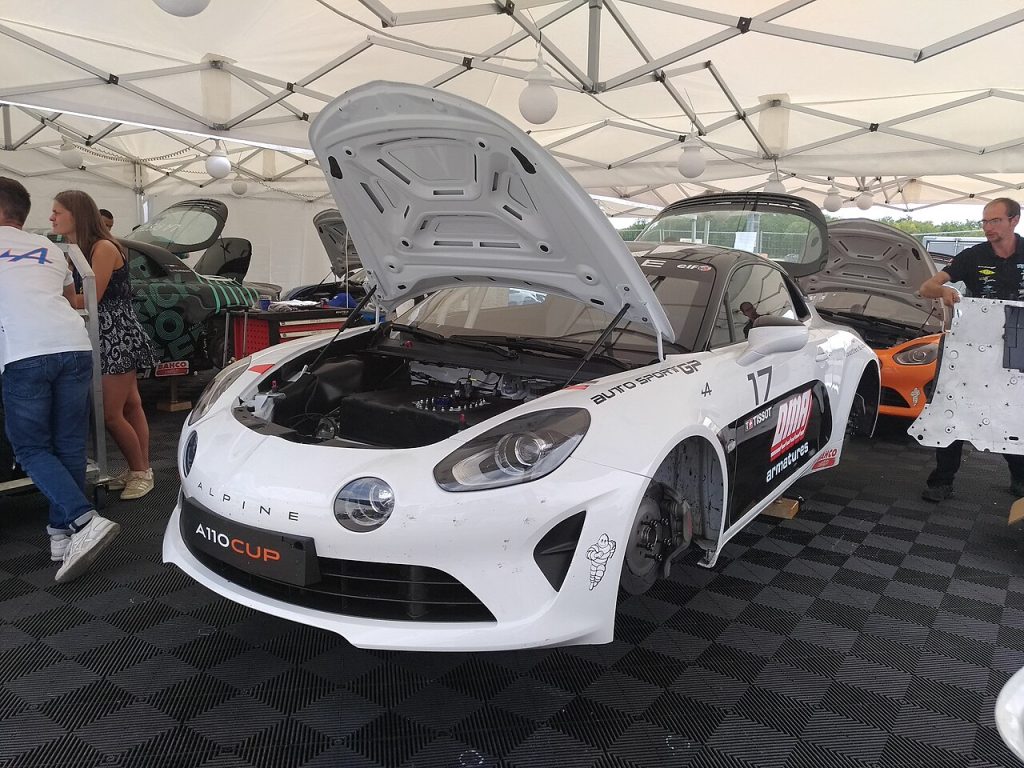
The supplied photograph identifies an A110 Cup in 2018 and shows a customer competition example. It is not claimed as a particular championship-winning chassis. Its source and licence are retained visibly even though the image is offered under a public-domain dedication. For an individual car profile, photographs of build identification, cage details and repair work should accompany the general exterior image. Those records can support provenance and condition claims that a public event photograph cannot answer on its own.
Frequently asked questions
Is the A110 Cup a road-car trim level?
No. The 2017 announcement describes a dedicated customer competition car for the Alpine Europa Cup.
What transmission did the original Cup use?
The launch specification lists a 3MO six-speed sequential gearbox. It should be kept separate from road-A110 transmission specifications.
Can a Cup become a GT4?
Alpine announced a Cup-to-GT4 upgrade kit in 2018. A converted car needs its original build and later conversion documented together.
How many Cups were built?
The reviewed sources do not provide a complete manufacturing census. Championship entries and conversions cannot be used as a substitute.
Explore related Alpine profiles
Sources
- Alpine: A110 Cup launch and technical specification, October 2017
- Alpine: Pure, Légende and GT4 reveal, March 2018
- Alpine: customer racing development, May 2019
Historical statements follow the linked manufacturer and competition-programme records. Inspection and collecting guidance is editorial analysis. Individual catalogue claims remain attributed to the relevant car and source.
Photography and credit
Alpine A110 Cup photographed in 2018; a representative customer competition car, not an authenticated chassis history. Photo: Guillaume Vachey from Chalon sur Saone, France / Wikimedia Commons · CC0. Wikimedia thumbnail resized from the original; no cropping or colour changes.
Why this machine matters
The Alpine A110 Cup is the purpose-built customer racer introduced in 2017 for the revived Alpine Europa Cup. It uses the road A110’s lightweight architecture as the basis for a dedicated competition package, with a sequential transmission, safety cage and series-specific preparation.
Built in limited numbers
No complete A110 Cup manufacturing total is established by the reviewed sources. The number of cars entered in a season does not provide it: cars can race repeatedly, change teams, be held as spares or receive conversion work. This profile therefore retains the Verified model identity as a competition archive entry, with the exact production field unset. An individual chassis should be researched through its build record and racing history. A current championship grid size is not entered as a global completed count or a survivor census.
Gallery
Specifications
Factory specifications may vary by model year, market and configuration.
Identity & production
- Official model
- Alpine A110 Cup
- Base model
- A110 II
Powertrain & performance
- Engine
- Rear-mid-mounted 1.8-litre competition four-cylinder — original Cup specification