Alpine A442B Le Mans Winner
The Renault-Alpine A442B won the 1978 24 Hours of Le Mans with Jean-Pierre Jaussaud and Didier Pironi. This profile follows that winning configuration and its place in Alpine history, keeping the single celebrated car separate from the wider A442 production programme.
The Renault-Alpine A442B won the 1978 24 Hours of Le Mans with Jean-Pierre Jaussaud and Didier Pironi. This profile follows that winning configuration and its place in Alpine history, keeping the single celebrated car separate from the wider A442 production programme.
Alpine A442B Le Mans Winner at a glance
| Manufacturer | Alpine |
|---|---|
| Model family | A442B |
| Profile scope | Competition archive |
| Inventory reference | ALP-039 |
| Engine reference | Turbocharged competition V6 — Renault museum heritage reference |
| Displacement | 1996 cc — scoped heritage specification |
The Alpine that won overall
On 10–11 June 1978, the A442B delivered the overall Le Mans victory associated with Renault-Alpine’s endurance campaign. Jean-Pierre Jaussaud and Didier Pironi were the winning drivers. This result is the central fact of the profile and should retain its exact scope: the event, year, driver pairing and A442B designation. Earlier Alpine class wins and the A441’s European title are different achievements. Preserving those distinctions gives each model its own history and prevents the familiar yellow winning car from becoming a shorthand for every prototype the marque raced.
An achievement built through development
The winning car followed years of work across the A440, A441 and A442 lineage. Its significance lies partly in the transformation of performance into endurance. A car has to survive the race, not merely demonstrate speed over a lap. For a collector display, show the earlier development stages alongside the eventual result. That makes the 1978 victory easier to understand without assuming that every predecessor had the same engine, aerodynamics or racing role. The A442B is a culmination within that programme, with an identity that deserves more precision than a generic A442 label.
The bubble cockpit treatment
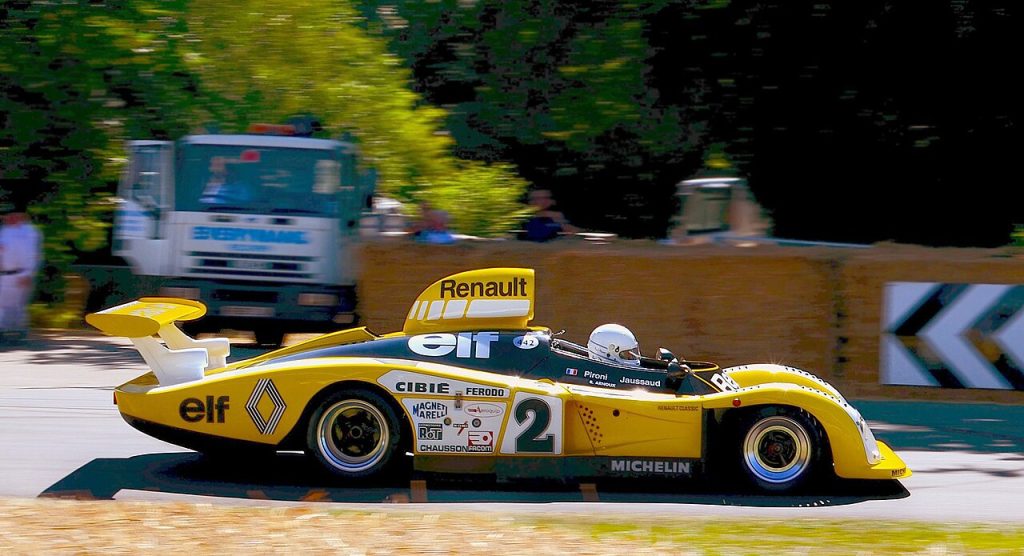
Renault’s museum highlights the A442B’s transparent cockpit bubble as an aerodynamic device and discusses the severe heat experienced by its drivers. This makes the cockpit treatment part of the car’s historical significance, not just a striking visual feature. A museum photograph taken decades later may show a presentation chosen for display rather than every detail used during the race. When assessing a restoration, ask which dated configuration the cockpit represents and what evidence supports it. Do not reconstruct a whole race specification from one modern front-view image.
Engine figures with a source label
The Originals Renault Museum lists a turbocharged V6 of 1,996 cc and 500 horsepower for the A442B. These are historical reference figures, not a current engine test. The museum page contains some awkward translations and dimensional entries, so this profile does not import every field automatically. A surviving car’s engine installation needs its own identification and build documentation. Record the operating specification used for modern demonstrations separately from the heritage figures, especially where changes were made to protect components or improve reliability.
Production and rarity
This inventory row represents the winning A442B configuration and a single celebrated winning car. It is not an independent batch of customer vehicles and must not be added to the A442 programme as a new production allocation without a chassis census. Renault’s museum describes a single model, while the wider lineage includes cars and conversions with different histories. The numeric completed-production field stays unset to avoid misleading family arithmetic. The profile’s rarity is the singular historical achievement and identified configuration; it does not claim that only one related Alpine endurance chassis ever existed.
The A443’s separate role in 1978
Alpine’s Le Mans Classic account explains that the A443 of Jean-Pierre Jabouille and Patrick Depailler led during the race before retiring with engine failure. The A442B then took the victory. Both cars belong in the story, but their driver pairings and results must remain separate. The faster or more powerful specification in a programme is not automatically the winning one. This comparison is useful for explaining endurance racing to visitors and for keeping a collection catalogue accurate when it contains more than one yellow Renault-Alpine prototype.
Provenance for a famous chassis
A famous result increases the need for careful documentation. Ask how the offered or exhibited chassis is connected to the winning race record, how it was retained after competition and which major components have changed. Compare dated photographs, conservation records and institutional documentation. A number 2 painted on yellow bodywork is a presentation detail, not a complete identity test. Keep any demonstration replica, display reconstruction or replacement body clearly labelled. That protects the historical value of the original story and the credibility of the person presenting it.
Restoration choices and the race moment
A winning car can be conserved as it finished, restored to its starting configuration or prepared for a modern demonstration. These are different objectives. Before work begins, record the existing material and explain the chosen approach. Retain evidence of period repairs and usage where practical, and document reproduced components. A restoration that looks cleaner than the race-finished car should not quietly be described as untouched. The value of the conservation file is that it allows future custodians to understand what the object preserves and which parts of its appearance are reconstruction.
A display story visitors can follow
A clear exhibit can tell the story through the winning drivers, the race result, the cockpit trade-off and the wider development programme. Use the A443 as a comparison to explain why endurance and speed are related but different measures. Label any quoted performance figure as a manufacturer reference. Include a small chronology instead of allowing a large photograph to imply the entire provenance. This makes the A442B accessible to someone who does not know Alpine’s model numbers while still supplying enough detail for a knowledgeable enthusiast.
Running an important historic winner
Historic significance does not determine whether a car should be driven. That decision requires a conservation policy and a mechanical assessment of the installed equipment. Review engine, transmission, fuel system, brakes and safety preparation with the relevant specialists. Establish what material would be put at risk by sustained running and what purpose the demonstration serves. Keep operating logs and maintenance records. A static exhibit can preserve evidence that a running restoration might replace; a carefully planned demonstration can communicate sound and motion that a display alone cannot convey.
The supplied display photograph
The image source identifies René Arnoux driving an A442B at Goodwood in 2014. It is a later demonstration image, not a photograph of the car crossing the finish in 1978. Its caption deliberately preserves that distinction. The photo illustrates the winning-car subject, while the linked manufacturer records support the race history. Identification of the physical object and its conservation state would require additional museum or chassis documentation; no new ownership, originality or component claim is inferred from the image alone.
Frequently asked questions
Who won Le Mans in the A442B?
Jean-Pierre Jaussaud and Didier Pironi won the 1978 24 Hours of Le Mans in the Renault-Alpine A442B.
Was the A443 the winner?
No. The A443 led but retired. The A442B delivered the overall victory and has a separate model and driver identity.
Does this row add one car to A442 production?
No. It is a winning-car configuration profile. Programme totals need a chassis census that accounts for conversions and overlap.
Are the engine figures measured on the pictured car?
No. The 1,996 cc and 500 horsepower figures are Renault museum heritage references, not a modern test or inspection of the photographed exhibit.
Explore related Alpine profiles
Sources
- The Originals Renault Museum: Alpine A442 B
- Alpine: heritage in action at Le Mans Classic, 2014
- Club Alpine Dieppe: prototype model history
Historical statements follow the linked manufacturer, club, register and game-project records. Inspection and collecting guidance is editorial analysis. Individual catalogue claims remain attributed to the relevant car and source.
Photography and credit
Renault-Alpine A442B with René Arnoux at Goodwood in 2014; a later demonstration of the winning-car design, not a photograph from the 1978 race. Photo: Nic Redhead / Wikimedia Commons · CC BY-SA 2.0. Wikimedia thumbnail resized from the original; no cropping or colour changes.
Why this machine matters
The Renault-Alpine A442B won the 1978 24 Hours of Le Mans with Jean-Pierre Jaussaud and Didier Pironi. This profile follows that winning configuration and its place in Alpine history, keeping the single celebrated car separate from the wider A442 production programme.
Built in limited numbers
This inventory row represents the winning A442B configuration and a single celebrated winning car. It is not an independent batch of customer vehicles and must not be added to the A442 programme as a new production allocation without a chassis census. Renault’s museum describes a single model, while the wider lineage includes cars and conversions with different histories. The numeric completed-production field stays unset to avoid misleading family arithmetic. The profile’s rarity is the singular historical achievement and identified configuration; it does not claim that only one related Alpine endurance chassis ever existed.
Gallery
Specifications
Factory specifications may vary by model year, market and configuration.
Identity & production
- Official model
- Alpine A442B Le Mans Winner
- Base model
- A442B
- Country of manufacture
- France
Powertrain & performance
- Engine
- Turbocharged competition V6 — Renault museum heritage reference