Alpine A442
The Alpine A442 is the turbocharged sports-prototype programme that put Renault-Alpine in contention for outright endurance success. Its story runs through speed, mechanical development and Le Mans setbacks before the distinct A442B delivered the 1978 victory.
The Alpine A442 is the turbocharged sports-prototype programme that put Renault-Alpine in contention for outright endurance success. Its story runs through speed, mechanical development and Le Mans setbacks before the distinct A442B delivered the 1978 victory.
Alpine A442 at a glance
| Manufacturer | Alpine |
|---|---|
| Model family | A442 |
| Profile scope | Competition archive |
| Inventory reference | ALP-034 |
| Engine reference | Turbocharged competition V6; specification depends on year and configuration |
From European success to Le Mans ambition
The A442 belongs to the phase in which Alpine’s endurance programme aimed beyond the earlier small-capacity objectives. Renault’s museum places its entry into the Prototypes World Championship in 1975; a later manufacturer chronology emphasizes the A442’s World Championship campaign from 1976. Those descriptions concern different points in the development and racing timeline. The 1975 inventory date is retained as the programme reference, while individual appearances should be dated from their own records. Neither account justifies assigning one unchanging specification to all A442s.
What the turbo changed
Turbocharging made the endurance project a different engineering proposition. More power could improve straight-line speed, but sustained running required suitable cooling, lubrication, fuel delivery and durability. A prototype that could qualify quickly still had to complete a long race. This is the useful framework for understanding the A442’s development without reducing its history to a horsepower headline. For a surviving car, the boost setting and engine build matter as much as the badge. A present-day demonstration tune should be documented separately from a period qualifying or race specification.
The model name needs a configuration
Use A442 for this programme-level profile and A442B for the specifically named winning development. The A443 is another distinct step, not an interchangeable spelling. Bodywork, cockpit treatment and engine specification can vary across the wider history. A collector file should identify which year and event the current presentation represents. A car wearing a later livery may still have an earlier chassis history, but that needs an explanation supported by records. A broad family heading is useful for research only when it does not erase these distinctions.
1977: speed without the desired finish
Club Alpine Dieppe describes Renault-Alpine placing four cars among the first five qualifiers at Le Mans in 1977, followed by piston problems during the race. The episode illustrates why grid position and the final classification must be recorded separately. It also helps explain the importance of subsequent durability work. Avoid describing every fast A442 as a Le Mans winner. A chassis can have a significant competition history built around development, pole positions or an unsuccessful race campaign, and that history deserves accurate presentation in its own right.
Production and rarity
No complete A442 manufacturing census has been established by the reviewed sources. A race entry count is not a build total: spare chassis, conversions and repeated appearances complicate the calculation. The A442 therefore remains a competition archive record with no exact numeric production field. A claim that a car is one of a particular number needs a chassis list and a definition that explains whether A442B conversions are included. The winning-car profile must not be added to the programme count as though it automatically represents another newly built car.
Engine evidence beyond the headline
Begin with the engine identification and build history. Ask who assembled the current unit, which specification was followed and what documentation links it to the car’s earlier racing career. Establish whether the installation uses period, replacement or newly manufactured components. Record the cooling system and turbo arrangement as part of that specification. An engine can be suitable for safe demonstrations without being the exact unit used at a famous event. Equally, an important period engine may require conservation decisions that make sustained running inappropriate.
A chassis history that can be followed
An effective A442 history file connects the competition record with ownership, storage, restoration and modern appearances. Dated photographs should identify more than the number painted on the body. Compare visible construction, repairs and mounting details with the written timeline. Preserve uncertainty where a source does not name a chassis. If two publications repeat the same claim, check whether they ultimately depend on a single older account. Several repetitions do not necessarily provide several independent pieces of evidence for a proposed identity.
Bodywork as evidence
Prototype bodywork is often a working component, altered for aerodynamic or cooling needs and replaced after damage. Inspect the present panels with that history in mind. Ask which features are supported by period photographs and which were recreated during restoration. Panel shape can help identify a represented configuration, but a removable body is not enough to authenticate the structure beneath it. Keep a separate record of nose, tail, cockpit and underbody changes so that a future repaint or panel replacement does not erase knowledge of how the car was assembled.
Track preparation and operating records
Before running an A442, obtain a specialist assessment of the actual installed equipment. Review engine running hours where recorded, gearbox inspection, brakes, tires, fuel containment and the condition of plumbing and wiring. Establish a suitable starting, warm-up and shutdown procedure with the preparer. A historic demonstration should be planned around the car’s preservation needs as well as the event’s requirements. Keep a log of each outing and the maintenance that follows. A well-kept operating file makes the current condition easier to understand for a later custodian.
Collecting the programme rather than a legend
The A442 is valuable to an Alpine story because it documents the work that preceded the celebrated result. A collection organized only around winners can miss the engineering decisions and failures that made those wins possible. Display records of unsuccessful races alongside photographs of the later success. Make the difference between a team’s overall achievement and one car’s own career explicit. That gives an A442 a credible place in a collection without borrowing the identity, driver pairing or provenance of the winning A442B.
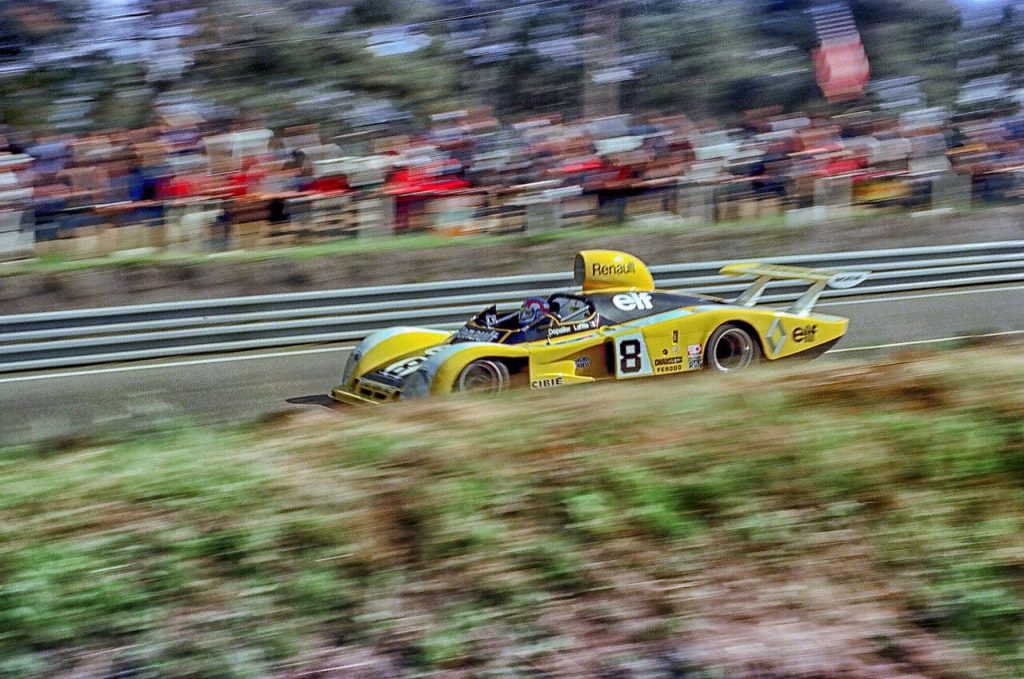
The supplied 1977 photograph
This profile uses a photograph identified by its author as an A442 at Le Mans in 1977. It illustrates the programme in a later competition configuration than the inventory’s introductory year. The caption retains that distinction. A photograph’s upload date may be much later than the event it depicts, so use the subject description and archive context together. The image is not offered as evidence that the pictured chassis was the 1978 winner or that its visible configuration represents every A442 ever raced.
Frequently asked questions
When did the A442 programme begin?
The inventory uses 1975, matching Renault’s museum account of its World Championship entry. Renault’s later chronology highlights campaigning from 1976; event-specific dates require their own records.
Is the A442 the same as the A442B?
The A442B is a named development within the wider lineage, with its own winning-car profile. The labels should not be used interchangeably for provenance or specifications.
Can race entries establish the build total?
No. Entries can repeat a chassis, omit spares or record a converted car under a later designation.
Is a restored A442 ready to race?
That cannot be determined from appearance or historic results. The installed mechanical and safety equipment needs inspection for the intended event.
Explore related Alpine profiles
Sources
- The Originals Renault Museum: Alpine A442 B
- Renault Group: A424 preview, historic endurance chronology
- Club Alpine Dieppe: prototype model history
Historical statements follow the linked manufacturer, club, register and game-project records. Inspection and collecting guidance is editorial analysis. Individual catalogue claims remain attributed to the relevant car and source.
Photography and credit
A442 at Le Mans in 1977, as identified by the photographer; a later competition configuration illustrating the A442 programme. Photo: Gillfoto / Wikimedia Commons · CC BY-SA 3.0. Wikimedia thumbnail resized from the original; no cropping or colour changes.
Why this machine matters
The Alpine A442 is the turbocharged sports-prototype programme that put Renault-Alpine in contention for outright endurance success. Its story runs through speed, mechanical development and Le Mans setbacks before the distinct A442B delivered the 1978 victory.
Built in limited numbers
No complete A442 manufacturing census has been established by the reviewed sources. A race entry count is not a build total: spare chassis, conversions and repeated appearances complicate the calculation. The A442 therefore remains a competition archive record with no exact numeric production field. A claim that a car is one of a particular number needs a chassis list and a definition that explains whether A442B conversions are included. The winning-car profile must not be added to the programme count as though it automatically represents another newly built car.
Gallery
Specifications
Factory specifications may vary by model year, market and configuration.
Identity & production
- Official model
- Alpine A442
- Base model
- A442
- Country of manufacture
- France
Powertrain & performance
- Engine
- Turbocharged competition V6; specification depends on year and configuration