Alpine A441
The Alpine A441 made Alpine’s two-litre endurance ambitions credible before the turbocharged Le Mans campaign. Its defining achievement is Alain Serpaggi’s 1974 European title, while its collector identity depends on separating the original A441 from later turbo development and individual chassis histories.
The Alpine A441 made Alpine’s two-litre endurance ambitions credible before the turbocharged Le Mans campaign. Its defining achievement is Alain Serpaggi’s 1974 European title, while its collector identity depends on separating the original A441 from later turbo development and individual chassis histories.
Alpine A441 at a glance
| Manufacturer | Alpine |
|---|---|
| Model family | A441 |
| Profile scope | Competition archive |
| Inventory reference | ALP-033 |
| Engine reference | Two-litre competition V6; original and turbo configurations distinct |
The A441’s place in Alpine history
Alpine’s manufacturer chronology connects three important steps: the A440 introduced in 1973, the A441’s European success in 1974 and the development of turbocharged machinery for the next phase. Alain Serpaggi’s title belongs to the A441 chapter. That makes the model more than an intermediate number in a list of prototypes. It represents a successful competition objective reached before the team pursued the different demands of an overall Le Mans victory. A collector should begin with that specific achievement, rather than transferring the later A442B result backwards.
A441 versus A441 Turbo
The ordinary A441 and the A441 Turbo should have separate specification labels. Renault’s later endurance chronology dates the turbo installation to 1975 and quotes 490 horsepower for that development. Those figures are not the specification of every A441. The distinction matters when identifying photographs, writing display cards or assessing a restored car. A yellow livery, a familiar body shape or a caption containing A441 cannot by itself establish the engine configuration. Record the date, chassis and mechanical installation together before deciding which version a document describes.
What the two-litre programme demanded
A two-litre sports prototype is an exercise in making a limited engine capacity work efficiently. The vehicle must turn its available power into speed through mass, gearing, traction and aerodynamics. Racing rules and the duration of an event influence each choice. This is an engineering reading of the A441’s role, rather than a claim about an undocumented chassis dimension. For a display, the useful comparison is with the preceding A440 and the turbocharged successors: the objective changes even when the marque and some of the design language remain familiar.
Construction and mechanical identity
Club Alpine Dieppe describes the A441 as an evolution of the A440 and identifies the engine’s structural role as an important difference. Treat that account as a starting point for examining the actual car. Ask a prototype specialist to explain the engine mounting, transmission support and surrounding structure against dated factory or team material. A replacement engine of the correct general type does not establish that the car retains its original installation. Mounting details, fabrication changes and workshop photographs can reveal a much more precise development story.
Production and rarity
The Dieppe club reports three A441s and discusses the turbo car separately. This is useful evidence for numerical rarity, but the definition should accompany the number: it is a club account of the original model, not a fresh factory census of every related development chassis. The numeric production field remains unset here until the original and turbo scopes are reconciled against chassis documentation. The A441 is retained as a competition archive entry with a verified model identity. No number of surviving, complete or running cars is inferred from the reported build count.
How to read an A441 competition record
Build a timeline with one row for each dated event and columns for chassis identification, driver, entrant, engine configuration and source. Include retirements and development appearances as well as victories. A championship summary answers who won the series, but it may not answer which physical car contested every round. Separate team-level success from chassis-level evidence. If a history file jumps directly from a period result to a modern restoration, flag the missing ownership and workshop years; that gap is a research task, not automatic proof that the proposed identity is wrong.
Authentication before restoration
Photograph identifying marks and the surrounding material before cleaning or repainting. Compare them with paperwork and earlier photographs, noting whether a plate, stamped member or component has been replaced. Request the restoration account in enough detail to distinguish retained structure from newly fabricated sections. For a competition machine, repairs are part of its working history. The important question is how the documented car continued through those repairs. A polished finish and period-correct decals can make a car attractive without answering that question.
Inspecting a running prototype
Mechanical inspection should follow the intended activity. A museum display, a short demonstration and a historic race require different preparation. Review the engine build record, lubrication checks, cooling arrangement, gearbox service and brake condition with someone familiar with the installed components. Ask about storage intervals and the most recent sustained running, not simply whether the engine starts. Check the fuel system, hoses and safety equipment before planning track use. None of these checks establishes provenance, but provenance alone cannot make an old competition car mechanically ready.
Preserving configuration evidence
An A441 may be presented in a configuration selected to represent one point in its career. The choice should be explained. Keep photographs of alternative bodywork, recorded engine changes and removed components alongside the car’s present specification. Where material has been reproduced, label it as such in the conservation file. That approach allows a visitor or later owner to understand what is original, what is restored and what is interpretive. It also prevents the most visually appealing racing livery from quietly becoming the assumed identity of the whole chassis.
Why the A441 belongs in an Alpine collection
An A441 adds a circuit-racing story that a Berlinette alone cannot tell. Displaying it near an A110 makes the contrast between road-derived rallying and purpose-built prototype racing clear. Placing it beside an A442 makes the transition toward turbocharged endurance ambition equally legible. The collector significance is therefore historical and technical, not simply a claim that fewer cars are better. An accurately documented A441 can illuminate a successful stage in the programme even when it lacks the instant recognition of the 1978 Le Mans winner.
Photographs and chassis claims
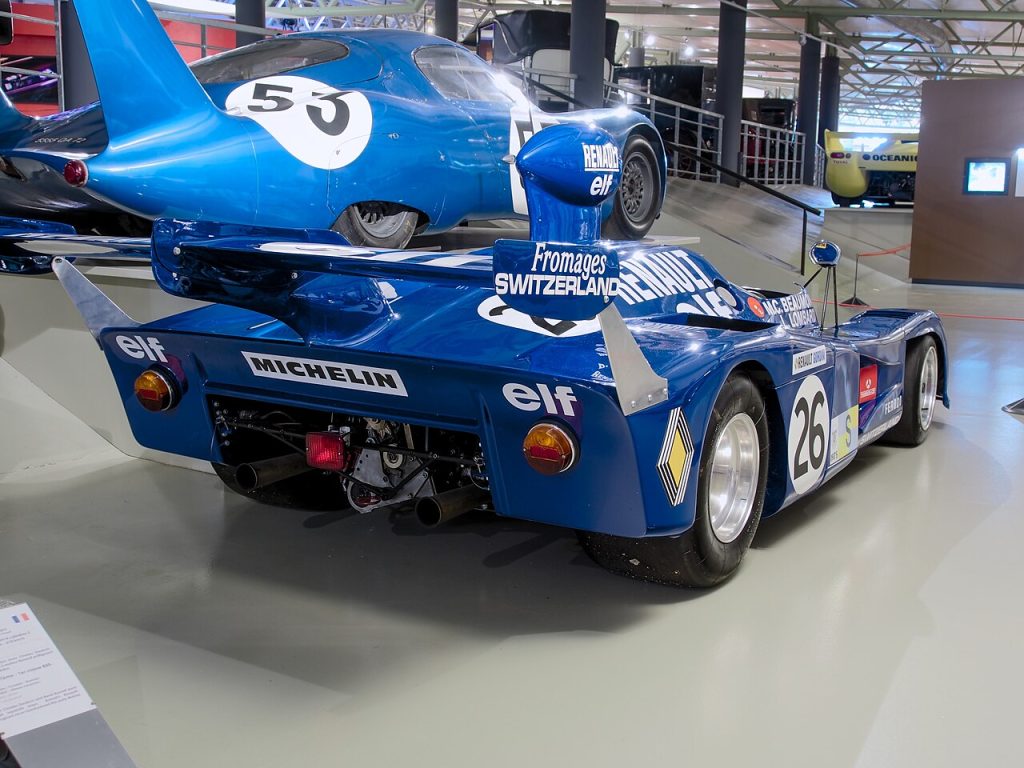
The supplied photograph is a modern museum image identified as an A441 in its source record. It is a model illustration, not certification that the pictured car won Serpaggi’s 1974 championship. A photograph can show body form and visible equipment, but it cannot prove hidden construction, ownership continuity or an engine’s internal specification. Use the caption to establish what the picture actually records. For a chassis-specific feature, add dated identification photographs and documentation rather than asking a general model photograph to carry the full provenance claim.
Frequently asked questions
Did the A441 win Le Mans in 1978?
No. That overall victory belongs to the A442B driven by Jean-Pierre Jaussaud and Didier Pironi. The A441’s key title was Alain Serpaggi’s 1974 European success.
Was every A441 turbocharged?
No. The original model and the 1975 A441 Turbo development must be separated; turbo output should not be assigned to the earlier cars.
How many A441s were built?
Club Alpine Dieppe reports three original A441s and treats the turbo development separately. A reconciled programme-wide chassis census has not been established here.
Does the photograph identify a championship-winning chassis?
No. It illustrates the model in a later museum setting. The source caption does not verify a specific 1974 championship chassis.
Explore related Alpine profiles
Sources
- Renault Group: A424 preview, historic endurance chronology
- Club Alpine Dieppe: prototype model history
- The Originals Renault Museum: Alpine A442 B
Historical statements follow the linked manufacturer, club, register and game-project records. Inspection and collecting guidance is editorial analysis. Individual catalogue claims remain attributed to the relevant car and source.
Photography and credit
A441 displayed at the Musée des 24 Heures du Mans in 2017; representative of the model, not proof of a particular 1974 championship chassis. Photo: Alf van Beem / Wikimedia Commons · Public domain (author dedication). Wikimedia thumbnail resized from the original; no cropping or colour changes.
Why this machine matters
The Alpine A441 made Alpine’s two-litre endurance ambitions credible before the turbocharged Le Mans campaign. Its defining achievement is Alain Serpaggi’s 1974 European title, while its collector identity depends on separating the original A441 from later turbo development and individual chassis histories.
Built in limited numbers
The Dieppe club reports three A441s and discusses the turbo car separately. This is useful evidence for numerical rarity, but the definition should accompany the number: it is a club account of the original model, not a fresh factory census of every related development chassis. The numeric production field remains unset here until the original and turbo scopes are reconciled against chassis documentation. The A441 is retained as a competition archive entry with a verified model identity. No number of surviving, complete or running cars is inferred from the reported build count.
Gallery
Specifications
Factory specifications may vary by model year, market and configuration.
Identity & production
- Official model
- Alpine A441
- Base model
- A441
- Country of manufacture
- France
Powertrain & performance
- Engine
- Two-litre competition V6; original and turbo configurations distinct