Alpine A210
The Alpine A210 carried Alpine’s small-capacity endurance programme into the second half of the 1960s. With an eight-car production total supported by specialist sale records, it combines genuine numerical rarity with a history in which each chassis deserves its own account.
The Alpine A210 carried Alpine’s small-capacity endurance programme into the second half of the 1960s. With an eight-car production total supported by specialist sale records, it combines genuine numerical rarity with a history in which each chassis deserves its own account.
Alpine A210 at a glance
| Manufacturer | Alpine |
|---|---|
| Model family | A210 |
| Profile scope | Competition archive |
| Inventory reference | ALP-021 |
| Completed production | 8 — A210 model total |
| Engine reference | Renault-Gordini twin-cam inline-four; capacity varies by chassis and event |
The A210 in one sentence
The A210 is an endurance sports prototype, not a rebodied road A110 and not the later three-litre A220. For a collector, its importance comes from a compact competition package and the individual careers of a very small set of cars. Its dramatic profile makes it easy to recognize in a display; authenticating a particular example requires much more than recognizing that silhouette. The chassis record, mechanical development and event history are the foundations of a useful description.
From 1966 to the end of the decade
Alpine’s exhibition material dates the A210 programme to 1966–1969. Its purpose-built competition identity belongs within the early endurance sequence that also includes the M65. Think of the designation as a model boundary rather than an instruction to merge earlier cars into the same production total. A programme can retain an engineering approach while introducing a different chassis and body. That distinction matters whenever a database attempts to count vehicles or transfer results between entries.
Eight cars, with distinct histories
RM Sotheby’s and Ascott Collection both state that eight A210s were produced. Ascott scopes its account to chassis 1720 through 1727. This is a completed-model count, not a claim that eight cars are currently intact or available to buy. It satisfies the site’s production ceiling for the A210 model. The separate question of a survivor’s original fabric still requires investigation. A small build total makes careful documentation more valuable; it does not make a disputed identity automatically true.
Chassis 1725 as a documented example
RM Sotheby’s describes chassis 1725 with different engines at different events: 1296 cc at Le Mans in 1967, 1005 cc in 1968 and 1470 cc in 1969. The catalogue records class victories in 1967 and 1968, with the Index of Performance in 1968. These are chassis-specific claims. The same catalogue contains conflicting image captions and an earlier title-year addendum, so its narrative and result table should be checked against original records before repeating every detail. This example illustrates why an A210 cannot be assigned one universal displacement.
Class wins are not overall victories
When discussing an A210, write down the event, year, drivers, class and overall finishing position together. A class-winning car may finish well down the general classification and still have achieved exactly what its design intended. Describing it simply as a Le Mans winner removes that context. Equally, a retirement in another year does not invalidate a documented earlier success. The chronology should explain both, without selecting only the most flattering part of the car’s career.
Why engine history belongs in the profile
The changing capacities documented for 1725 make the engine file central to the vehicle story. A present engine might represent one event, a later upgrade or a practical restoration choice. The collector should ask which. Record the engine identity, the build specification and the evidence for the selected configuration. A spare engine deserves its own inventory entry in the history file. Its presence does not prove that it was installed during the car’s most important race.
Bodywork, presentation and conservation
A competition body can preserve an evocative appearance while carrying a mixture of original and replacement material. Inspect its mounting points, panel construction, finishes and repair history as a set. Ask whether the displayed race number and color scheme were restored from period evidence or chosen for presentation. Neither a fresh finish nor a patinated one establishes authenticity on its own. What makes the presentation persuasive is an explanation that connects the visible car with dated photographs and a documented sequence of work.
A210 inspection priorities
Start with the supporting structure and the documentary chain linking it to the chassis number. Then review suspension geometry, braking equipment, wheels and engine installation against the proposed period configuration. Have a specialist assess the quality and extent of structural repairs. Discuss what was inspected when the car last ran and what has happened since. A historic racing car can accumulate deterioration while sitting unused; the absence of new mileage does not mean the absence of maintenance needs.
Building a useful ownership dossier
Organize the file by date and by system. Keep original competition evidence separate from later catalogues, invoices and owner recollections. Preserve source references for a claimed driver or result. Include photographs taken before dismantling and notes identifying replaced panels or mechanical parts. Where two accounts disagree, retain both and state the disagreement. A transparent dossier is easier to assess than a polished narrative which silently selects one version. The uncertainty itself may help guide the next research step.
The A210 beside the A220
The A210 and A220 make a particularly useful comparison in an Alpine collection. The former explains a small-capacity competition approach; the latter belongs to the marque’s larger-engined endurance ambitions. Their significance does not depend on one being declared better. Use them to show how objectives, regulations and resources change the shape of a programme. Keep the eight-car A210 total within its own scope, and do not add the A220 as though it were simply another A210 specification.
Frequently asked questions
How many A210s were built?
Two reviewed specialist sale records give eight, with Ascott identifying the sequence 1720–1727.
Did every A210 have the same engine?
No. The documented career of chassis 1725 includes several capacities, so an individual event configuration must be specified.
Is the photograph chassis 1725?
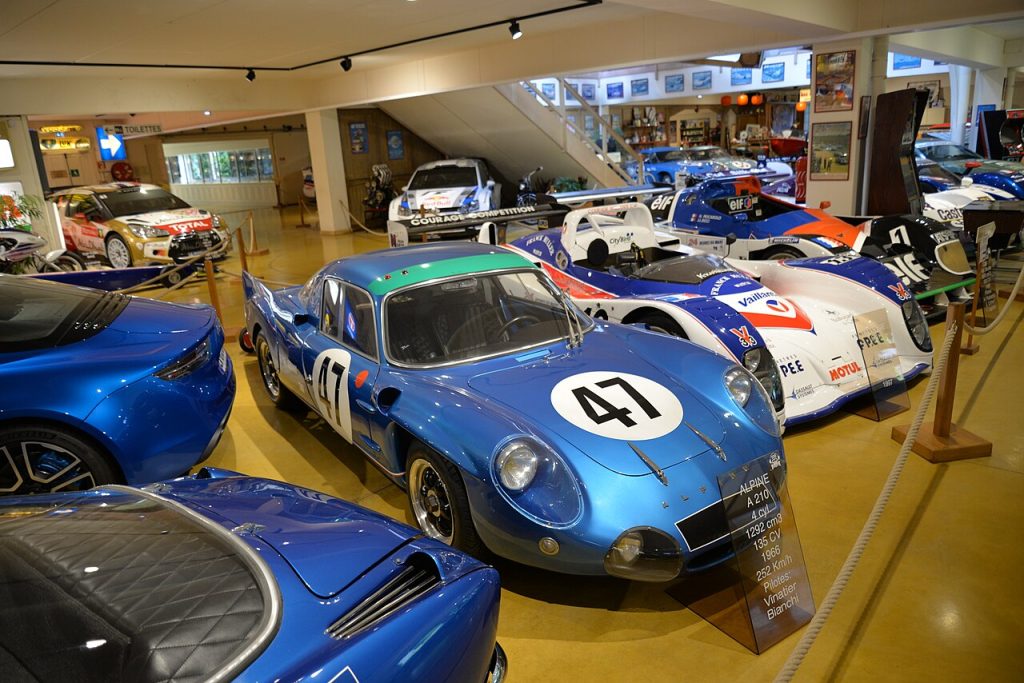
The image is an A210 museum illustration; no chassis identification is claimed.
Can a class win be called an outright Le Mans victory?
No. The class and the overall classification must be described separately.
Explore related Alpine profiles
Sources
- RM Sotheby’s: 1967 A210, chassis 1725
- Ascott Collection: A210, chassis 1725
- Alpine: International Automobile Festival heritage exhibition
Historical statements follow the linked manufacturer, club, homologation and vehicle records. Inspection and collecting guidance is editorial analysis. Individual catalogue claims remain attributed to the relevant car and source.
Photography and credit
Alpine A210 at the Manoir de l’Automobile, photographed in August 2026. The pictured car is not identified as chassis 1725. Photo: Calips / Wikimedia Commons · CC BY-SA 4.0. Wikimedia display copy; no content retouching. WordPress may resize further and website layouts may crop the image.
Why this machine matters
The Alpine A210 carried Alpine’s small-capacity endurance programme into the second half of the 1960s. With an eight-car production total supported by specialist sale records, it combines genuine numerical rarity with a history in which each chassis deserves its own account.
Built in limited numbers
RM Sotheby’s and Ascott Collection both state that eight A210s were produced. Ascott scopes its account to chassis 1720 through 1727. This is a completed-model count, not a claim that eight cars are currently intact or available to buy. It satisfies the site’s production ceiling for the A210 model. The separate question of a survivor’s original fabric still requires investigation. A small build total makes careful documentation more valuable; it does not make a disputed identity automatically true.
Gallery
Specifications
Factory specifications may vary by model year, market and configuration.
Identity & production
- Official model
- Alpine A210
- Base model
- A210
- Worldwide production
- 8
- Country of manufacture
- France
Powertrain & performance
- Engine
- Renault-Gordini twin-cam inline-four; capacity varies by chassis and event