Carbon fibre in rare cars: five ways to use the same material
The weave catches your eye first. What it does deserves a second look. Carbon-fibre composite can form the structure around the occupants, replace an individual panel, shape the air around a car or become part of its visual language.
Those uses carry different meanings. A carbon roof and a carbon passenger cell are different engineering decisions, even if their surfaces look related. The component’s position and purpose explain more than the number of times the material appears in a brochure.
These five small-series cars provide a practical way into the subject. Start at the centre of the Alfa Romeo, move through BMW’s selective panel replacement, then study the Porsche’s finishes, Lamborghini’s exterior bodywork and Toyota’s aerodynamic additions. The same family of materials appears in five distinct roles.
01 / The structure around you — Alfa Romeo 4C Spider 33 Stradale Tributo
Alfa Romeo’s 33 Stradale Tributo brought a red finish to the 4C Spider’s visible carbon-fibre monocoque. The manufacturer announced 33 cars for the North American programme, with Rosso Villa d’Este exterior paint and edition-specific details. The small series uses the 4C’s underlying carbon structure as a prominent part of its identity. [1]
A monocoque is a structural shell. In this case, the carbon around the cabin belongs to the architecture of the car, so its significance extends beyond an exposed decorative surface. The visible finish makes that architecture unusually easy to notice.
The Tributo therefore offers two things to examine together: the function of the passenger cell and the way the edition presents it. Colour changes the visual experience of the material, while the structure explains why that material is there. Follow the sill and cockpit rather than stopping at the body paint.
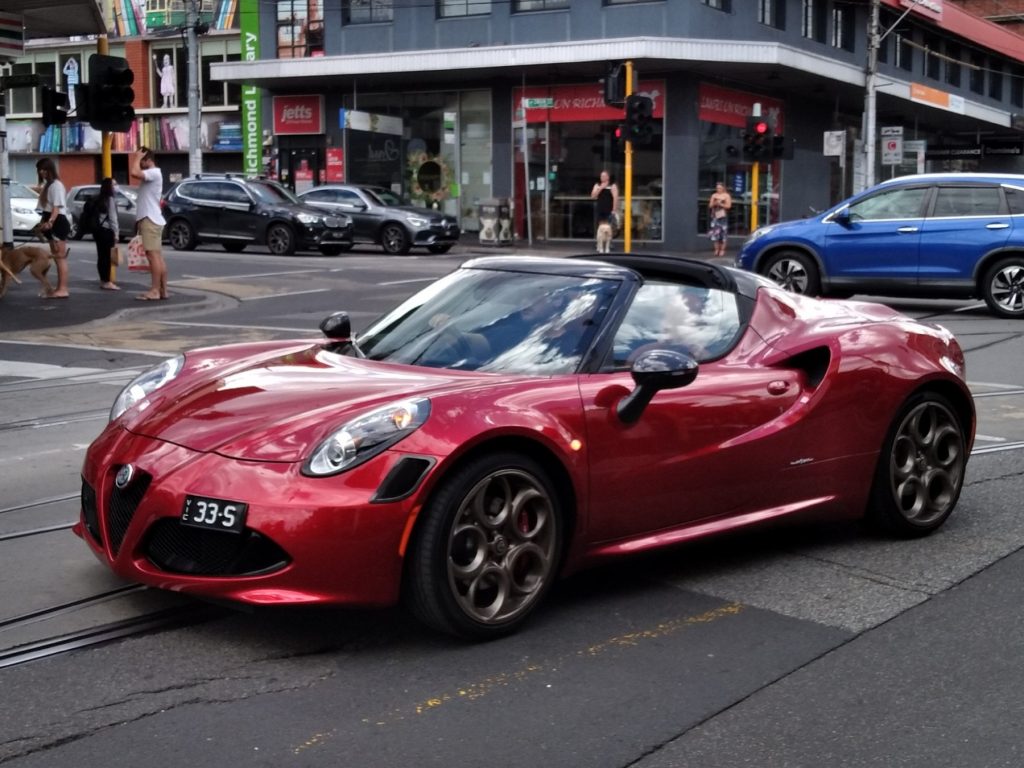
Alfa Romeo 4C Spider 33 Stradale Tributo
The 4C Spider 33 Stradale Tributo was announced in December 2020 with 33 cars for North America.
Explore the full profile02 / Replacing selected components — BMW M3 CRT
The E90 M3 CRT demonstrates another approach. BMW’s account of the 67-car programme describes carbon-fibre-reinforced plastic used selectively, including the bonnet and seat structures. CRT stands for Carbon Racing Technology, placing the manufacturing method at the centre of the model’s name. [2]
Here, the subject is the targeted component. Changing a bonnet or seat structure does not require every other part of the body to use the same material. An existing saloon can retain its overall architecture while introducing a different solution where the development team sees a benefit.
That gives the CRT a particular place in this collection. Its four-door outline is familiar, yet the limited programme experiments with how individual parts are made. The important question is where the changes sit within the whole car: what each part supports, where its mass is located and how the new component relates to the structure around it.

BMW M3 CRT E90 (2011)
The 2011 BMW M3 CRT E90 combines a high-output V8 with a focused carbon-material development programme in the M3 sedan body. Its 67-car worldwide series makes it much rarer than the regular…
Explore the full profile03 / Material becomes a design language — Porsche 911 Turbo S Exclusive Series
Porsche announced 500 Turbo S Exclusive Series coupés worldwide. Its launch material identifies carbon components including the bonnet, roof and side skirts, with visible weave stripes on the bonnet and roof. Inside, copper thread is integrated into the carbon trim. [3]
This is a particularly clear example of engineering material and finish working together. The exterior components and the interior trim do different jobs, but Porsche gives them a related visual treatment. The weave becomes a recurring motif across the object.
It also shows why visible carbon is only one way to recognise a composite part. Paint can cover a component while selected areas reveal the material beneath. On this edition, the relationship between painted surface and exposed weave is deliberately composed. Reading that finish alongside the component list explains both how the car is presented and where the carbon is actually used.

2017 Porsche 911 Turbo S Exclusive Series — Coupé
The 2017 Porsche 911 Turbo S Exclusive Series combined a 3.8-litre twin-turbo engine with an extensively finished 991 Coupé body and cabin. Porsche announced 500 cars and an uprated 446 kW or…
Explore the full profile04 / A new outer skin — Lamborghini Reventón Coupé
Lamborghini’s Reventón history describes carbon-fibre bodywork and a 20-car coupé series. Its account of the few-off models distinguishes that outer skin from the underlying steel-and-composite chassis arrangement. The Reventón’s angular surfaces therefore illustrate a different application from the Alfa’s carbon passenger monocoque. [4] [6]
The distinction is worth carrying into any discussion of a car described as carbon-bodied. Bodywork is the outer form; the supporting structure needs its own description. Knowing the material of one does not settle the construction of the other.
On the Reventón, the exterior surface is also central to a new design identity. Its sharply drawn planes make a familiar V12 mechanical lineage look very different. The material helps create that physical form, while the chassis record explains what lies beneath it. The full story comes from following the relationship between the two.
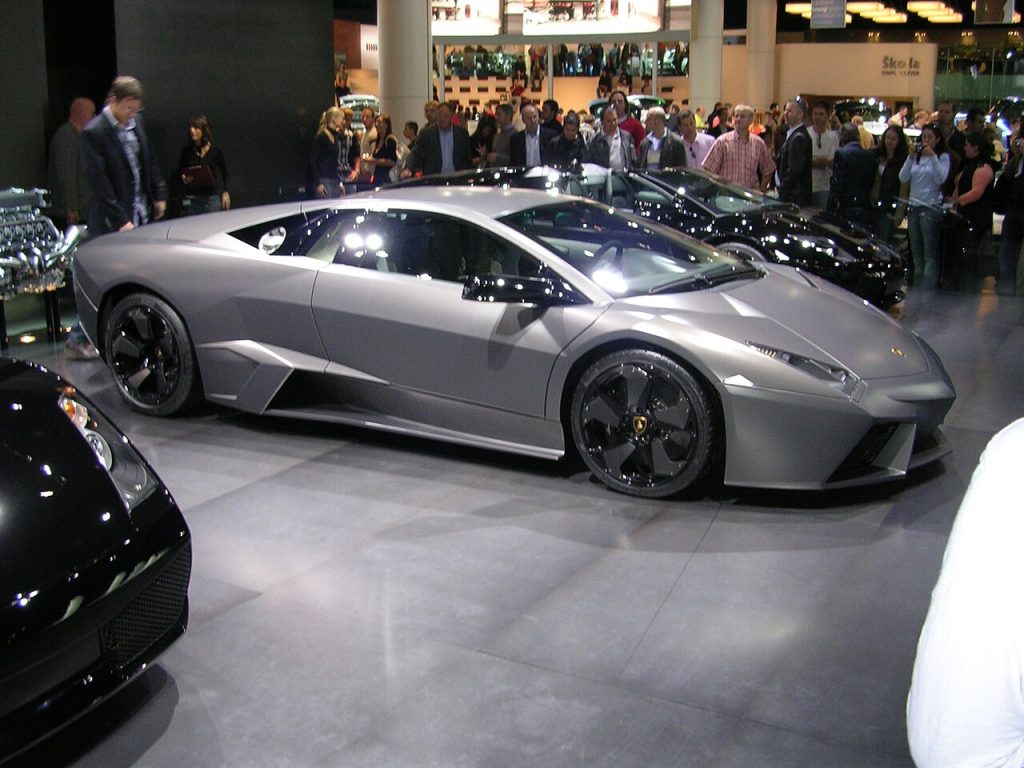
2007 Lamborghini Reventón Coupé
The Lamborghini Reventón Coupé marks a distinct few-off design programme with aircraft-influenced surfaces. Its original 2007 identity and real Frankfurt photograph remain separate from the later Reventón Roadster.
Explore the full profile05 / Shaping the airflow — Toyota GR Supra A91-CF Edition
Toyota’s A91-CF announcement set out a 600-car North American edition with carbon-fibre aerodynamic additions. The manufacturer identified a front splitter and canards, side rockers, a rear spoiler and lower rear canards among the details. CF names the edition’s Carbon Fiber theme. [5]
The focus is on components around the edges of the car, where their shape interacts with airflow. Their place in the package differs from the cabin structure of the 4C or the replacement bonnet of the BMW. Component purpose is the thread that makes the distinction useful.
Toyota’s programme also provides a reminder to keep market scope attached to an edition. The announced 600 applies to the North American A91-CF series. With that identity clear, the reader can concentrate on the interesting question: how a set of small, precisely placed exterior pieces becomes the defining idea of a limited model.

2022 Toyota GR Supra A91-CF Edition
The 2022 GR Supra A91-CF Edition paired the six-cylinder Supra with distinctive exposed-carbon aerodynamic pieces and a red-and-black cabin. Toyota limited the named North American edition to 600 vehicles. The profile covers…
Explore the full profileAsk what the component does
When you next see an exposed carbon surface, trace it to a component. Is it part of the passenger structure, an exterior panel, an aerodynamic device or a trim piece? Then look for the manufacturer’s description of how that component is built and used.
The answer often makes the car more interesting. A saloon can demonstrate a new production process through a small number of parts. A supercar can use composite bodywork to establish a dramatic new shape. A special finish can make structural material part of the cabin’s visual character.
These five profiles form a collection organised around those different jobs. The weave is the invitation; the construction beneath it is the reason to stay.
Sources & further reading
- Alfa Romeo: 4C Spider 33 Stradale Tributo — Manufacturer announcement, red carbon monocoque and market-specific series.
- BMW M: M3 CRT E90 — Factory retrospective on the 67-car programme and carbon components.
- Porsche: Turbo S Exclusive Series — 2017 launch account of components, visible weave and interior finish.
- Lamborghini: Reventón — Factory record of the coupé programme.
- Toyota: GR Supra A91-CF introduction — Carbon aero package and 600-car North American edition.
- Lamborghini: few-off construction history — Manufacturer account distinguishing Reventón body panels and chassis construction.
Continue exploring
Explore the people and processes behind unusual bodies in Modern coachbuilding and bespoke bodies, then browse the complete series.