1912 Peugeot L76 Grand Prix
Explore the L76 Grand Prix: history, verified identity, specification references, rarity evidence and real credited photos.
The Peugeot L76 put a compact, sophisticated cylinder head at the centre of a new approach to Grand Prix performance. Developed for the 1912 season by the team remembered as the Charlatans, it joined a 7.6-litre four-cylinder engine with twin overhead camshafts and four valves per cylinder. Georges Boillot's French Grand Prix victory made the project famous. This profile follows the L76 programme and separates it from later, smaller-engined Peugeot racing derivatives.
The drivers who challenged the established order
L’Aventure's archive account places Georges Boillot, Jules Goux, Paolo Zuccarelli and Ernest Henry at the heart of the project supported by Robert Peugeot. The memorable Charlatans nickname came from internal opposition to their approach, rather than from a lack of practical racing experience. Their importance lies in the collaboration between drivers and technical design. A single-inventor story misses the way the engine, chassis and competition objectives were developed together for the 1912 ACF Grand Prix.
L’Aventure: Charlatans, L76 engineering and competition history
Why the cylinder head mattered
The museum describes a 7,600 cc four-cylinder engine combining two overhead camshafts, four inclined valves per cylinder and a hemispherical combustion chamber. Its historical argument concerns that combination, rather than claiming that Peugeot invented every component separately. Better breathing and a more purposeful valve layout offered another route to performance beyond simply increasing displacement. These are the architectural features that make the L76 a recurring reference in histories of the modern racing engine.
Dieppe, Brooklands and Indianapolis
Boillot won the 1912 French Grand Prix at Dieppe, while Goux's subsequent Brooklands record work and 1913 Indianapolis victory extended Peugeot's reputation internationally. These achievements should retain their event dates and technical context. Peugeot's later American successes involved developments with different engine capacities, so a list of every Peugeot victory in the decade is not automatically the record of one unchanged L76 chassis. The archive account is most useful when those distinctions remain visible.
L’Aventure: Charlatans, L76 engineering and competition history
A racing family rather than a single surviving object
L76 identifies an early racing design and programme, not a retail trim with an ordinary production register. Later L3 and L45 machines belong to the wider engineering story but have separate specifications. Period photographs, modern reconstructions and museum interpretations also have different evidential roles. An image can show the original appearance without proving that an exhibited object retains a particular 1912 frame, engine or race identity. That connection requires an individual chain of custody.
Peugeot: official family and motorsport history
How to read an L76 provenance file
For a claimed original car or component, the valuable evidence is a dated sequence of race entries, workshop records, contemporary photographs and later ownership documentation. The museum's description of the original three-car proposal is not treated here as a reconciled total of every engine or chassis subsequently constructed. Likewise, an historic registration or replica plate cannot establish a period Grand Prix result. Keep the programme's engineering significance separate from the authentication of a specific surviving object.
Specifications and identity reference
| Reference season | 1912 |
|---|---|
| Discipline | Grand Prix racing |
| Engine architecture | 7.6-litre inline four |
| Cylinder head | Twin overhead camshafts; four valves per cylinder |
| Key French result | Boillot, 1912 ACF Grand Prix |
| Later programme milestone | Goux, Indianapolis 1913 |
| Count boundary | Works programme; no reconciled chassis census assigned |
| Archive scope | L76; later smaller-engined derivatives kept distinct |
Rarity and production scope
Verified historic L76 programme. Race results identify events and drivers, not every surviving or reconstructed object. No exclusive one-car claim or completed programme total is assigned.
This is an Archive record. Concepts, restored heritage vehicles, works cars and competition programmes are not added to customer road-production totals. A programme profile does not establish how many physical chassis were made, and repeated exhibition appearances do not create additional vehicles.
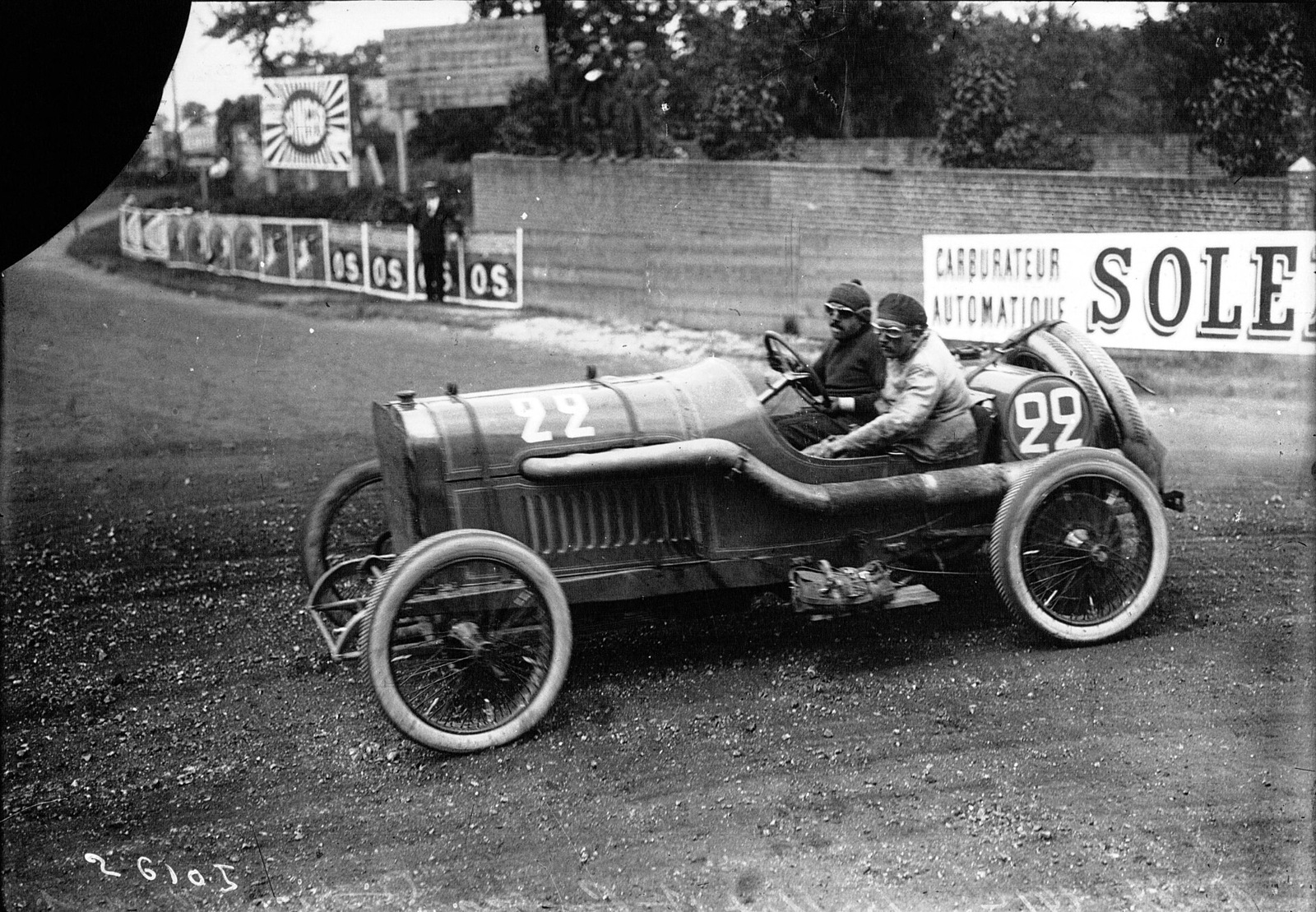
What the photograph represents
Period photograph of Georges Boillot at the 1912 French Grand Prix. Historical programme illustration, not a photograph authenticating a modern surviving or reconstructed L76 chassis.
Related Peugeot heritage profiles
Frequently asked questions
Did Peugeot invent the overhead camshaft with the L76?
The museum emphasises the combination of twin overhead cams, four valves and combustion-chamber design, rather than separate invention of each element.
Are later L45 victories automatically L76 results?
No. The later derivatives require their own engine and chassis descriptions.
What is the production-count boundary for this profile?
Verified historic L76 programme. Race results identify events and drivers, not every surviving or reconstructed object. No exclusive one-car claim or completed programme total is assigned.
Sources and further reading
- L’Aventure: Charlatans, L76 engineering and competition history
- Peugeot: official family and motorsport history
Research checked 16 October 2026. Linked factory, heritage and specialist-register records support the specifically attributed claims. Photographic descriptions identify the illustrated subject. Design analysis and suggested authentication steps are editorial interpretation.
Built in limited numbers
Verified historic L76 programme. Race results identify events and drivers, not every surviving or reconstructed object. No exclusive one-car claim or completed programme total is assigned.
Gallery
Specifications
Factory specifications may vary by model year, market and configuration.
Identity & production
- Official model
- Peugeot L76 Grand Prix
Sources and verification
Source citations are being prepared for this profile.