Audi Concept C
A physical all-electric two-seat sports-car concept unveiled in Milan in September 2025, combining a retractable hardtop, a vertical front frame and tactile controls in Audi’s new design philosophy.
A physical all-electric two-seat sports-car concept unveiled in Milan in September 2025, combining a retractable hardtop, a vertical front frame and tactile controls in Audi’s new design philosophy.
Audi Concept C at a glance
| Manufacturer | Audi |
|---|---|
| Model / programme | Concept C |
| Profile scope | Physical concept archive |
| Historical reference year | 2025 |
| Inventory reference | AUDI-098 |
| Engine reference | All-electric concept architecture; exact output not populated |
| Exact original object count | Unresolved; no numeric production badge populated |
| Object scope | Physical two-seat concept; full development-object census unresolved |
What is the Audi Concept C?
Audi presented Concept C in Milan on September 2, 2025, as a physical expression of a new design philosophy. The two-seat electric sports-car study brings the discussion back to the relationship between proportion, controls and a focused driving environment. It belongs in the archive as a named concept rather than a customer production series. A later manufacturer account describes road approval, giving it a different evidential status from a static display alone. That does not make the study a production specification. The useful historical task is to preserve what Audi showed and subsequently documented, while keeping later production announcements attached to their own dates and names.
A vertical frame and a different front identity
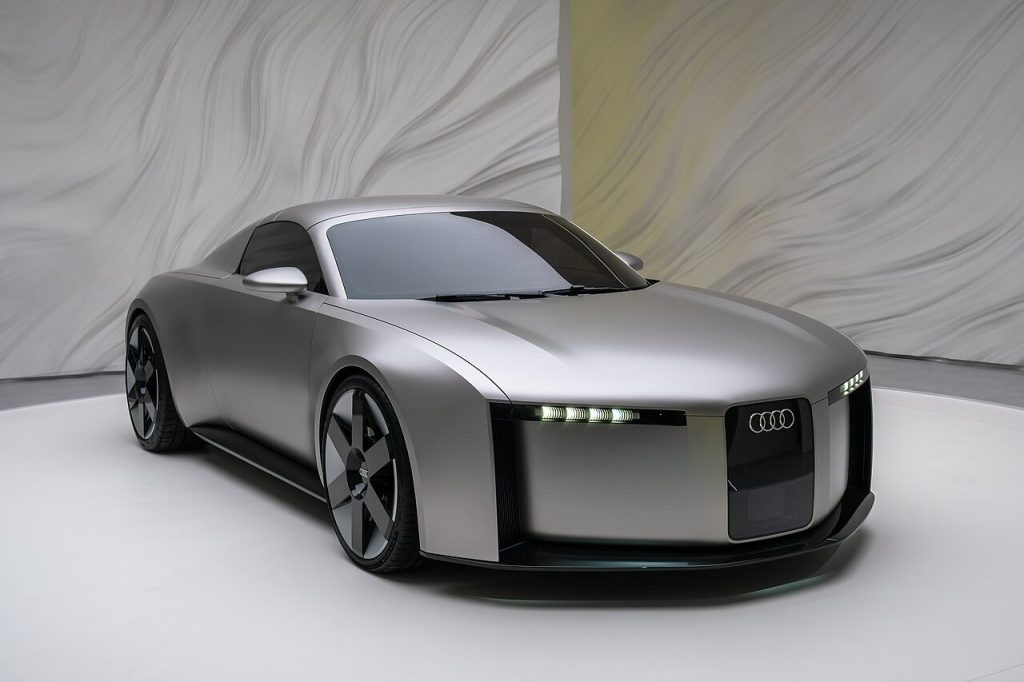
The front is organized around a tall, narrow frame containing the Audi rings, rather than relying on width alone to create its identity. Audi explicitly links this design reference to the Auto Union Type C and an earlier A6. A comparison with the Type C is therefore useful as a study of visual reference, not a claim of mechanical continuity. Look at how the frame relates to the headlights and the surrounding surfaces in the supplied front three-quarter photograph. The shape gives the design a clear center, allowing a reader to discuss the proposal in concrete terms rather than repeating an abstract claim about minimalism.
The retractable hardtop changes how the shape is read
Audi describes an electrically retractable hardtop using two roof elements. The purpose is to combine a closed, continuous-looking form with an open-top experience. For a design comparison, examine the roofline in its closed state, then compare the opened configuration and the remaining structure around the cabin. Each state can change how the car’s proportions are perceived. A photograph of one state should not be treated as a complete explanation of the mechanism. The feature also creates a useful relationship with earlier Audi roadster studies: the shared interest is how open-air use is integrated into the design, while the specific roof arrangements remain distinct.
Electric packaging without invented performance figures
The debut account identifies an all-electric architecture and describes proportions related to a central-battery layout. This profile does not fill engine-output, torque or range fields by borrowing numbers from unrelated Audi electric models or speculative reporting. The absence of a populated performance figure is an evidence boundary, not a reason to obscure the study’s design contribution. For a specific physical demonstrator, the custodian’s installed-hardware record would be needed to document the present configuration. Keep that object record separate from the styling brief and from any future customer-car specification. A coherent archive should make those stages easier to follow.
Tactile controls and the foldable screen
The cabin uses physical controls, with Audi emphasizing their materials and mechanical feel, alongside a foldable 10.4-inch display. This gives Concept C an interesting place beside studies that move more of the interface into projected or virtual layers. Consider what a user can find by touch, what remains visible when the display is hidden and how the interaction supports the two-seat environment. These are design questions raised by the presentation rather than findings from an independent ergonomic test. A useful cabin photo sequence would show both the quiet resting state and the controls in use, making the relationship between surfaces and information easier to understand.
Titanium tones, lighting and surface restraint
Audi identifies Titanium as the exterior presentation color and describes a four-element lighting signature. The official design account emphasizes controlled surfaces and precise details, while the supplied event image gives a concrete view of the finished physical form. Look at the relationship between the body color, the dark front opening and the bright light elements. Then examine how the side surfaces carry light without relying on numerous intersecting creases. This is visual analysis, not a manufacturing claim about every material. A painted finish named after a metal should not be interpreted as evidence that the entire body is made from that material.
September presentation and October road approval
The September debut establishes the design study’s public introduction. Audi’s October 20, 2025 account then explicitly describes it as street-legal and available to experience from behind the wheel. Those are separate dated pieces of evidence, and they should not be collapsed into an unsupported claim about where the car may operate today. Road approval depends on a particular object and the relevant conditions. The manufacturer’s statement supports a running physical concept with documented approval in that context. It does not establish universal homologation, customer availability or permission for every possible custodian to use the vehicle on any public road.
Rarity and the concept-object census
Concept C is a Verified physical archive subject in the workbook. The cited public releases do not establish a complete count of development objects, display bodies and running demonstrators, so this profile leaves numeric production fields empty. An event image shows a presented vehicle; it does not identify every related build. The September 2025 Munich photograph is captioned with its actual display date rather than presented as a photograph of the Milan reveal. To establish the history of a particular object, request factory project identification and custody documentation. The named study can be described accurately without turning an unresolved development census into a one-of-one certificate.
Comparisons with Type C, TTS and Le Mans quattro
The Auto Union Type C is the manufacturer-cited visual reference; the TTS roadster concept offers an earlier exploration of open-top sports-car design; and Le Mans quattro provides a separate example of an Audi sports-car study within the archive. Compare them by the design questions they address and the relationship between concept and later production. The names should not be used to claim that Concept C is officially a new TT or R8 unless a dated manufacturer record establishes that designation. A clear related-reading route can show continuity in Audi’s use of sports-car concepts while preserving the independence of each programme.
How to document Concept C as a physical exhibit
An object file should preserve project identity, public appearances, working-system descriptions, transport history and any repairs or changes made for demonstration. Record the roof in both states, cabin controls, presentation finish and identifying details with dates. Where the road-approval claim is relevant, retain the responsible custodian’s documentation and operating conditions. A future production model should receive its own specification and count record, even if the concept strongly anticipates it. Concept C’s archive value lies in a documented design proposition and a physical vehicle that made that proposition visible. Keeping those records distinct gives readers a reliable foundation for following the story forward.
Frequently asked questions
When was Audi Concept C unveiled?
Audi’s manufacturer account dates the Milan debut to September 2, 2025. The supplied photograph records its later Munich IAA display.
Is Concept C electric?
Yes. Audi describes an all-electric two-seat sports-car concept. Unverified output, torque and range figures are not populated here.
Was the physical concept approved for road use?
Audi’s October 20, 2025 release describes road approval and a street-legal concept. This does not establish universal customer-model homologation.
Was exactly one Concept C built?
The cited public material does not establish a complete development-object census. Numeric production fields remain empty.
Explore related vehicle profiles
Sources
- Audi — Concept C design philosophy, September 2, 2025
- Audi — Concept C road approval and driving preview, October 20, 2025
- Audi — New design presentation in Milan, September 2025
History and published specifications follow the linked manufacturer records. Visual comparisons, documentation questions and inspection priorities are editorial analysis. Photographs retain their original subject descriptions and separate rights records.
Photography and credit
Audi Concept C displayed at the IAA Open Space in Munich on September 9, 2025, photographed by Matti Blume. Photo: Matti Blume / Wikimedia Commons · CC BY-SA 4.0. Resized proportionally without additional cropping or color alteration.
Why this machine matters
A physical all-electric two-seat sports-car concept unveiled in Milan in September 2025, combining a retractable hardtop, a vertical front frame and tactile controls in Audi’s new design philosophy.
Built in limited numbers
Concept C is a Verified physical archive subject in the workbook. The cited public releases do not establish a complete count of development objects, display bodies and running demonstrators, so this profile leaves numeric production fields empty. An event image shows a presented vehicle; it does not identify every related build. The September 2025 Munich photograph is captioned with its actual display date rather than presented as a photograph of the Milan reveal. To establish the history of a particular object, request factory project identification and custody documentation. The named study can be described accurately without turning an unresolved development census into a one-of-one certificate.
Gallery
Specifications
Factory specifications may vary by model year, market and configuration.
Identity & production
- Official model
- Audi Concept C
- Base model
- Concept C
Powertrain & performance
- Engine
- All-electric concept architecture; exact output not populated