Audi skysphere concept
An electric roadster concept introduced in 2021, using a variable-wheelbase design to explore the relationship between a driver’s sports car and a more spacious grand-touring experience.
An electric roadster concept introduced in 2021, using a variable-wheelbase design to explore the relationship between a driver’s sports car and a more spacious grand-touring experience.
Audi skysphere concept at a glance
| Manufacturer | Audi |
|---|---|
| Model / programme | skysphere |
| Profile scope | Physical concept archive |
| Historical reference year | 2021 |
| Inventory reference | AUDI-075 |
| Engine reference | Published rear-motor electric concept architecture |
| Exact original object count | Unresolved; no numeric production badge populated |
| Manufacturer power reference | 465 kW |
| Manufacturer torque reference | 750 Nm; concept rating where applicable |
| Object scope | Physical concept exhibition programme; exact development-object census unresolved |
The first sphere concept
Audi announced skysphere in August 2021 as the first study in its sphere family. It presents two contrasting experiences within an electric roadster concept: active driving and a more relaxed grand-touring scenario. The car’s historical interest is that this argument is expressed through moving architecture rather than only through a choice of cabin colours or a software menu. The profile follows the physical concept and its published design brief. It does not imply that the public could order the study, that every proposed service was implemented or that a show appearance establishes unrestricted road-driving capability.
What the variable wheelbase changes
The defining proposal is a wheelbase and overall-length variation of up to 250 mm. Audi describes a shorter sports configuration and an extended grand-touring configuration, with controls able to withdraw in the automated-driving scenario. Those statements explain the design intention. For a researcher examining the physical object, the next questions concern the movement’s mechanism, demonstration procedure and installed systems. A parked photograph cannot answer them all. Compare dated views with care, because changes in angle, seat position and the vehicle’s presentation configuration can make proportions look different even without showing the architecture in motion.
A long bonnet in an electric roadster
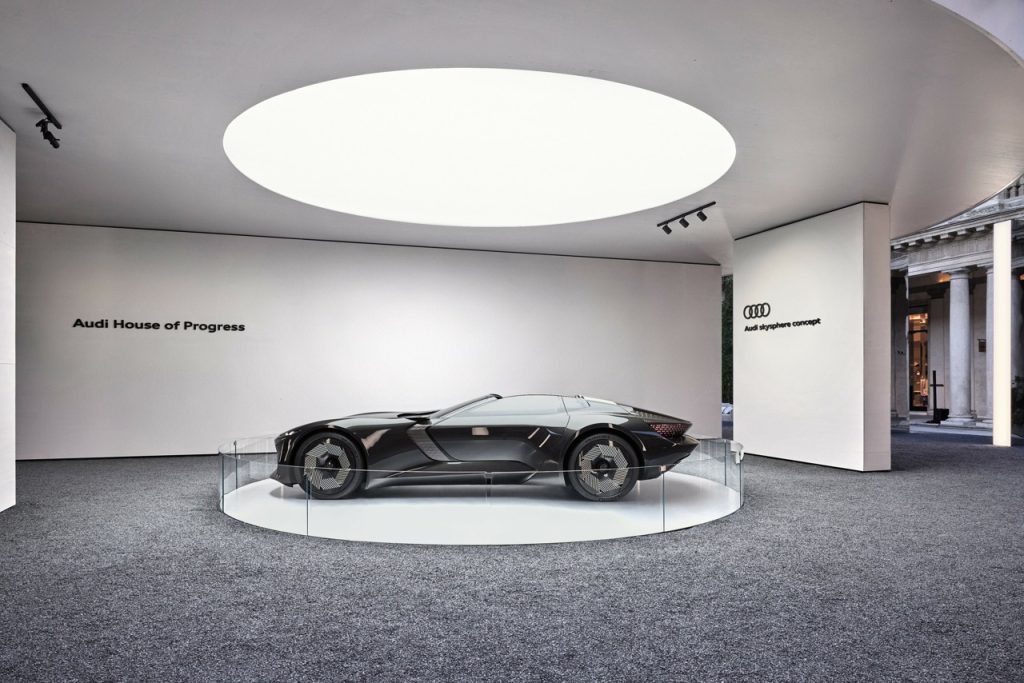
Skysphere deliberately invites comparison with the proportions of a traditional luxury roadster. The length ahead of the cabin becomes a design choice to investigate rather than immediate evidence of a combustion engine. This is a useful reminder that styling can carry a historical reference while the intended powertrain changes fundamentally. Read the side view as an arrangement of body, cockpit and wheels, then consult the technical brief for the architecture underneath. The best comparison explains both layers. It does not reduce the concept to a replica of an earlier car or assume that a familiar silhouette makes its construction conventional.
Published electric-drive reference
Audi’s launch description specifies a rear-axle electric motor rated at 465 kW and 750 Nm. These values describe the concept’s published technical proposition. They should not be copied into a later customer model’s specifications or used as proof of the current exhibit’s installed output. For a running demonstration, an engineering record would need to identify the motor, battery, controls and test conditions. Separating the design reference from the object’s present condition is useful even when both are supplied by the manufacturer: it allows a reader to understand what was proposed, what was built and what was actually demonstrated.
A cockpit that can change its role
The interior makes skysphere’s two-experience proposition tangible. The central question is how a cockpit can support a person who sometimes drives and sometimes travels as a passenger. Consider the relationship between seat, steering controls, foot space and sightlines rather than simply counting displays. That framework lets a visitor read photographs more intelligently, including images taken with the car in a particular show configuration. A proposed automated mode does not prove that the driving system was validated for everyday use. It is the premise that makes the cabin experiment understandable and should be labelled as such whenever the concept’s functions are described.
Rarity without an invented customer build total
Skysphere belongs in a physical concept archive, not in a numbered road-edition census. A manufacturer presentation confirms a named study, while a complete count of development objects would need more specific archive evidence. This profile therefore leaves a numeric production total empty. Repeated exhibitions are not proof of additional builds, and a separate render or scale model should not be counted as a full-size vehicle. Where continuity of the original exhibit can be established, dated records can show a single object’s history. Where it cannot, the uncertainty should remain visible rather than be resolved by an attractive “one of one” headline.
The Milan photograph and its limits
The official image supplied here identifies skysphere at Audi’s House of Progress during Milan Design Week 2023. The event date is later than the 2021 introduction, which is normal for a concept with an ongoing exhibition life. The image confirms a display context and helps explain the vehicle’s open-roadster silhouette. It does not establish a fresh launch, a new production programme or a complete test of the variable-wheelbase system. Keep the event and launch dates in different fields. That simple distinction makes an archive more accurate and helps readers understand why a 2021 concept can appear in a photograph from 2023.
Skysphere alongside other Audi design studies
Compare it with grandsphere to see how the sphere programme adapts its occupant-focused argument to a different body shape. Compare it with the older quattro Spyder concept to explore how Audi has used an open two-seat sports-car study in another technological period. These comparisons should begin with the documented purpose of each object. They can then examine exterior proportions and cabin presentation without claiming identical engineering. A good related-profile route encourages a reader to investigate the differences. It should not imply that one concept is a direct production predecessor or successor unless the manufacturer establishes that relationship.
Documentation for the physical concept
An object dossier should identify the factory project, custodial chain and exhibition sequence, then explain the functioning and non-functioning systems. For a moving architectural concept, records of maintenance and demonstration procedures are especially informative. Ask whether the body, actuation hardware, controls and electrical assemblies remain in the specification documented at launch. Preserve changes as part of the object’s history rather than treating every later display as an untouched original state. Insurance, transport and safe-use requirements belong to the responsible custodian’s documentation. The public profile cannot supply them merely because a power figure and a dramatic studio photograph exist.
Why the concept’s design question is enduring
Skysphere asks whether one vehicle can express two different relationships between occupant and journey through a visible change of form. That is a more specific historical contribution than a generic claim to represent the future. The concept remains useful to the archive because the question, the introduction date and the physical presentation can all be documented even if future customer products take another path. Judge a later resemblance on its evidence and date rather than treating the study as a binding promise. This keeps the profile informative for design researchers, Audi enthusiasts and readers exploring how electric architecture can reshape a familiar roadster theme.
Frequently asked questions
When was skysphere introduced?
Audi announced the concept in August 2021. The credited Milan photograph documents a later 2023 display.
What is skysphere’s defining design feature?
Its published variable-wheelbase architecture can change wheelbase and overall length by up to 250 mm to support different driving and touring scenarios.
What power figures did Audi describe?
Audi published 465 kW and 750 Nm for the rear-axle electric motor in its concept brief. They are not a current inspection certificate.
Was it a customer production roadster?
No customer series is established here. It is treated as a physical concept archive subject; exact development-object numbers and validated autonomous operation remain separate questions.
Explore related vehicle profiles
Sources
History and published specifications follow the linked manufacturer records. Visual comparisons, documentation questions and inspection priorities are editorial analysis. Photographs retain their original subject descriptions and separate rights records.
Photography and credit
Audi skysphere concept displayed at Milan Design Week 2023; official photograph A231664. Photo: AUDI AG / Audi Media Center · Audi Media Center: editorial use free of charge. Resized without cropping or color alteration.
Why this machine matters
An electric roadster concept introduced in 2021, using a variable-wheelbase design to explore the relationship between a driver’s sports car and a more spacious grand-touring experience.
Built in limited numbers
Skysphere belongs in a physical concept archive, not in a numbered road-edition census. A manufacturer presentation confirms a named study, while a complete count of development objects would need more specific archive evidence. This profile therefore leaves a numeric production total empty. Repeated exhibitions are not proof of additional builds, and a separate render or scale model should not be counted as a full-size vehicle. Where continuity of the original exhibit can be established, dated records can show a single object’s history. Where it cannot, the uncertainty should remain visible rather than be resolved by an attractive “one of one” headline.
Gallery
Specifications
Factory specifications may vary by model year, market and configuration.
Identity & production
- Official model
- Audi skysphere concept
- Base model
- skysphere
Powertrain & performance
- Engine
- Published rear-motor electric concept architecture