Bentley Speed Six — Old Number One
Old Number One is the named Bentley that won Le Mans in 1929 and 1930, originally identified as chassis LB2332 and registration MT3464. Its later rebuilding makes it an important study in historical continuity and physical originality. This guide preserves both the racing achievement and the distinction between the winning configurations and the surviving car’s later form.
Old Number One is the named Bentley that won Le Mans in 1929 and 1930, originally identified as chassis LB2332 and registration MT3464. Its later rebuilding makes it an important study in historical continuity and physical originality. This guide preserves both the racing achievement and the distinction between the winning configurations and the surviving car’s later form.
Bentley Speed Six — Old Number One at a glance
| Manufacturer | Bentley |
|---|---|
| Model / family | Speed Six |
| Profile scope | Named historic competition vehicle |
| Historical reference year | 1929 |
| Inventory reference | BEN-020 |
| Engine reference | 6½ Litre inline-six in the Le Mans history; later forms included different components |
| Documented individual subject | Old Number One, original LB2332 / MT3464; later rebuilt forms retain documented historical continuity |
| Inventory date note | 1930 in supplied inventory; historical build or launch reference corrected above |
Two victories and one continuing identity
Old Number One belongs to Bentley’s most successful early endurance chapter. The ACO records Woolf Barnato and Tim Birkin as the 1929 winning pair, followed by Barnato and Glen Kidston in 1930. The historic name connects those campaigns with a vehicle whose form continued to change afterwards. That combination is the subject of this profile. It is not a generic Speed Six guide, nor a claim that every car subsequently built to resemble the winner carries its racing identity. The original build reference is 1929; the inventory’s 1930 date describes the second victorious season rather than the first assembly. Keeping both years visible helps readers understand why different records can emphasise different dates without necessarily describing different cars. The achievement remains precise even when the later material history is complicated.
The original chassis and the Le Mans configurations
The 1990 judgment account identifies the original chassis as LB2332 and engine LB2336, prepared for competition from Bentley’s production line. It describes the car’s development between its early races and the next Le Mans campaign. These identities and configurations should be treated as historical stages, not a specification frozen forever. A competition car can be rebuilt to suit a new season while remaining known by the same name. For a reader examining a photograph, the date and event therefore matter. A later streamlined body, a road-use body or a reconstruction of a racing form may all belong to the continuing account, but none should be captioned automatically as the untouched 1929 winner. The original chassis number anchors the history; it does not certify that every chassis member now present dates from the first construction.
Why the name can be confused with other Bentleys
Old Number One, Blower No. 1 and Team Car No. 2 are different subjects. Their names contain numbers, but those numbers arise from different histories. A race-entry number is not necessarily a permanent chassis identity, and a later commemorative edition is another separate programme. The practical way to avoid confusion is to pair each familiar name with its model family, registration and source. Old Number One belongs to the Speed Six history associated with MT3464. The Birkin single-seater is the supercharged HB3402 / UU5871, while the original Team Blower is HB3403 / UU5872. A green racing body or a prominent Bentley radiator does not bridge those identities. Precise naming allows the stories to be linked and compared naturally without giving a Blower the Speed Six’s victories or borrowing the single-seater’s Brooklands record.
Rebuilding and the question of originality
Old Number One’s later life included significant chassis, engine and body changes. The judgment distinguishes its continuing historical identity from the physical originality of the machines that crossed the Le Mans finishing line. This is the key qualification for an honest profile. It is possible to describe the car as the continuing historic Old Number One while explaining that its later form is not composed wholly of the components used in either winning race. Avoid the shortcut of turning authenticity into a percentage without a complete component study. Different parts also carry different evidential importance. A continuous ownership and service history may establish one kind of claim, while the age and identity of a frame or engine establish another. The reader deserves to know which question a source is actually answering.
Using the 1990 judgment as a historical record
The judgment is useful here as a dated account of documentary and expert evidence about this particular car. Its conclusion recognised historical continuity while separating that finding from untouched physical originality. This profile uses that distinction to explain the surviving object, not as a universal rule for every rebuilt racing car or as present legal advice. The linked transcription should also be read with care: the original court record is the authoritative reference if exact wording is required. Historical reports can contain transcription errors, so an isolated line should not override the consistent vehicle identity established elsewhere. A good study file would retain the judgment, the underlying service and registration evidence, and later restoration records together. That allows subsequent appearances to be interpreted without pretending that a report from 1990 is a current condition certificate.
What the Hampton Court photograph establishes
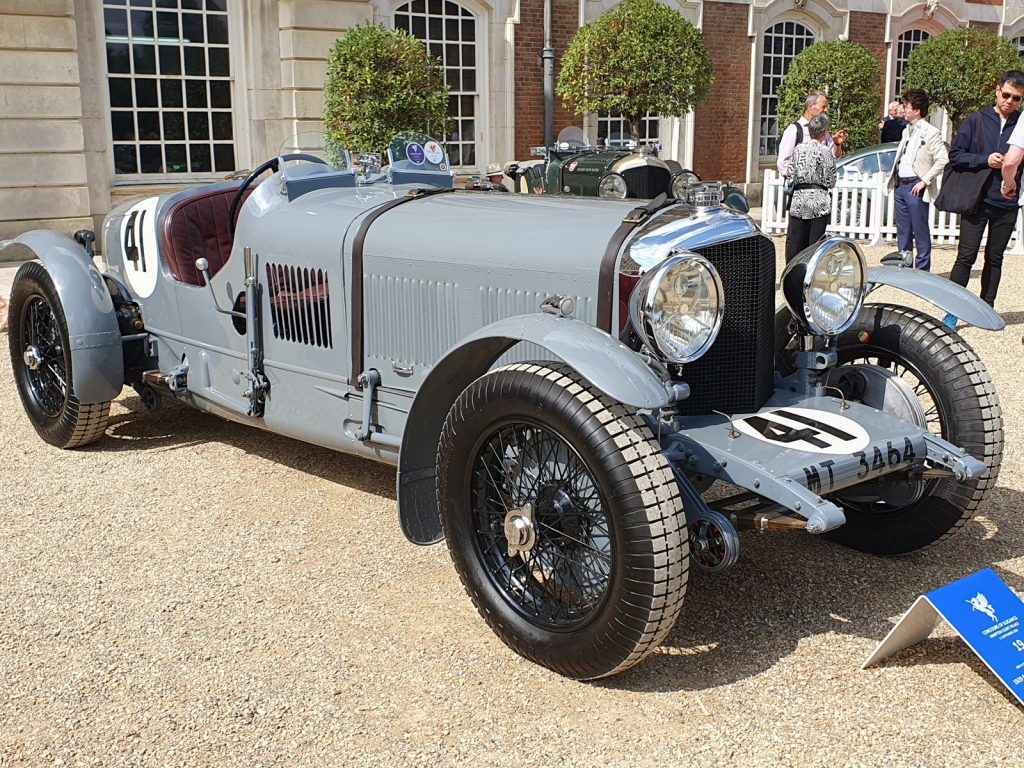
The featured photograph identifies Old Number One, MT3464, at Hampton Court in September 2023. It records a modern appearance of the surviving historic car rather than the 1929 or 1930 race itself. That is a useful illustration as long as the caption preserves the distinction. Readers can study the body presentation and visible fittings, then compare them with period photographs and the documented rebuilding sequence. The image cannot independently date every component or prove which internal engine parts are installed. Its creator, date and licence remain visible so the source can be checked. This is particularly important for a car frequently reproduced in models, replicas and tribute builds. The archival identity comes from the historical record, while the modern photograph gives a clearly dated view of the object presented under that identity.
How a careful collection file should be arranged
For Old Number One, a single headline specification is less useful than a chronological record. Separate the initial Speed Six build, the two Le Mans campaigns, later competition development, road-use forms and subsequent restoration. Under each stage, record the supporting documents and explain what is known about the chassis, engine and body. That arrangement helps prevent contradictory-looking photographs from being mistaken for different cars or, conversely, different cars from being merged because they share a familiar name. It also exposes where evidence remains incomplete. A period race result can establish an achievement without proving the present engine’s originality. A restoration invoice can explain a replacement without establishing the original race entry. Reading those documents for their proper purpose makes the file more reliable and the history more interesting.
Its place in the Bentley competition story
The strongest comparison is with the 1924 winner and the Blower team car. The first shows Bentley’s initial Le Mans success, the second shows a different technical direction that did not deliver the same 1930 result, and Old Number One shows the Speed Six’s achievement across two seasons. These connections explain why the car remains significant even after extensive rebuilding. They also offer a way to appreciate historic competition machines without requiring every survivor to be an untouched time capsule. The essential archive task is to preserve the identity, results and material changes together. Old Number One is compelling because all three are substantial. Its value as a subject comes from the depth of that history, rather than an invented current price, a simplified originality badge or a racing result transferred to a lookalike.
Frequently asked questions
Which races did Old Number One win?
It won Le Mans in 1929 with Barnato and Birkin, and in 1930 with Barnato and Kidston.
Which identity anchors its original history?
The historical record identifies the original chassis as LB2332 and the familiar registration as MT3464.
Is the surviving car physically unchanged from its victories?
No. Significant rebuilding is documented. Historical continuity and the physical configuration used in a particular winning race are different claims.
Is Old Number One the same as Blower No. 1?
No. Old Number One belongs to the Speed Six history; the Birkin Blower single-seater is a separate supercharged four-cylinder car.
Explore related vehicle profiles
- Bentley 3 Litre — 1924 Le Mans Winner
- Bentley Blower No. 1 — Birkin Single-Seater
- Bentley Blower Team Car No. 2 — UU5872
Sources
- ACO — Bentley Boys and the 1924–1930 victories
- Hubbard v Middlebridge — 1990 judgment transcription on Old Number One
- Bentley — Paul Williams describes driving Old Number One
Historical facts follow the linked manufacturer, race-organizer, institutional and specialist records. Visual comparisons and documentation priorities are editorial analysis. Dated specifications, restoration accounts and published estimates retain their original scope; they do not certify a car’s current condition.
Photography and credit
Bentley Speed Six Old Number One, registration MT3464, displayed at Hampton Court in September 2023. This is the surviving car in its later appearance, not a contemporary Le Mans photograph. Photo: Mwsmith20 / Wikimedia Commons · CC BY-SA 4.0. Resized proportionally where needed and saved as JPEG; no additional cropping or color alteration. Use under the linked Creative Commons license; adapted photographs retain the same license when ShareAlike applies.
Why this machine matters
Old Number One is the named Bentley that won Le Mans in 1929 and 1930, originally identified as chassis LB2332 and registration MT3464. Its later rebuilding makes it an important study in historical continuity and physical originality. This guide preserves both the racing achievement and the distinction between the winning configurations and the surviving car’s later form.
Built in limited numbers
Original1929 build; inventory1930 is second Le Mans winning season. Historic continuity retained with substantial rebuild disclosed; no untouched1929 / 1930 physical-original claim. Different from BA2580 recreation.
Gallery
Specifications
Factory specifications may vary by model year, market and configuration.
Identity & production
- Official model
- Bentley Speed Six — Old Number One
- Base model
- Speed Six
Powertrain & performance
- Engine
- 6½ Litre inline-six in the Le Mans history; later forms included different components