Bentley Embiricos — Paulin / Pourtout Coupé
The Embiricos Bentley is the named aerodynamic one-off associated with André Maris Embiricos, Georges Paulin and Pourtout. It links Bentley’s Derby-era chassis with French coachbuilding and later Continental design thinking. Official accounts use both 1938 and 1939 references, which this profile keeps visible rather than treating every date as the same milestone.
The Embiricos Bentley is the named aerodynamic one-off associated with André Maris Embiricos, Georges Paulin and Pourtout. It links Bentley’s Derby-era chassis with French coachbuilding and later Continental design thinking. Official accounts use both 1938 and 1939 references, which this profile keeps visible rather than treating every date as the same milestone.
Bentley Embiricos — Paulin / Pourtout Coupé at a glance
| Manufacturer | Bentley |
|---|---|
| Model / family | Derby Bentley 4¼ Litre |
| Profile scope | Named coachbuilt one-off |
| Historical reference year | 1939 |
| Inventory reference | BEN-030 |
| Engine reference | Derby Bentley 4¼ Litre six-cylinder petrol platform |
| Documented individual subject | Original named Embiricos / Paulin / Pourtout commission; replicas and scale models excluded |
A named commission with an aerodynamic purpose
The Embiricos Bentley is compelling because its identity joins a particular commission with a distinctive design purpose. Bentley’s official history describes the streamlined one-off associated with André Maris Embiricos and Georges Paulin, while the car’s Pourtout coachwork gives the project its physical form. The profile concerns that named full-size car, not the many later models, replicas or bodies inspired by its shape. That definition matters for both rarity and photography. A one-off commission can be documented without suggesting that every coachbuilt Derby Bentley was unique in the same way or that every similar fastback belongs to the commission. Start with the named object, then follow the evidence about its design, construction and influence. The resulting history is richer than a simple caption describing an old Bentley with an unusual roof.
Why the dates need explanation
The supplied inventory places the Embiricos Bentley in 1939. Bentley’s heritage-garage account refers to the Embiricos of 1938, while its current official timeline describes design in 1938 and completion in 1939. These references deserve to remain visible rather than being silently reduced to one supposedly undisputed date. This profile retains 1939 as the inventory’s principal reference and describes the project across the 1938–1939 chronology. It does not claim to have resolved every build, delivery and testing milestone from a complete chassis archive. For readers, the lesson is useful beyond this particular car: a design date, a completion date and the date used in a later model summary may serve different purposes. The strongest individual chronology comes from dated original records, interpreted alongside the manufacturer’s later accounts.
Paulin’s design and Pourtout’s coachwork
The Embiricos story benefits from separating design authorship from body construction. Paulin is associated with the aerodynamic design; Pourtout is associated with the coachwork. Those roles are related but not interchangeable. A coachbuilt car is the product of several decisions, from the mechanical platform to body proportions, materials and construction methods. For a reader looking at the featured photograph, consider the transition from bonnet to windscreen, the roof’s continuation toward the tail and the way the wings sit within the overall composition. These observations explain what makes the form distinctive without pretending to measure aerodynamic performance from an image. A full research file would add drawings, correspondence, coachbuilder records and dated photographs. That evidence allows the car to be understood as a specific collaboration rather than a loose example of fashionable streamlining.
The Derby Bentley platform
The manufacturer identifies the Embiricos car with a 4¼ Litre Bentley chassis. That anchors the commission in the Derby-era mechanical family and separates it from the earlier Cricklewood 4½ Litre Blowers. The similar-looking capacity names should not obscure the different models. A streamlined body also does not change a car into a later R-Type Continental simply because the design influenced subsequent thinking. For this profile, the mechanical description remains at the supported model-family level; an exact current power figure, component inventory or installed specification is not invented. Those claims would need a dated record for the individual car. Readers interested in the relationship between body and chassis can still explore it meaningfully by comparing the named commission with the Corniche prototype and later Continental, while preserving each project’s own identity and manufacturing context.
Streamlining and the grand-touring idea
Bentley’s 2022 Continental anniversary account identifies the Embiricos and the pre-war Corniche as demonstrations of improved aerodynamics that informed later thinking. That is the documented historical connection. The editorial comparison concerns how a flowing enclosed body can express fast-distance travel differently from an upright open tourer. It does not establish a numerical drag advantage for the pictured car. Avoid converting influence into a claim that the Embiricos was already a production Continental under another name. The later model had its own engineers, chassis development and manufacturing population. The one-off’s role is interesting enough on its own: it offered a concrete example of how Bentley mechanicals and an aerodynamically ambitious body could be combined. That makes it a useful bridge between coachbuilt experimentation and the better-known post-war grand-touring chapter.
The actual car in a credited photograph
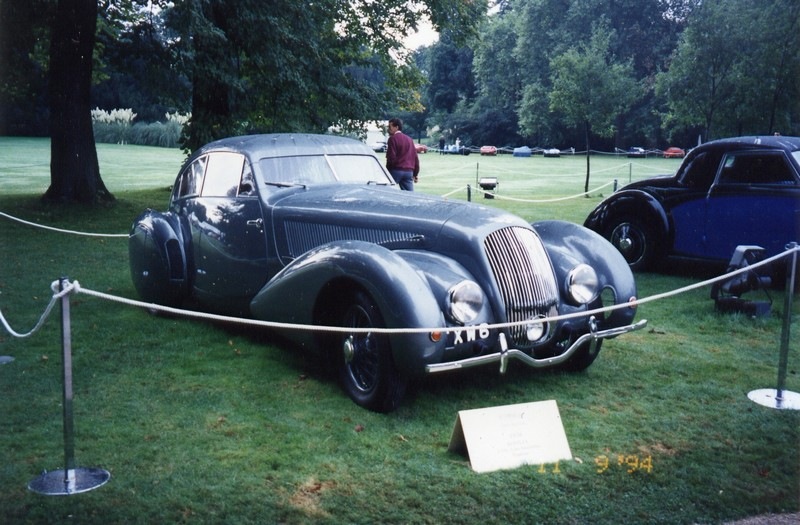
The bundled photograph by Kévin Pourtout identifies the full-size Embiricos Bentley at the Bagatelle concours. Its source is particularly useful because many search results for this car instead show small models or replicas. The image is an archival event photograph of the real subject as identified by its creator, not a generated substitute or a photograph of a Minichamps model. It remains a relatively modest-resolution image, so it is preserved without artificial upscaling. The visible caption makes the subject and source clear. It does not certify every component’s originality or replace a chassis inspection. A reader can use it to observe the body’s overall composition, while the manufacturer and coachbuilding records provide the historical framework. Authenticity of subject and completeness of mechanical provenance remain different questions.
One-off identity and the limits of a database count
This profile follows the original named Embiricos commission. That one-off scope should not be expanded to include every later replica, interpretation or derivative body. Nor should the car be added to a parent model total as if the separate profile created a new extra chassis. A database can give a significant individual vehicle its own page while explaining its place within a wider mechanical family. For closer research, distinguish the commission identity, chassis record, body authorship and any later alterations. The relevant question is which documented object the reader is seeing. A familiar outline or a car advertised as Embiricos-style is not sufficient. Clear naming protects the useful rarity claim and makes it possible to discuss related designs honestly without implying that they all belong to the same original one-car commission.
A study file for a coachbuilt Bentley
The most useful file would bring together the original correspondence, chassis information, coachbuilder evidence and dated views of the car. Organise the material chronologically so that a change of appearance or a conflicting year can be investigated rather than hidden. When a modern description gives a precise engine output or performance figure, check which configuration and source it represents before copying it into the profile. The featured photograph cannot answer those questions by itself. Compare the Embiricos with the Corniche to explore the different survival histories of connected design projects, and with the 8 Litre to explore another form of Bentley coachbuilt ambition. The result is a guide that explains why this particular car matters: a documented named commission, a distinctive aerodynamic body and a place in the development of Bentley’s grand-touring language.
Frequently asked questions
Who designed and bodied the Embiricos Bentley?
The car is associated with Georges Paulin’s aerodynamic design and Pourtout coachwork, commissioned for André Maris Embiricos.
Is it a 1938 or 1939 car?
Official Bentley accounts use both references. This profile explains the 1938–1939 project chronology and retains the inventory’s1939 reference without declaring every milestone resolved.
Is it the same car as the 1939 Corniche?
No. They are connected but distinct projects. The Corniche is associated with Vanvooren bodywork; the Embiricos car with Pourtout.
Does the included image show a replica or scale model?
The credited Pourtout photograph identifies the full-size Embiricos car at Bagatelle. Models and explicitly labelled replicas were excluded from the photo selection.
Explore related vehicle profiles
Sources
- Bentley Motors — official model and heritage timeline
- Bentley — 70 years of the R-Type Continental, May 2022
- Bentley Motors — Corniche and the development of the Continental
Historical facts follow the linked manufacturer, race-organizer, institutional and specialist records. Visual comparisons and documentation priorities are editorial analysis. Dated specifications, restoration accounts and published estimates retain their original scope; they do not certify a car’s current condition.
Photography and credit
The Embiricos Bentley with Pourtout coachwork at the Bagatelle concours, photographed by Kévin Pourtout. This is the full-size car, not a scale model or replica. Photo: Kévin Pourtout / Wikimedia Commons · CC BY-SA 3.0. Resized proportionally where needed and saved as JPEG; no additional cropping or color alteration. Use under the linked Creative Commons license; adapted photographs retain the same license when ShareAlike applies.
Why this machine matters
The Embiricos Bentley is the named aerodynamic one-off associated with André Maris Embiricos, Georges Paulin and Pourtout. It links Bentley’s Derby-era chassis with French coachbuilding and later Continental design thinking. Official accounts use both 1938 and 1939 references, which this profile keeps visible rather than treating every date as the same milestone.
Built in limited numbers
Named full-size aerodynamic one-off; Pourtout andPaulin roles separated. Inventory1939 retained with official1938/1939 chronology conflict disclosed. No unsupported exact chassis or performance number populated.
Gallery
Specifications
Factory specifications may vary by model year, market and configuration.
Identity & production
- Official model
- Bentley Embiricos — Paulin / Pourtout Coupé
- Base model
- Derby Bentley 4¼ Litre
Powertrain & performance
- Engine
- Derby Bentley 4¼ Litre six-cylinder petrol platform