Bentley Blower — Original Production Cars
The original production Blower Bentleys combined a 4½ Litre four-cylinder engine with supercharging. The National Motor Museum identifies fifty production cars, a scope kept separate here from Birkin’s competition machines and modern continuations. The featured museum example also shows why a genuine original chassis and original coachwork are different claims.
The original production Blower Bentleys combined a 4½ Litre four-cylinder engine with supercharging. The National Motor Museum identifies fifty production cars, a scope kept separate here from Birkin’s competition machines and modern continuations. The featured museum example also shows why a genuine original chassis and original coachwork are different claims.
Bentley Blower — Original Production Cars at a glance
| Manufacturer | Bentley |
|---|---|
| Model / family | 4½ Litre Blower |
| Profile scope | Rare original production series |
| Historical reference year | 1929 |
| Inventory reference | BEN-013 |
| Engine reference | 4,398 cc supercharged inline-four petrol |
| Original model production | 50 — Original production supercharged cars, National Motor Museum definition; racers and modern continuations excluded |
What makes an original production Blower special
The Blower is visually memorable because its supercharger sits prominently ahead of the engine, giving the car an unmistakable mechanical presence. Yet the most useful starting point is the production identity behind that appearance. This profile concerns the original supercharged production cars, not every Bentley subsequently fitted with a blower and not the modern factory continuation programme. That narrower definition gives the history a meaningful rarity boundary. It also makes the collector questions more concrete: was the chassis built as a production supercharged Bentley, what engine and blower does it now carry, and how has its body changed? A correct answer requires records rather than a famous silhouette. The car can be admired for the boldness of its engineering while still being described precisely enough to distinguish an original machine from a later conversion.
Fifty production cars and differing wider totals
The National Motor Museum calls its car one of fifty production supercharged Bentleys. Bentley’s Team Car No. 2 account describes an approval for fifty-four supercharged cars, with four allocated for competition. The museum separately refers to five Birkin racing cars. These records do not provide a single fully reconciled chassis ledger, so this profile does not force their wider totals into an artificial agreement. The fifty production-car figure is retained with its museum-defined scope. It is not silently converted into a certified fifty-four- or fifty-five-car worldwide census, nor are historic racers added to the road population as separate customer production. This is particularly important for a rare-vehicle database, where a neat-looking number can disguise differences in allocation, construction, conversion or the identity of a car that changed during development.
Birkin, Villiers and supercharging
The museum attributes the programme’s development to Sir Henry Tim Birkin and identifies Amherst Villiers with the Roots-type supercharger. Those names help explain why the Blower belongs to a distinct engineering chapter. Supercharging offers a way to increase the charge delivered to the engine, but it also introduces hardware, drive arrangements and operating considerations that should be understood as a system. A collector guide should therefore look beyond the presence of the front-mounted unit. The blower’s identity and specification, the engine’s configuration and the installation records all matter. This profile does not assume that every surviving example operates at the same boost or reproduces an identical racing tune. The published museum engine capacity is 4,398 cc. Output claims should remain attached to the road or competition specification from which they were taken.
Road cars and competition cars need different records
A touring car and a racing car can share an engine family while serving different purposes. The production Blower population should therefore be studied alongside Birkin’s racers, not merged with them. A racing output reference or competition result cannot be transferred automatically to a road chassis simply because the car now wears a sporting body. Equally, the fact that the Blower is famous does not make it the winner of Bentley’s 1929 or 1930 Le Mans victories; those successes belonged to Speed Six entries. Keeping the distinction clear allows the Blower’s technical and cultural importance to stand on its own. It also helps a reader interpret a photograph correctly. A genuine production example can illustrate the series without being described as Team Car No. 2 or the Brooklands single-seater.
The Beaulieu example and its later coachwork
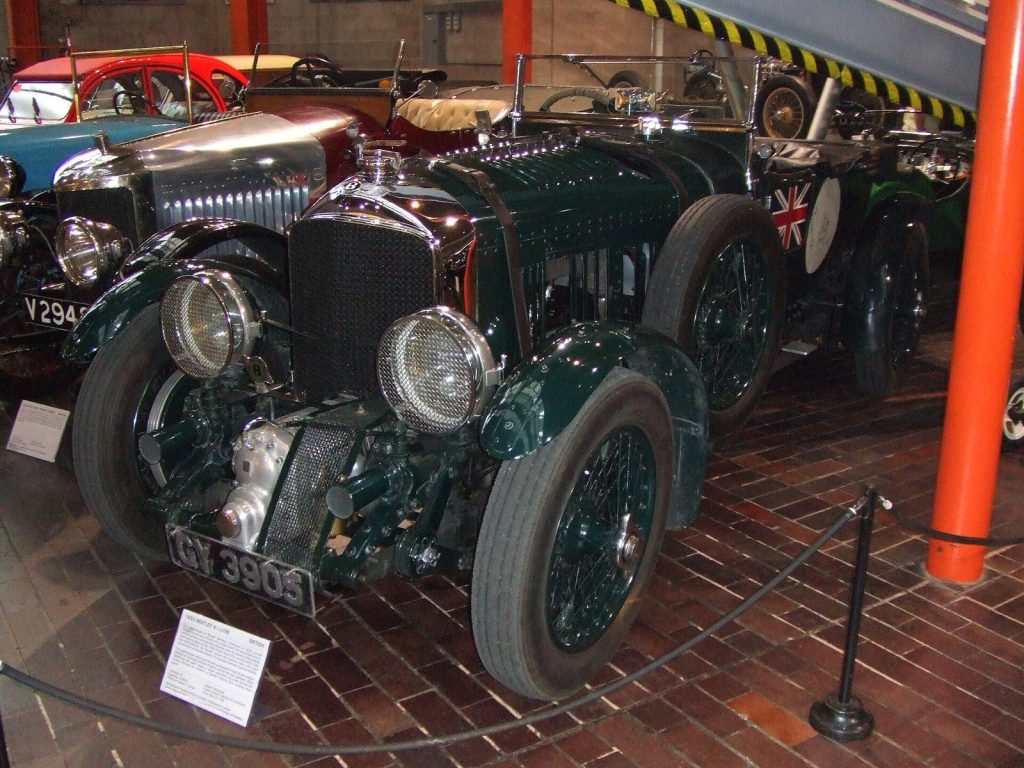
The featured photograph shows the National Motor Museum example, identified in the image record as chassis MS3946. The museum says its car originally had a Vanden Plas drophead coupé body and was later rebodied as an open tourer. That is a valuable lesson in how classic-car appearance can change. A period-looking touring body may be beautifully made and historically sympathetic without being the body fitted when the chassis was delivered. Body style should therefore be recorded separately from chassis authenticity. This caption makes the later rebody explicit and does not describe the photographed car as an untouched 1931 tourer. A full record would compare the original body description, subsequent photographs, coachbuilder evidence and restoration documentation before presenting any detailed claim about the material or construction of its current coachwork.
How to evaluate an original Blower identity
Begin with a chassis-linked build record and compare it with the engine and supercharger identities. Then separate what the original documents establish from what later owners or restorers changed. This is a method of asking useful questions, not a remote inspection certificate. A modern photograph cannot authenticate stampings, internal components or a claimed ownership chain. For a car offered with a substantial history file, the best reading order is chronological: factory origin, early use, major alterations, restoration and current specification. Discrepancies deserve an explanation rather than an immediate assumption of fraud or originality. A properly documented replacement component can be an honest part of a car’s history. What matters for a profile is that the explanation does not quietly turn that replacement into evidence that the complete machine remains exactly as built.
Continuation cars are a separate manufacturing programme
Bentley’s modern continuation project used its original Team Car No. 2 as a reference, including detailed scanning of components. The new cars are significant in their own right, but they are newly constructed vehicles from a separate programme. Their production does not increase the number of original interwar customer cars. Nor does factory involvement transform a continuation into a chassis delivered in the early 1930s. The practical implication is simple: keep manufacturing date, programme name and vehicle identity visible in a collection database. A reader should be able to tell whether a photograph shows an original production car, an original competition car, a modern continuation or a different replica or conversion. That clarity protects the usefulness of both the original and continuation profiles while leaving room to discuss their engineering relationship.
Collector appeal beyond an imposing photograph
The Blower’s attraction lies in the combination of a small documented production population, a distinctive mechanical solution and its connection with Bentley’s competition era. A useful guide can explain those qualities without predicting auction prices or promising future appreciation. For closer study, compare this road-series profile with the single-seater No. 1 and Team Car No. 2. The differences in body, use and identity are at least as informative as their shared supercharged engine family. Also compare the naturally aspirated 8 Litre, which represents another answer to the pursuit of performance and refinement. Reading the cars together encourages a deeper understanding of Bentley engineering. It replaces the assumption that all famous vintage Bentleys are equivalent with a more interesting picture of distinct approaches, individual histories and clearly bounded rarity claims.
Frequently asked questions
How many original production Blowers were built?
The National Motor Museum identifies fifty production supercharged cars. This profile retains that road-production scope and explains differing wider racing-family counts.
Did the Blower win Bentley’s 1930 Le Mans victory?
No. Bentley’s winning entry was a Speed Six. Team Blower No. 2 raced but retired; road-series cars do not inherit that racing history.
Is the featured tourer’s body its original coachwork?
The museum says its example originally had a Vanden Plas drophead coupé body and was later rebodied as an open tourer.
Do modern continuation cars count as original Blowers?
No. They belong to a separate modern manufacturing programme, even though Bentley used an original team car as its reference.
Explore related vehicle profiles
Sources
- National Motor Museum — production Blower and its coachwork history
- Bentley Heritage Collection — original Team Blower No. 2, UU5872
- Bentley — first new Blower and the original master car, December 2020
Historical facts follow the linked manufacturer, race-organizer, institutional and specialist records. Visual comparisons and documentation priorities are editorial analysis. Dated specifications, restoration accounts and published estimates retain their original scope; they do not certify a car’s current condition.
Photography and credit
An original production Blower Bentley, chassis MS3946, at the National Motor Museum, Beaulieu, photographed in 2006. Its open tourer body is a later rebody, as documented by the museum. Photo: Hugh Llewelyn / Wikimedia Commons · CC BY-SA 2.0. Resized proportionally where needed and saved as JPEG; no additional cropping or color alteration. Use under the linked Creative Commons license; adapted photographs retain the same license when ShareAlike applies.
Why this machine matters
The original production Blower Bentleys combined a 4½ Litre four-cylinder engine with supercharging. The National Motor Museum identifies fifty production cars, a scope kept separate here from Birkin’s competition machines and modern continuations. The featured museum example also shows why a genuine original chassis and original coachwork are different claims.
Built in limited numbers
50 museum-defined production supercharged cars. Manufacturer54/four competition and museum five racing cars are not fully reconciled; no fabricated combined census. Beaulieu photo explicitly a later rebody.
Gallery
Specifications
Factory specifications may vary by model year, market and configuration.
Identity & production
- Official model
- Bentley Blower — Original Production Cars
- Base model
- 4½ Litre Blower
- Worldwide production
- 50
Powertrain & performance
- Engine
- 4,398 cc supercharged inline-four petrol