Bentley 8 Litre
The Bentley 8 Litre was the final flagship designed by W.O. Bentley for the original company. Bentley records one hundred examples built between 1930 and 1932. Its large six-cylinder engine and individually commissioned coachwork make it a distinct collector subject, with W.O.’s personal GK706 providing a documented example rather than a specification for every car.
The Bentley 8 Litre was the final flagship designed by W.O. Bentley for the original company. Bentley records one hundred examples built between 1930 and 1932. Its large six-cylinder engine and individually commissioned coachwork make it a distinct collector subject, with W.O.’s personal GK706 providing a documented example rather than a specification for every car.
Bentley 8 Litre at a glance
| Manufacturer | Bentley |
|---|---|
| Model / family | 8 Litre |
| Profile scope | Rare original production model |
| Historical reference year | 1930 |
| Inventory reference | BEN-022 |
| Engine reference | 7,983 cc inline-six petrol |
| Original model production | 100 — Original Bentley 8 Litre model production,1930–1932 |
| Inventory date note | 1931 in supplied inventory; historical build or launch reference corrected above |
The flagship at the end of the W.O. era
The 8 Litre represents an ambition different from the stripped-down racing Bentleys that often dominate the marque’s early image. It sought substantial performance with the refinement expected of an expensive flagship, leaving room for the customer’s chosen coachwork. Bentley dates the model’s introduction to 1930 and records production through 1932. The inventory’s 1931 reference therefore belongs within the build period rather than defining the launch year. This profile uses 1930 as the model’s starting reference and retains the broader chronology. That precision helps explain why individually dated cars can differ without contradicting the model history. The 8 Litre deserves to be read as a complete engineering and coachbuilding programme, not simply as an enlarged racing car or a grand name applied retrospectively to any large vintage Bentley.
One hundred chassis and the rarity scope
The manufacturer records one hundred examples built between 1930 and 1932. That is a model production total, not a later announced allocation or a count of present survivors. Individual body variants and named cars belong within that original population unless a separate manufacturing history establishes otherwise. W.O. Bentley’s personal example is important, but its existence does not add another car beyond the model total. The distinction matters when an archive gives both the series and a notable chassis detailed coverage. Two profiles can discuss overlapping history without being two additional cars. No current global survival census is populated here. A dated specialist estimate can be useful background, but it should not be turned into an exact live number without a complete register and a clear definition of what counts as a surviving original vehicle.
The large six-cylinder engine
The Heritage Collection account describes a 7,983 cc six-cylinder engine, with four valves per cylinder and advanced features for its period. Capacity gives a sense of the model’s scale, but it does not answer every question about performance or refinement. The arrangement of the engine, its valve gear, ignition and construction are useful points of study. For a reader examining an individual car, confirm the engine identity and any documented internal changes before applying a general model specification. A later competition special using an 8 Litre engine is a different configuration from a coachbuilt 8 Litre road car. The engine family may connect the subjects, but it should not merge their identities. A careful specification table states the historical reference and leaves individual installed-condition claims to the records relevant to that car.
Performance and the role of coachwork
Bentley’s heritage account says the company guaranteed 100 mph capability regardless of chosen coachwork. That is a historical manufacturer claim, not a contemporary road-test result or advice about using a surviving car at that speed. Its interest is the relationship between an ambitious chassis programme and the variety of bodies customers could select. Body weight, construction and aerodynamic form still matter when interpreting an individual example. For an encyclopedia, keep the period guarantee in the narrative and avoid turning it into a measured current maximum for every restored 8 Litre. Readers benefit from knowing what the factory promised and what the claim was intended to demonstrate. They also benefit from recognising that tyres, maintenance, alterations and present condition cannot be certified by a general historical description or a modern photograph.
GK706, the founder’s own example
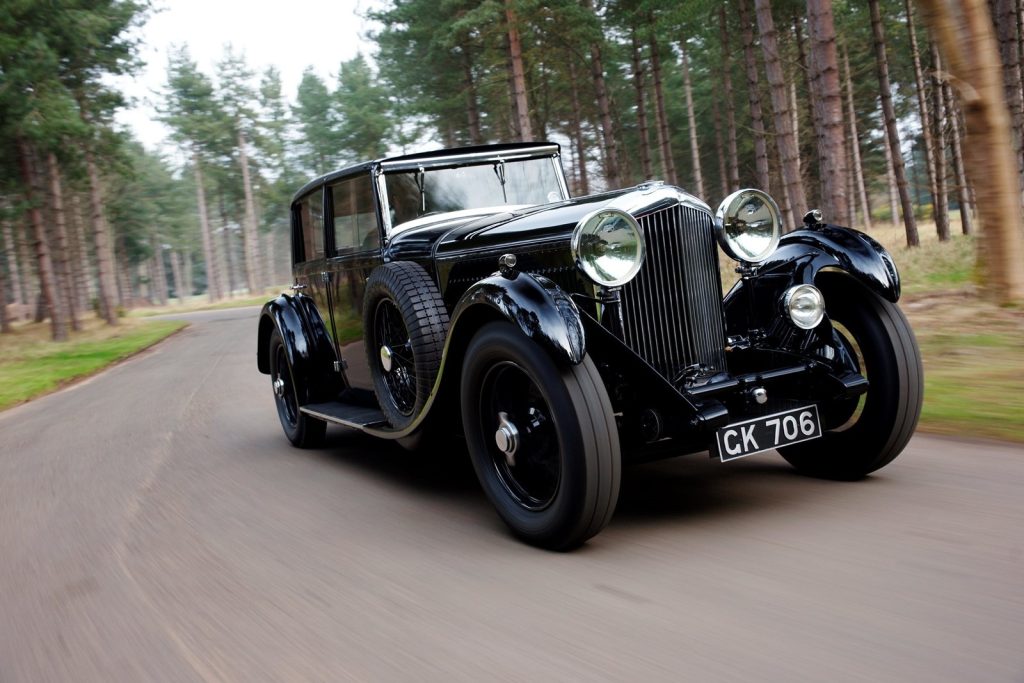
The featured car is GK706, documented by Bentley as W.O.’s personal 8 Litre and maintained in its Heritage Collection. It illustrates the model through a specific, well-described example. The manufacturer identifies HJ Mulliner coachwork and discusses the car’s ownership and later restoration history. Those details should remain attached to GK706, rather than becoming the assumed body and specification of all one hundred chassis. A named owner gives the example particular historical interest, but the more informative questions concern its delivery form, material changes and continuing documentation. The present photograph shows a restored heritage vehicle, not a guarantee that every fitting has survived unchanged from W.O.’s use. That clear caption lets the car illustrate the flagship while preserving the individuality that makes coachbuilt Bentleys rewarding subjects for research.
Original bodies and later sporting presentations
A surviving 8 Litre can have a long history of body alterations, mechanical work or changed use. A sporting open body may be visually convincing without being the coachwork selected by the original customer. For a detailed individual record, follow the chassis and body separately: who built the first body, what evidence describes it, when later coachwork appeared and which parts were retained. An attractive restoration does not answer those questions on its own. Equally, a documented rebody need not erase the car’s entire history; it should be explained as a later chapter. This approach is especially useful when a large chassis becomes a special or a tribute racer. The resulting vehicle may deserve coverage, but its later configuration should not be presented as representative of the complete original road-model population.
The later W.O. Edition connection
Bentley’s 2018 Mulsanne W.O. Edition commemorated the founder and his personal 8 Litre, incorporating material from an old crankshaft associated with GK706. That modern programme is an interesting historical connection, but it is not another batch of original 8 Litres. The commemorative Mulsannes retain their own model, manufacturing period and edition population. This distinction offers a useful lesson for reading heritage marketing: an authentic association can be meaningful without transferring the original car’s identity to every later tribute. For the archive, link the stories while keeping their counts and specifications separate. The original flagship belongs to the 1930–1932 hundred-car series. The later edition belongs to a modern named programme. Readers can appreciate the connection more clearly when neither population is used to inflate or redefine the other.
What to study in a collector file
The best starting point is a chassis-linked delivery record followed by coachbuilder evidence and a dated ownership chronology. Then review the engine, gearbox, body construction and restoration documentation for that individual car. These are research priorities, not a diagnosis of GK706 or every 8 Litre. A photograph cannot reveal the condition of structural material, the identity of internal components or the completeness of a claimed provenance chain. Compare the 8 Litre with the 4 Litre to explore the shared chassis context, and with the production Blower to explore a different route to performance. EXP2 supplies the earlier experimental beginning. Together these profiles show the range of Bentley’s ambitions before and around the company transition, while allowing the 8 Litre’s small documented production and flagship purpose to remain the centre of its own story.
Frequently asked questions
How many Bentley 8 Litres were built?
Bentley records one hundred examples, built between 1930 and 1932. This is the original model total.
Was it introduced in 1931?
The manufacturer dates the launch to 1930. The inventory’s 1931 reference lies within the production period.
Which car is shown in the featured photo?
The photograph comes from Bentley’s GK706 Heritage Collection record, illustrating W.O. Bentley’s personal 8 Litre.
Are W.O. Edition Mulsannes part of the 8 Litre total?
No. The modern Mulsanne commemorative programme is separate from the original one-hundred-car 8 Litre population.
Explore related vehicle profiles
Sources
- Bentley Heritage Collection — 8 Litre and GK706
- Bentley — W.O. Edition and the original 8 Litre, July 2018
- Vintage Bentley — 8 Litre model reference
Historical facts follow the linked manufacturer, race-organizer, institutional and specialist records. Visual comparisons and documentation priorities are editorial analysis. Dated specifications, restoration accounts and published estimates retain their original scope; they do not certify a car’s current condition.
Photography and credit
Bentley 8 Litre GK706, W.O. Bentley’s personal car, illustrates the 100-chassis model. Its present restored appearance is not a claim of untouched 1930 material. Photo: Bentley Motors (copyright credit) / Bentley Newsroom · Bentley Newsroom: free editorial reproduction. Resized proportionally where needed and saved as JPEG; no additional cropping or color alteration. Editorial vehicle-profile use only; the newsroom terms exclude advertising, marketing and sales use. Photographer not named on the supplied record.
Why this machine matters
The Bentley 8 Litre was the final flagship designed by W.O. Bentley for the original company. Bentley records one hundred examples built between 1930 and 1932. Its large six-cylinder engine and individually commissioned coachwork make it a distinct collector subject, with W.O.’s personal GK706 providing a documented example rather than a specification for every car.
Built in limited numbers
Manufacturer100 examples1930–1932; launch1930 corrects inventory1931 as model-start reference. GK706 only an illustrated chassis within model total; later rebodies, engine specials and Mulsanne tribute population separate.
Gallery
Specifications
Factory specifications may vary by model year, market and configuration.
Identity & production
- Official model
- Bentley 8 Litre
- Base model
- 8 Litre
- Worldwide production
- 100
Powertrain & performance
- Engine
- 7,983 cc inline-six petrol