Bentley 4 Litre
The Bentley 4 Litre is a fifty-car model from the closing chapter of the original Bentley company. Its six-cylinder engine and substantial chassis distinguish it from the similarly named 4½ Litre. This profile explains the small production run, model identity and the need to distinguish an original car from a later special or rebody.
The Bentley 4 Litre is a fifty-car model from the closing chapter of the original Bentley company. Its six-cylinder engine and substantial chassis distinguish it from the similarly named 4½ Litre. This profile explains the small production run, model identity and the need to distinguish an original car from a later special or rebody.
Bentley 4 Litre at a glance
| Manufacturer | Bentley |
|---|---|
| Model / family | 4 Litre |
| Profile scope | Rare original production model |
| Historical reference year | 1931 |
| Inventory reference | BEN-021 |
| Engine reference | 3,915 cc inline-six petrol, Ricardo inlet-over-exhaust design |
| Original model production | 50 — Bentley 4 Litre model population; current survivors and later specials counted separately |
Why this overlooked Bentley deserves a profile
Rarity does not always follow the most celebrated competition story. The 4 Litre is a useful example: a small production model whose interest lies partly in its position at the end of the original company’s development. Bentley’s timeline identifies only fifty, and the specialist model guide agrees on that total. That gives the profile a clear population rather than a vague statement that the car is uncommon. Its historical significance is different from a named Le Mans winner or an experimental prototype. It represents a model programme, with individual cars subsequently acquiring their own coachwork and ownership histories. Understanding that distinction makes the 4 Litre more interesting than treating it as a minor footnote beneath the 8 Litre. It shows another side of the decisions made during a difficult period for the manufacturer.
The 4 Litre and the 4½ Litre are different models
The similar names create an obvious trap. The 4 Litre discussed here is the six-cylinder model introduced in 1931; the 4½ Litre and its supercharged Blower derivatives belong to a different engine family. A photograph labelled four-litre Bentley casually may therefore be insufficient to establish the subject. Check the formal model name and supporting description before transferring a production total or specification. The distinction also matters for a collector database. A naturally aspirated 4½ Litre, a production Blower and a 4 Litre should not share one entry simply because the displacement names seem close. Their engines, purposes and counts are different. A careful profile states the capacity and cylinder arrangement clearly, while leaving uncertain individual-car details unpopulated until a reliable chassis-specific record is available.
Engine and chassis relationship
Vintage Bentley’s model guide gives the engine capacity as 3,915 cc with six cylinders and identifies a Ricardo inlet-over-exhaust design. Bentley’s timeline describes a platform based on a shortened 8 Litre chassis. These references help explain the model’s character without turning it into an 8 Litre with a different badge. Engine design, chassis dimensions and coachwork all contribute to how a car is configured. For a reader looking at a surviving example, the useful questions concern the original engine identity, the present mechanical installation and the body’s construction history. Do not infer a particular modern driving result solely from displacement. Equally, an engine replacement in a later special should not be presented as the standard 4 Litre specification. The original model and a modified individual car need separate descriptions.
Fifty cars, with chronology kept clear
The manufacturer’s timeline anchors the model in 1931. The specialist guide gives a production span of 1931–1933. Those references describe a launch milestone and a broader build or completion chronology, and this profile does not collapse them into a claim that every chassis was finished within one calendar year. The consistent fifty-car model total is retained separately from the dates. A total of cars built is also different from a count of cars surviving today. The specialist mentions known survivors, but a live complete register is not established here, so no present survivor figure is populated. That separation keeps the rarity claim durable. It allows a reader to understand the small original population without mistaking a dated specialist estimate for a continuously maintained census or assuming every surviving example retains its original body and engine.
Coachwork and the appearance of surviving examples
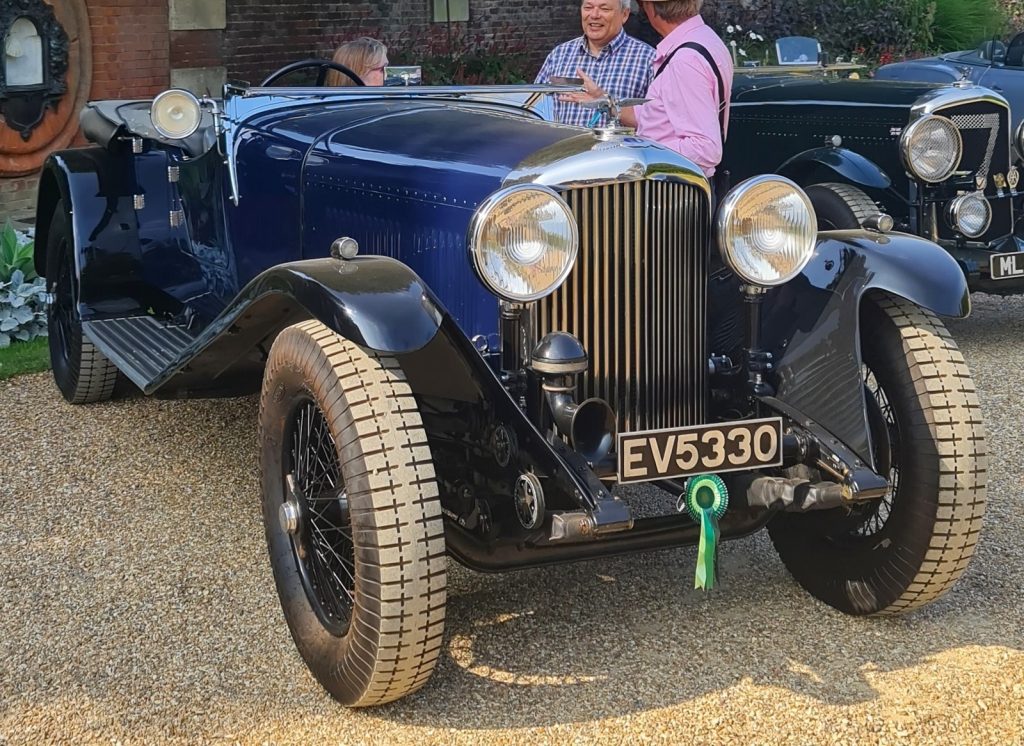
A model profile needs to allow for individual coachwork rather than imply that all fifty cars were visually identical. The featured photograph identifies a 4 Litre at Hampton Court in 2021, with Vanden Plas named in the image title. It is an illustration of the model, not independent proof that the depicted body is untouched original coachwork. That qualification is practical because many old Bentleys have been altered or rebodied. For an individual car, a strong record would connect the delivery specification, coachbuilder description, period photographs and later work. Attractive sporting coachwork can be part of a well-documented restoration or conversion without being the original form. An encyclopedia should make that distinction available to readers instead of allowing a photograph’s visual appeal to answer a question the image cannot settle.
Specials, donors and why provenance matters
The specialist’s guide notes that some 4 Litres have served as donors or been modified with different engines. That makes a chassis-based identity particularly important when studying a surviving car. A later special may incorporate authentic Bentley components while no longer representing the standard 4 Litre model configuration. The useful description should explain both origin and alteration. Avoid treating a badge, radiator or registration as sufficient evidence that the complete car matches the original production specification. At the same time, a recorded modification does not need to be hidden or dismissed: it can be a significant part of the vehicle’s history. The archive becomes more informative when it records the original chassis, the later mechanical arrangement and the work connecting them, rather than forcing every car into a simple untouched-or-replica category.
Questions for a documentation review
Begin with the chassis record, then identify the engine currently installed and compare it with the original model description. Follow the body history separately, including any coachbuilder documentation and dated photographs. Restoration invoices are useful because they can explain which material was repaired or replaced and why. These are priorities for reviewing evidence, not a diagnosis of a particular pictured car. The photograph does not establish structural condition, engine internals or the completeness of the history file. For an owner or researcher, the aim is a transparent chronology that another reader can follow. A well-maintained car with documented replacement parts can be described honestly and precisely. The problem arises when later work is omitted and the finished appearance is used to suggest a level of originality that the available records do not establish.
Comparing the 4 Litre with the 8 Litre and Blower
The 8 Litre provides the closest chassis-context comparison, while the Blower gives a useful contrast in engine family and technical ambition. The 4 Litre’s fifty-car total also offers a different rarity scope from EXP2’s individual prototype identity or Old Number One’s competition history. These comparisons help a reader see that rare Bentleys can qualify for different reasons. The 4 Litre does not need an invented Le Mans victory or a glamorous one-off commission to deserve a detailed guide. Its small model population and place in the company’s transition are sufficient. Read the connected profiles for their separate purposes, then return to the 4 Litre’s own documentation. That approach gives an often-overlooked model a clear identity and prevents better-known Bentley stories from overwhelming the evidence that makes this particular series distinctive.
Frequently asked questions
How many Bentley 4 Litres were built?
Bentley’s timeline and the specialist model guide identify fifty. The figure describes the model, not a current count of survivors.
Is the 4 Litre a six-cylinder Bentley?
Yes. The specialist guide lists a 3,915 cc six-cylinder Ricardo inlet-over-exhaust engine.
Is it the same model as the 4½ Litre Blower?
No. The 4 Litre is a separate six-cylinder model; the 4½ Litre Blower belongs to a supercharged four-cylinder family.
Does the photo prove original coachwork?
No. It illustrates a car identified as a 4 Litre. Chassis and coachbuilder records are needed to establish the original body and any later changes.
Explore related vehicle profiles
Sources
Historical facts follow the linked manufacturer, race-organizer, institutional and specialist records. Visual comparisons and documentation priorities are editorial analysis. Dated specifications, restoration accounts and published estimates retain their original scope; they do not certify a car’s current condition.
Photography and credit
Bentley 4 Litre displayed at Hampton Court Concours in 2021; a model example, not a claim of independently authenticated original coachwork. Photo: MrWalkr / Wikimedia Commons · CC BY-SA 4.0. Resized proportionally where needed and saved as JPEG; no additional cropping or color alteration. Use under the linked Creative Commons license; adapted photographs retain the same license when ShareAlike applies.
Why this machine matters
The Bentley 4 Litre is a fifty-car model from the closing chapter of the original Bentley company. Its six-cylinder engine and substantial chassis distinguish it from the similarly named 4½ Litre. This profile explains the small production run, model identity and the need to distinguish an original car from a later special or rebody.
Built in limited numbers
50 model cars supported by Bentley and specialist. Manufacturer milestone1931; specialist production span1931–1933 kept separate. No current survivor census or individual coachwork originality certified.
Gallery
Specifications
Factory specifications may vary by model year, market and configuration.
Identity & production
- Official model
- Bentley 4 Litre
- Base model
- 4 Litre
- Worldwide production
- 50
Powertrain & performance
- Engine
- 3,915 cc inline-six petrol, Ricardo inlet-over-exhaust design