Bentley Corniche Prototype — 1939
The original 1939 Bentley Corniche was an aerodynamic experimental car associated with the Mark V programme. Its accident and wartime loss interrupted an important design chapter. This profile follows that original prototype, with the 2019 Mulliner recreation explained separately and a genuine archive photograph of the damaged 1939 car used as the featured image.
The original 1939 Bentley Corniche was an aerodynamic experimental car associated with the Mark V programme. Its accident and wartime loss interrupted an important design chapter. This profile follows that original prototype, with the 2019 Mulliner recreation explained separately and a genuine archive photograph of the damaged 1939 car used as the featured image.
Bentley Corniche Prototype — 1939 at a glance
| Manufacturer | Bentley |
|---|---|
| Model / family | Corniche |
| Profile scope | Named historical experimental prototype |
| Historical reference year | 1939 |
| Inventory reference | BEN-029 |
| Engine reference | Mark V-related 4¼ Litre six-cylinder petrol programme |
| Documented individual subject | Original1939 Corniche experimental car;2019 reconstruction is a separate completion |
The Corniche before the later name became familiar
The 1939 Bentley Corniche predates the later cars that made the Corniche name familiar to a much wider audience. Its identity belongs to an experimental aerodynamic project associated with the Mark V. That is the subject here, rather than an ordinary post-war convertible or the 2019 recreation considered as a new manufacturing object. The prototype matters because it connects pre-war streamlining with the later Continental idea. A detailed profile can explain that connection without claiming that the car reached a normal customer production run. Its history also offers an unusually clear distinction between an original lost design and a modern reconstruction. Keep the two visible from the beginning: the original project explains the historical intent, while the later recreation explains how Bentley made that design physically accessible again.
Aerodynamics as a design objective
Bentley’s own historical account names Georges Paulin as the designer and Vanvooren as the coachbuilder for the aerodynamic Corniche. Their contribution should be kept distinct from Pourtout’s work on the related Embiricos Bentley. The streamlined body was more than a change of decoration. It reflected an effort to integrate body shape with the aim of fast continental travel. For a reader studying the car, look at the relationship between roof, wings, front treatment and tail rather than reducing the design to a single rounded detail. Those observations are an interpretation of the form, not a wind-tunnel result. No unsupported drag coefficient or modern performance improvement is populated here. The useful claim is the documented design purpose and the place of the prototype within Bentley’s developing interest in aerodynamic grand touring.
The Mark V relationship
The original Corniche was conceived as a higher-performance version of the Mark V programme. That connection makes the car a development subject rather than an unrelated styling exercise. Engine, chassis and body should be read together in their original context, with care taken not to substitute specifications from later Corniche models. The model name alone cannot establish the mechanical layout. Likewise, the 2019 recreation used historical components and newly made elements, so a current photograph of that vehicle would not certify the original prototype’s complete installed specification. For a historical file, distinguish the intended design, the configuration used during tests and the reconstruction choices made many decades later. That arrangement gives readers a way to follow the engineering story without flattening all versions into one supposedly unchanged car.
Accident, separated components and wartime loss
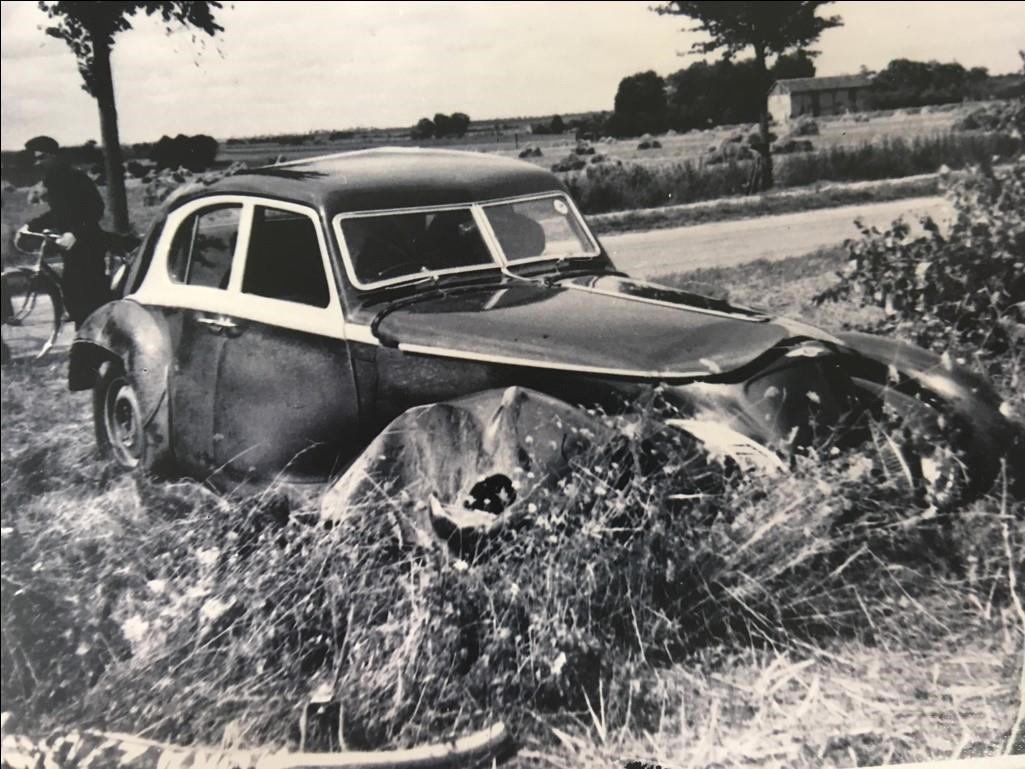
The manufacturer’s 2019 account explains that the original car was damaged during testing in France in August 1939. The chassis returned to Derby, while the body, sent for repair, was subsequently lost in a bombing raid at Dieppe. It is therefore more accurate to describe the loss precisely than to say that every part of the prototype vanished in a single incident. That distinction matters because the later project combined original historical components with reconstructed bodywork. The featured archive image shows the damaged original vehicle after the testing accident. Its appearance is stark, but it is valuable evidence of the actual prototype rather than a beautiful substitute miscaptioned as an untouched survivor. A profile can use that image honestly while explaining the original design through the written records and the separately identified recreation.
What Mulliner recreated in 2019
Bentley announced the completed recreation in August 2019, describing traditional coachbuilding work, historical components and a newly made body. The project made the lost design visible again, but it did not turn the new body into coachwork manufactured in 1939. The distinction should remain clear even when the manufacturer uses the language of rebuilding or restoration. A historically faithful reconstruction can be a substantial achievement in its own right. It provides a way to study shape, construction and craftsmanship that would otherwise remain largely documentary. For the archive, however, give it a separate completion date and object description. The original prototype and the modern recreation are connected histories, not two original 1939 production cars, and a photograph of one must not silently stand in as proof of the other’s survival.
How to interpret the historical image
The bundled photograph is supplied in Bentley’s Corniche release gallery and shows the original car after its accident. The photographer is not named in that record, so the credit identifies Bentley’s archive and copyright source without inventing a personal attribution. The image’s job is to document the original object at a particular stage. It cannot reveal every test specification or establish the full sequence of repairs. Use it alongside the manufacturer’s account, and label any comparison image of the 2019 car clearly if one is later added. A modern recreation photograph could help explain the intended appearance, but only with its actual date and status visible. This approach gives readers a stronger historical experience than a generic period-looking photograph whose relationship to the prototype cannot be established.
One prototype is not an ordinary edition count
The original Corniche is documented as a unique experimental project. That rarity scope differs from a numbered road-car edition or a completed model series. The profile therefore records a named prototype identity rather than manufacturing an ordinary customer-production badge. Nor does the later recreation increase the original prototype population to two. These distinctions are useful for a rare-vehicle database because design histories often include test vehicles, reconstructions and related commissions. An entry should tell readers which object is being described and which date belongs to it. The historical prototype’s significance comes from its design intent and interrupted development, while the recreated car’s significance comes from the later work that recovered that design. Keeping the two connected but separate preserves the interest of both and avoids a misleading survival claim.
The link to Embiricos and the Continental
The Embiricos Bentley and the Corniche illustrate connected but distinct pre-war experiments in streamlined coachwork. Bentley’s later R-Type Continental account places both in the background to its post-war grand-touring design. That is a useful relationship to explore through internal links, without suggesting the cars shared an identical chassis or body builder. For a reader, compare how each project approached the body’s overall form and how its documentary history survives. The Corniche’s accident and loss mean that its study depends particularly heavily on archives and the clearly identified modern recreation. The Embiricos car offers a different surviving-object story. Together they explain why the Corniche deserves a full profile even though it never became a conventional production model: it occupies an important point in the development of Bentley’s aerodynamic ambitions.
Frequently asked questions
What was the original Bentley Corniche?
It was a 1939 aerodynamic experimental car associated with the Mark V programme, designed by Georges Paulin and bodied by Vanvooren.
Was the entire car destroyed at Dieppe?
Bentley’s account says the chassis returned to Derby after the testing accident, while the body was lost in the bombing raid.
Is the 2019 Corniche an untouched 1939 survivor?
No. Mulliner recreated the car with historical components and a newly made body. Its 2019 completion is recorded separately.
Does the featured photo show the recreation?
No. It is Bentley’s archive photograph of the original damaged prototype after its 1939 testing accident.
Explore related vehicle profiles
Sources
- Bentley — original Corniche history and 2019 recreation
- Bentley Motors — Corniche and the development of the Continental
- Bentley — 70 years of the R-Type Continental, May 2022
Historical facts follow the linked manufacturer, race-organizer, institutional and specialist records. Visual comparisons and documentation priorities are editorial analysis. Dated specifications, restoration accounts and published estimates retain their original scope; they do not certify a car’s current condition.
Photography and credit
The original 1939 Corniche after its testing accident in France, from Bentley’s historical archive. This photograph shows the original damaged prototype, not the 2019 Mulliner recreation. Photographer not identified. Photo: Bentley Motors (copyright credit) / Bentley Newsroom · Bentley Newsroom: free editorial reproduction. Resized proportionally where needed and saved as JPEG; no additional cropping or color alteration. Editorial vehicle-profile use only; the newsroom terms exclude advertising, marketing and sales use. Photographer not named on the supplied record.
Why this machine matters
The original 1939 Bentley Corniche was an aerodynamic experimental car associated with the Mark V programme. Its accident and wartime loss interrupted an important design chapter. This profile follows that original prototype, with the 2019 Mulliner recreation explained separately and a genuine archive photograph of the damaged 1939 car used as the featured image.
Built in limited numbers
Original1939 prototype and2019Mulliner recreation separated. Chassis returned toDerby; body lost atDieppe. Featured archive photograph shows damaged original, not recreation; no customer-edition badge.
Gallery
Specifications
Factory specifications may vary by model year, market and configuration.
Identity & production
- Official model
- Bentley Corniche Prototype — 1939
- Base model
- Corniche
Powertrain & performance
- Engine
- Mark V-related 4¼ Litre six-cylinder petrol programme