Alpine M64
The Alpine M64 is a tiny-production endurance prototype with a substantial place in the marque’s Le Mans history. Its collector story becomes more precise when the achievements of a particular chassis are separated from the identity of the three-car model programme.
The Alpine M64 is a tiny-production endurance prototype with a substantial place in the marque’s Le Mans history. Its collector story becomes more precise when the achievements of a particular chassis are separated from the identity of the three-car model programme.
History and documented identity
RM Sotheby’s and Artcurial both state that three M64s were built. Their accounts document chassis 1711’s class and energy-efficiency success at Le Mans in 1964. Those results belong to that chassis and its drivers; they are not a claim that every M64 won the race. RM Sotheby’s — 1964 Alpine M64, chassis 1711.
Design and collector significance
For an endurance prototype, efficiency is a historical achievement in its own right. The collector does not need to recast a class-winning car as an outright winner to explain its significance. A clear description of the result, the class and the particular machine tells a stronger story than a broad Le Mans-winning headline that obscures what was actually achieved.
How to identify the right specification
The cited auction records concern chassis 1711. They describe both its period career and changes made during development and restoration. Read that record as a sequence. It is possible for a documented competition vehicle to preserve an important later development feature while being restored to an earlier general appearance. The chosen configuration should be explained rather than reduced to an unexplained claim of perfect originality.
Production, rarity and counting scope
The three-car M64 total is supported by two independently reviewed auction records and satisfies the production ceiling. It is a model total, not a current survivor count. This record is still classified Archive under the inventory’s competition rule. No production count from the M63 or A210 should be added to it unless a separate programme calculation explicitly defines that broader scope.
What to inspect before buying
Ask for dated race documentation, restoration invoices and an explanation of each major component’s history. A specialist should assess the relationship between the surviving structure, replacement bodywork and the claimed competition identity. For a running historic racer, verify present mechanical condition and event requirements independently from provenance. A historically important car can still require substantial work before it is suitable for modern track activity.
Where it fits in an Alpine collection
The M63 establishes the preceding Alpine Le Mans chapter. The M64 demonstrates how a model with a small documented build total can contain individual cars with different careers. Following that distinction helps a collector understand later prototypes without assigning every programme result to every surviving chassis.
Collector documentation checklist
- Separate the original build description from the car’s current specification.
- Keep chassis, engine and ownership evidence together in a dated file.
- Record which claims come from factory material, club research, an auction catalogue or the present owner.
- Retain photographs of restoration and significant component replacements.
- Keep completed production, regional allocation and known survivors in separate fields.
Frequently asked questions
How many Alpine M64s were built?
Both checked auction records state three.
Did the M64 win Le Mans outright in 1964?
No such claim is made. The documented achievement for chassis 1711 is a class victory and the energy-efficiency award.
Does the count of three mean three surviving cars?
No. A completed-production count and a current survivor count are different facts.
Explore related Alpine profiles
Sources and research scope
- RM Sotheby’s — 1964 Alpine M64, chassis 1711
- Artcurial — 1964 Alpine M64 berlinette, chassis 1711
- ACO — Alpine at Le Mans, 1963–1978
Historical facts follow the linked records; inspection guidance and collection comparisons are editorial analysis. Where sources use different counting scopes or a subtype remains broad, those limits are stated rather than resolved with an invented number.
Photography and credit
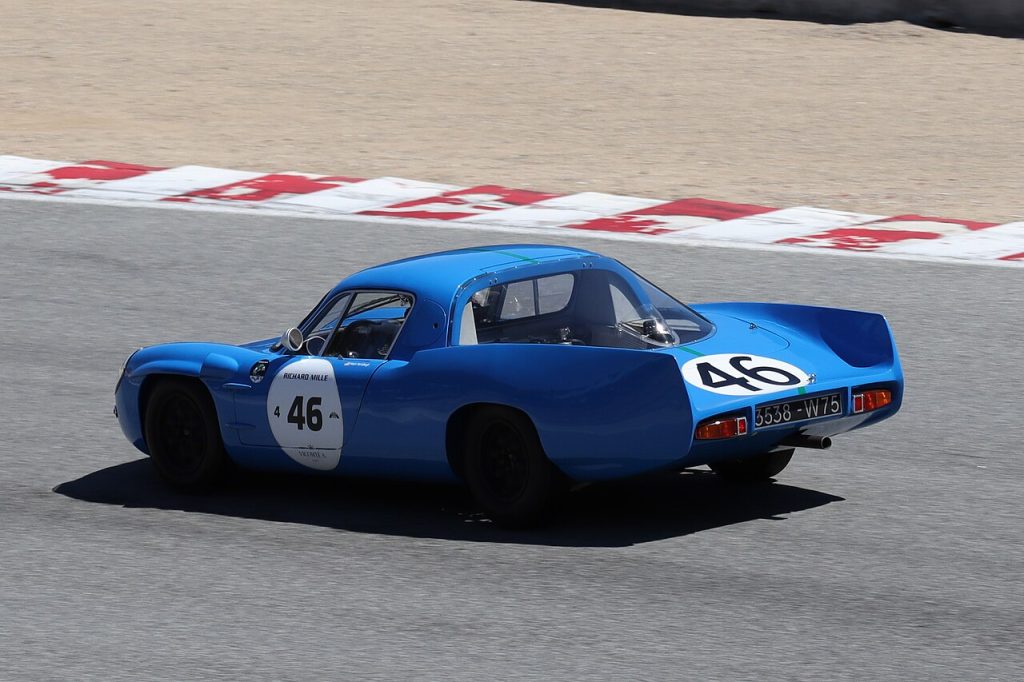
Alpine M64 competing at the 2022 Rolex Monterey Motorsports Reunion. Modern historic-racing appearance, not a photograph from the 1964 race. Photo: Prova MO / Wikimedia Commons · CC BY-SA 4.0. Original file imported without content retouching. WordPress may resize display copies; the website layout may crop them.
Why this machine matters
The Alpine M64 is a tiny-production endurance prototype with a substantial place in the marque’s Le Mans history. Its collector story becomes more precise when the achievements of a particular chassis are separated from the identity of the three-car model programme.
Built in limited numbers
The three-car M64 total is supported by two independently reviewed auction records and satisfies the production ceiling. It is a model total, not a current survivor count. This record is still classified Archive under the inventory’s competition rule. No production count from the M63 or A210 should be added to it unless a separate programme calculation explicitly defines that broader scope.
Gallery
Specifications
Factory specifications may vary by model year, market and configuration.
Identity & production
- Official model
- Alpine M64
- Base model
- M64
- Worldwide production
- 3
- Country of manufacture
- France
Powertrain & performance
- Engine
- 1149 cc Gordini inline-four; cited chassis 1711 specification