2006 Citroën C-Buggy Concept
Explore the 2006 Citroën C-Buggy Concept: sourced history, design, specifications and rarity evidence, with credited documentary photos.
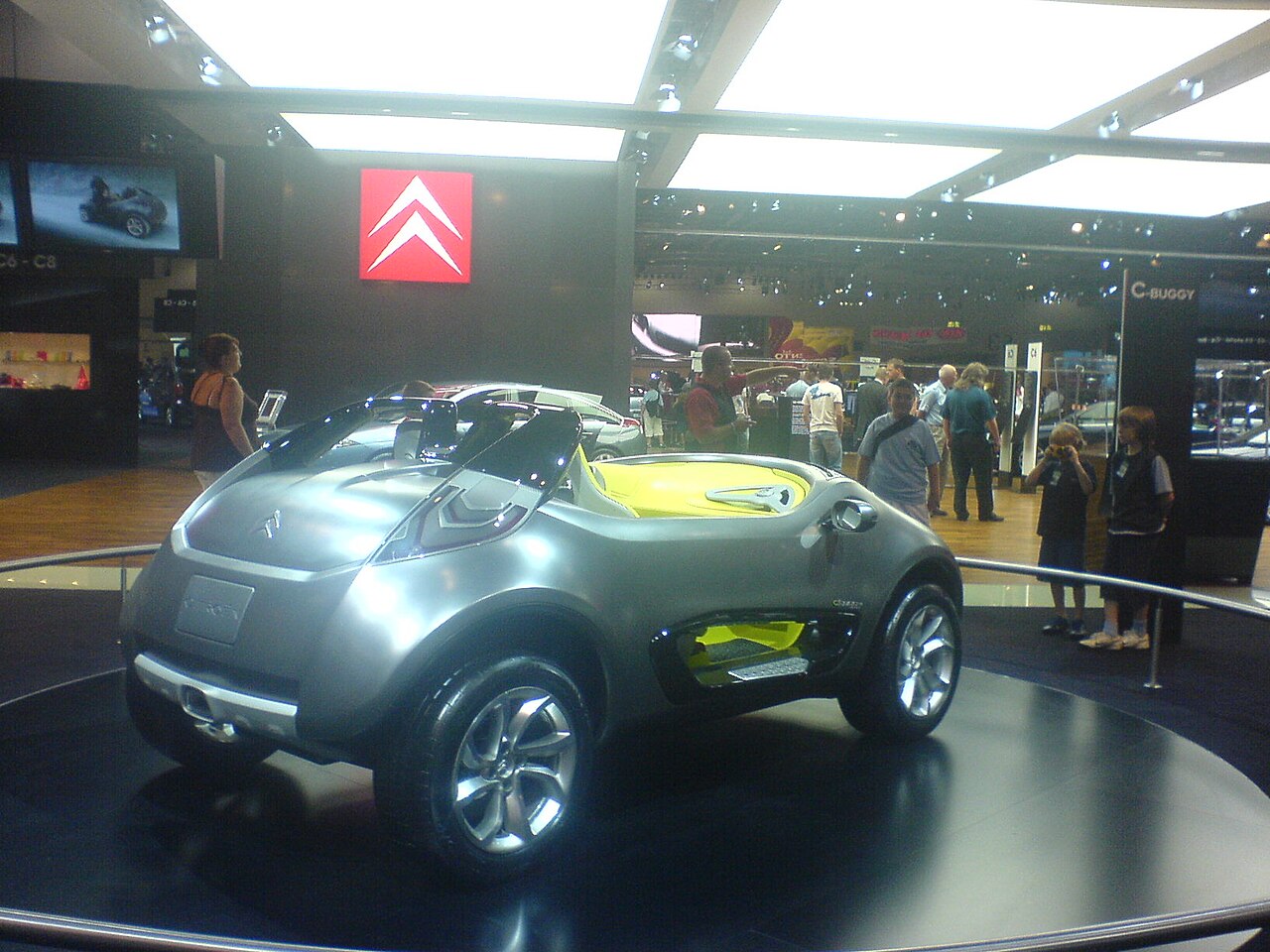
The 2006 Citroën C-Buggy turns openness into the main design feature. Its short, broad body and exposed two-seat compartment make the physical concept an energetic counterpoint to the marque’s enclosed luxury and family-car experiments.
A documented single leisure concept
Citroën Origins records one manufactured C-Buggy, with two seats, an 850 kg mass and dimensions of 3.45 by 1.91 by 1.34 metres. The preserved period press account describes an open leisure vehicle without a conventional roof, windscreen or doors and explicitly sets it beside the earlier C-AirPlay concept.
Those features define the scope of the object. The photograph does not certify a road-approved customer vehicle or an off-road performance result. The interest is a physical design study that makes a particular leisure experience visible. Its openness is part of the proposition rather than an accidental absence of production equipment.
The British motor-show photograph
The supplied show photograph reveals a dark metallic body with bright yellow accents around the seating area. The wheel arches are broad, and the nose is short and rounded. A shallow opening in place of a conventional side door exposes the cabin. Exhibition lighting creates strong reflections across the curved panels, which remain visible in the documentary image.
The wheels and body width give the car a planted visual stance. With so little enclosed upper volume, the eye stays close to the occupants and the chassis-level surfaces. This is a reading of the styling, not a measurement of stability. Its strength is that the outdoor theme can be understood from a stationary photograph.
Exposure changes the meaning of comfort
An enclosed concept can make comfort visible through seats, trim and lighting. An open leisure concept asks the reader to think about exposure, access and interaction with the surroundings. The appropriate historical description therefore differs from the vocabulary of a luxury saloon, even when both objects belong to the same marque.
A full technical presentation would show how the occupants enter, where their personal items are accommodated and how the exposed controls and materials were treated. Such evidence can make the proposal concrete without inventing a customer specification. Concept history benefits from those ordinary practical questions as much as from a dramatic overall view.
A useful contrast within the Citroën archive
Pair C-Buggy with C-AirPlay to examine different degrees of openness. Pair it with C-Crosser to compare minimal enclosure with a transformable utility body. These comparisons explain the car through specific design questions rather than a generic label such as “adventurous.”
For preservation, unusual interior surfaces and exposed fittings deserve careful documentation. Their condition can communicate how the object was constructed and displayed. A dated record of the whole concept, followed by details of the seating and body openings, preserves the complete proposal instead of leaving only the striking front-quarter silhouette.
Specifications and verified rarity
| Reference year | 2006 |
|---|---|
| Model / project | C-Buggy Concept |
| Body / role | Open two-seat leisure concept |
| Seats | Two |
| Dimensions | 3.45 × 1.91 × 1.34 m |
| Archive mass | 850 kg |
| Body concept | Open leisure vehicle without conventional doors or windscreen |
| Rarity scope | Citroën Origins explicitly records one C-Buggy manufactured in 2006. |
| Exact manufacturing tally | 1 |
| Inventory reference | CIT-124 — Verified |
Frequently asked questions
How many were manufactured according to the official archive?
One.
Did it have conventional doors and a windscreen?
The period description presents the concept without those conventional enclosing elements.
Is a road-approved customer range asserted?
No. The documented subject is a physical leisure concept.
What is its natural design companion?
C-AirPlay, which explores a less exposed compact passenger space.
What rarity or archive scope is verified?
Citroën Origins explicitly records one C-Buggy manufactured in 2006.
Who took the supplied photograph?
Alan_D from Crawley, United Kingdom via Wikimedia Commons, under CC BY 2.0. Keep the photographer, original-file link and licence credit with the image.
Related Citroën profiles
Sources and photo credits
Photograph: Alan_D from Crawley, United Kingdom via Wikimedia Commons original file, CC BY 2.0. Source photograph supplied without local cropping, retouching or text removal. A source-provided thumbnail is used where available. C-Buggy at the British International Motor Show in 2006.
Built in limited numbers
Citroën Origins explicitly records one C-Buggy manufactured in 2006.
Gallery
Specifications
Factory specifications may vary by model year, market and configuration.
Identity & production
- Official model
- C-Buggy Concept