2019 Citroën Ami One Concept
Explore the 2019 Citroën Ami One Concept: sourced history, design, specifications and rarity evidence, with credited documentary photos.
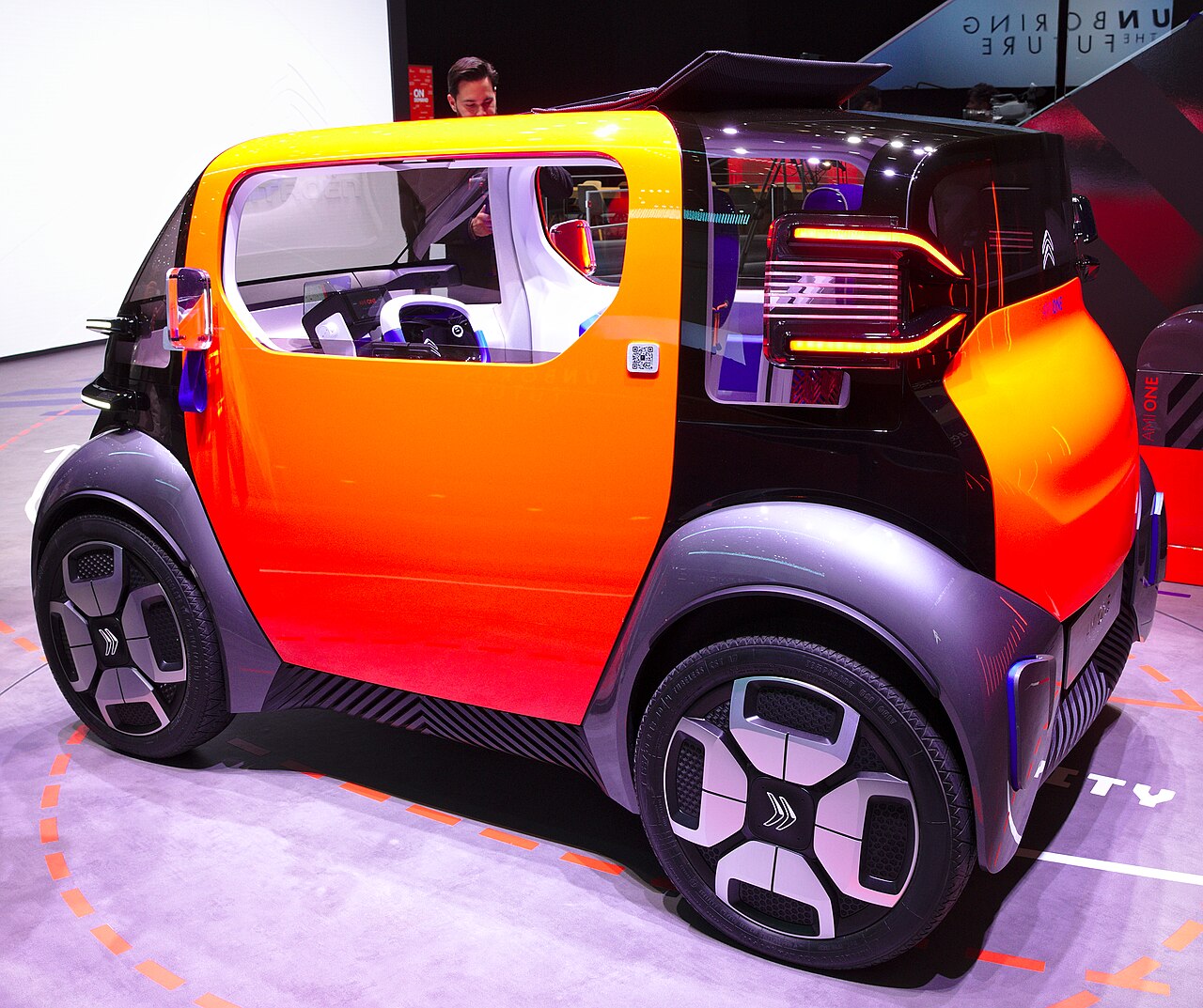
The 2019 Citroën Ami One Concept gives urban electric mobility a small, upright and immediately legible form. Its orange and black body makes the proposed two-seat vehicle look more like an approachable everyday object than a miniature conventional hatchback.
The concept before the production Ami
Citroën announced Ami One in February 2019 for Geneva. The two-seat electric concept explored access through a smartphone and a proposed range of usage durations. Repeated body components and door symmetry were important design ideas. This is the original Ami One concept, and its project specifications should not be replaced by those of the later production Ami.
The distinction is more than a naming preference. A concept can illustrate a service model and a manufacturing philosophy alongside the vehicle itself. A production version has its own market rules, technical approvals and equipment. The original proposal is valuable precisely because it records the earlier questions, including how a small vehicle might be borrowed, unlocked and used in a dense city.
Reading the small orange body
The Geneva photograph shows a tall, compact enclosure in orange, with dark glazing and contrasting lower-body details. The wheels sit near the corners, leaving the central cabin as the dominant visual element. Broad, relatively flat surfaces make the body appear simple and easily readable.
The upright shape avoids the visual language of a small sports car. It puts enclosure, visibility and proximity to the street at the centre of the image. Colour helps the individual components stand out without requiring elaborate trim. Those observations explain the design impression; they do not establish turning-circle measurements, crash performance or the actual ease with which passengers enter the photographed prototype.
Symmetry as an industrial idea
The original announcement described identical doors that opened differently on the two sides, alongside other repeated exterior components. Repetition was therefore part of the concept’s construction logic as well as its visual character.
That is an unusually useful feature to record in a collector profile. It shows how a vehicle can challenge the assumption that every side-specific part must have a distinct form. A photograph may reveal the broad arrangement, but a detailed component study would be needed to document what was actually shared on the surviving object. The design proposal and the physical implementation should remain connected without being treated as interchangeable evidence.
Mobility services belong to the proposal
The smartphone access and flexible usage scenarios were ideas presented with Ami One. They are not listed here as currently available subscriptions or guaranteed services. Similarly, concept performance claims belong to the dated project announcement rather than to a modern ownership test.
The physical concept is the verified archive subject, with its exact fabrication tally left unknown. A strong custodial record would preserve the show vehicle’s identity, exhibition dates and the supporting graphics that explained its service brief. Ami One is worth studying because its modest size carries an ambitious discussion: a city vehicle can be designed around access, repeated components and daily utility, rather than around the usual hierarchy of power, prestige and ever-larger dimensions.
Specifications and verified rarity
| Reference year | 2019 |
|---|---|
| Model / project | Ami One Concept |
| Body / role | Two-seat urban electric concept |
| Debut | Geneva, 2019 |
| Seats | Two |
| Dimensions | 2.50 m long × 1.50 m wide × 1.50 m high |
| Project focus | Electric urban mobility and shared access |
| Rarity scope | Documented physical 2019 Ami One concept, separate from the later production Ami; exact fabrication tally not established. |
| Exact manufacturing tally | Not established |
| Inventory reference | CIT-163 — Verified |
Frequently asked questions
Is Ami One the production Ami?
No. It is the distinct 2019 concept that preceded the production vehicle.
How many seats did the proposal have?
Two.
Are its proposed app services described as live products here?
No. They are recorded as part of the period concept brief.
Why retain a blank build count?
The original project identity is documented, without an exact fabrication tally.
What rarity or archive scope is verified?
Documented physical 2019 Ami One concept, separate from the later production Ami; exact fabrication tally not established.
Who took the supplied photograph?
Alexander Migl via Wikimedia Commons, under CC BY-SA 4.0. Keep the photographer, original-file link and licence credit with the image.
Related Citroën profiles
Sources and photo credits
Photograph: Alexander Migl via Wikimedia Commons original file, CC BY-SA 4.0. Source photograph supplied without local cropping, retouching or text removal. A source-provided thumbnail is used where available. Ami One concept at Geneva 2019. Distinct from the production Ami.
Built in limited numbers
Documented physical 2019 Ami One concept, separate from the later production Ami; exact fabrication tally not established.
Gallery
Specifications
Factory specifications may vary by model year, market and configuration.
Identity & production
- Official model
- Ami One Concept