1968 Ferrari 365 GTB/4 Daytona
Explore 365 GTB/4 Daytona: verified history, design, rarity scope and specifications, with a credited documentary photograph.
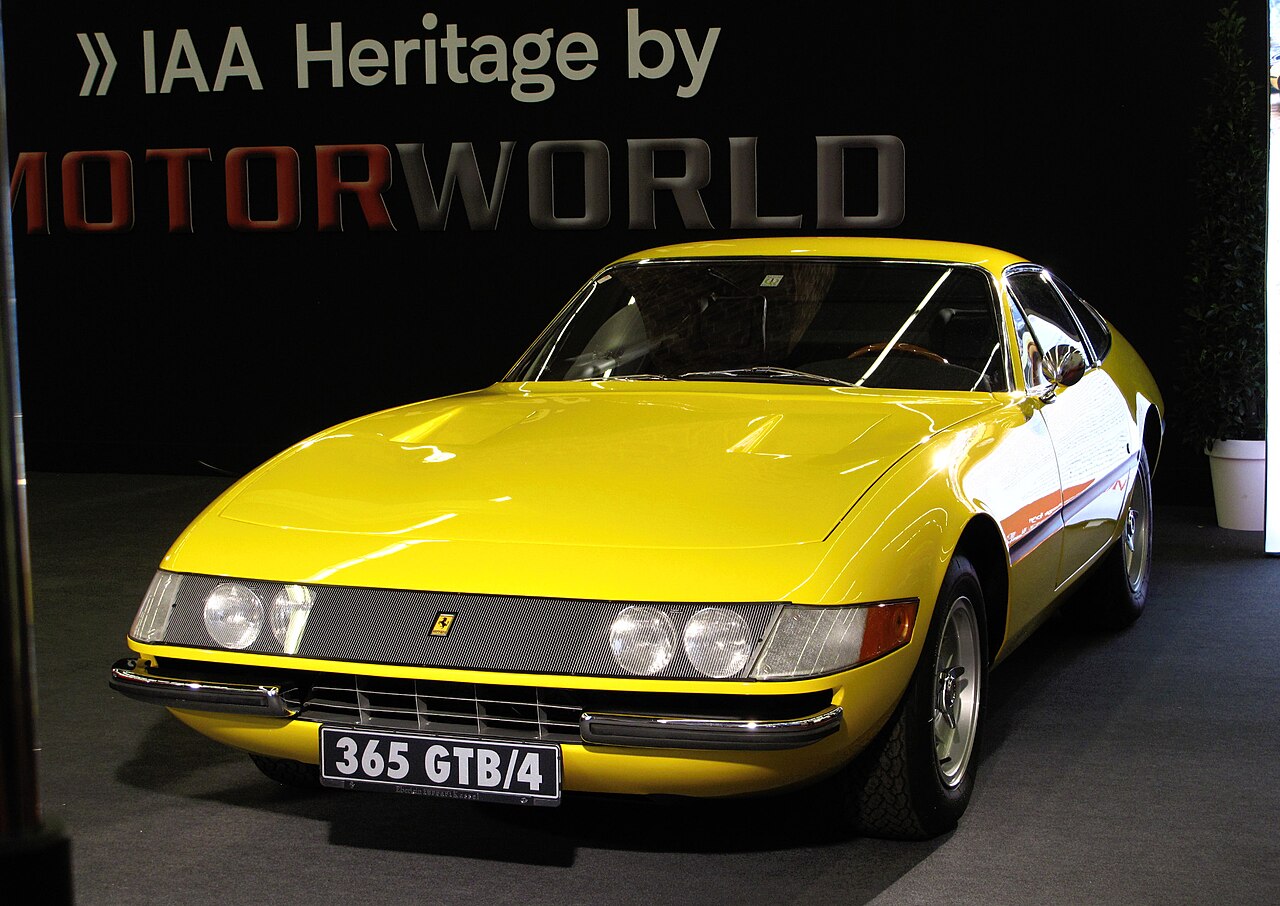
The Ferrari 365 GTB/4 appeared at the 1968 Paris show as a front-engine V12 grand touring berlinetta.
History and purpose
The Ferrari 365 GTB/4 appeared at the 1968 Paris show as a front-engine V12 grand touring berlinetta. Daytona became its familiar informal name, but the factory model identity remains 365 GTB/4. Ferrari’s model history gives a complete road-berlinetta tally of 1,284 and records the open Spider separately. This profile uses that whole coupé programme rather than selecting an arbitrary year or market to produce a lower rarity number. Its limited scale is sufficient on its own. The Daytona nickname adds historical recognition; it does not imply that every road car competed at the race from which the nickname draws its association.
Design and engineering
The supplied photograph shows the early frontal treatment with headlights behind a broad transparent strip. Ferrari’s history describes the change to pop-up lights on later cars, making the headlamp arrangement useful for understanding the programme’s visual evolution. The long bonnet, compact cabin and wide front give the berlinetta a different presence from the rounded early 250 coupés. Its front V12 and rear transaxle are documented mechanical architecture, not conclusions drawn from the image. The pictured example is a road coupé. A competition Daytona with additional bodywork or an open Spider would require a different caption and a separately scoped record.
Identifying the original configuration
Early and later headlight configurations belong within the road-berlinetta programme covered here. Their differences should be recorded for an individual car, but they are not used to invent new exact production totals. The 1,284 count excludes the factory’s separately documented Spiders. It also does not authenticate a later conversion from a coupé to an open body. A donor car’s original chassis identity and later body history remain relevant after such a change. This entry gives the complete original closed-road-car scope so that readers can distinguish model production from present appearance, current survivor counts and the narrower populations sometimes used in sale descriptions.
Collector context and preservation
For collectors, the Daytona offers a clear example of how an informal name can become more familiar than a factory designation. A reliable archive should retain both, making the car searchable without allowing the nickname to replace specification and chassis evidence. Original delivery records, headlight configuration, body form and restoration history help describe an individual survivor. The early photo is particularly useful for visual comparison with later pop-up-light cars, but it does not make early equipment universal. The model’s significance can be explained through its grand touring proportions and documented V12 architecture. There is no need to transfer competition results from another chassis or to imply that a production figure predicts the condition or desirability of every remaining example.
Reading the evidence for this profile
The original source links below identify the programme and the historical statements used in this article. The photograph has its own creator and licence record, separate from the manufacturer’s vehicle history. Keep both when transferring this profile into a collection catalogue. A manufacturing tally describes how many cars belong to a defined original programme; it does not measure how many survive, how many are publicly visible, or how many retain all their original components. Those individual questions require dated chassis and restoration evidence. The reference year likewise describes the programme’s introduction or named historic configuration, while the supplied caption states the photographed setting and any established individual identity. This lets future research expand the car’s history without blurring the scope of the record already assembled here.
Specifications and verified rarity
| Reference year | 1968 |
|---|---|
| Model / programme | 365 GTB/4 Daytona |
| Body / role | Front-engine V12 grand touring berlinetta |
| Engine architecture | Front-mounted 4.4-litre four-cam V12 |
| Transmission | Five-speed rear transaxle |
| Exact manufacturing tally | 1284 |
| Eligibility bound | 1284 for the documented scope or parent programme |
| Rarity scope | Complete original 365 GTB/4 road berlinetta programme: 1,284 coupés in Ferrari’s model record. The separately counted Spider and competition bodies are excluded. |
| Inventory reference | FER-096 — Verified |
Frequently asked questions
How many road berlinettas does Ferrari record?
1,284 in the complete 365 GTB/4 road coupé programme.
Is Daytona the factory model designation?
It is the familiar informal name; the model designation is 365 GTB/4.
Does the tally include the open Spider?
No. Ferrari records the Spider separately.
Why do some cars have different headlights?
Ferrari documents an early transparent-strip treatment and later pop-up lights within the road-car programme.
What rarity or archive scope is verified?
Complete original 365 GTB/4 road berlinetta programme: 1,284 coupés in Ferrari’s model record. The separately counted Spider and competition bodies are excluded.
Who took the supplied photograph?
Rutger van der Maar via Wikimedia Commons, under CC BY 2.0. The original file and licence links accompany the image. Retain that credit when the photograph is uploaded, exported or reused.
Related Ferrari profiles
Sources and photo credits
Photograph: Rutger van der Maar via Wikimedia Commons original file, CC BY 2.0. Source-provided photograph supplied without local cropping, retouching or text removal. A source thumbnail is used where available. Road-going Ferrari 365 GTB/4 Daytona with the early transparent-strip headlamp treatment, photographed at a modern exhibition.
Built in limited numbers
Complete original 365 GTB/4 road berlinetta programme: 1,284 coupés in Ferrari’s model record. The separately counted Spider and competition bodies are excluded.
Gallery
Specifications
Factory specifications may vary by model year, market and configuration.
Identity & production
- Official model
- 365 GTB/4 Daytona