1976 Ferrari 400 Automatic First Series
Explore 400 Automatic First Series: verified history, design, rarity scope and specifications, with a credited documentary photograph.
The Ferrari 400 Automatic introduced an automatic transmission to Ferrari’s production road-car range at the 1976 Paris show.
History and purpose
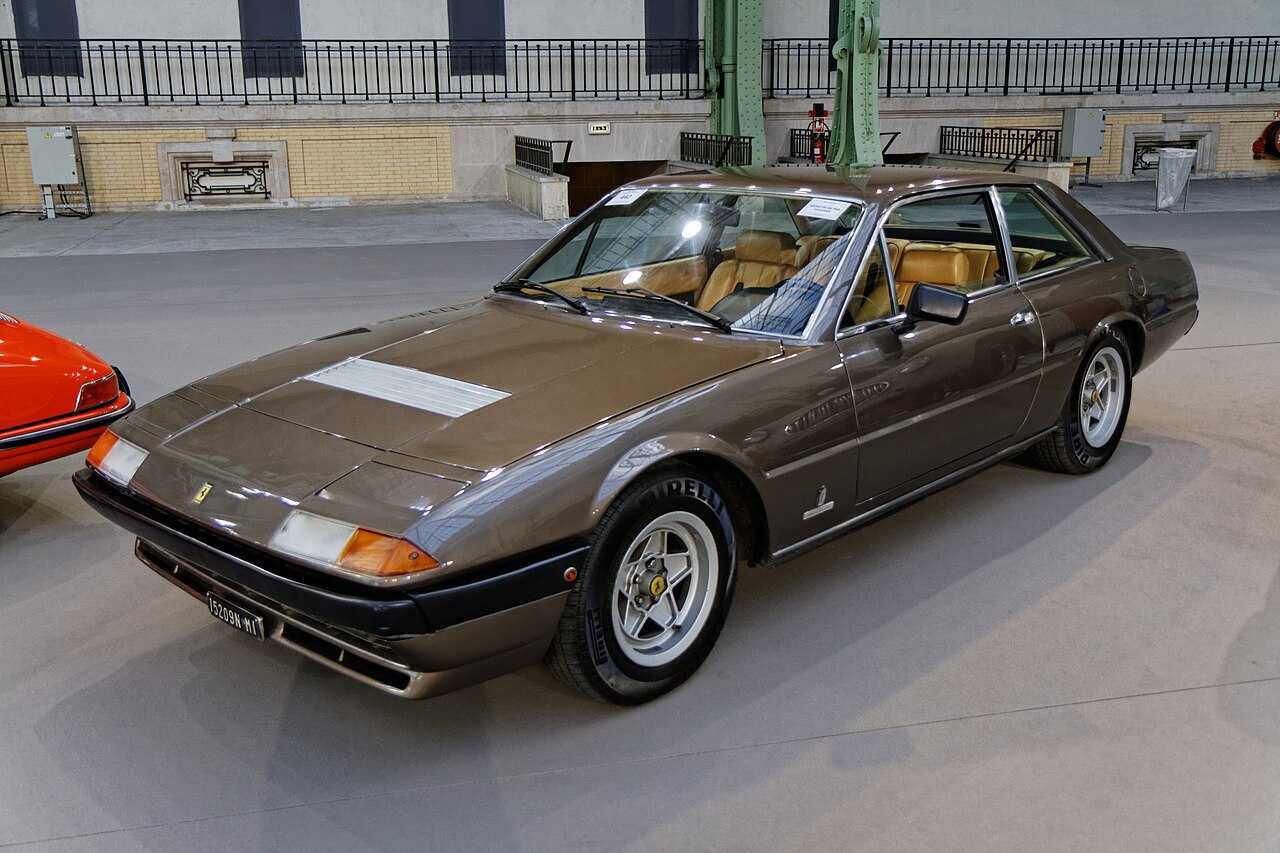
The Ferrari 400 Automatic introduced an automatic transmission to Ferrari’s production road-car range at the 1976 Paris show. Ferrari’s model record identifies a General Motors three-speed unit and gives 355 cars for the original carburetted automatic programme. The series ended before the later fuel-injected 400 i, so that subsequent model is kept outside this count. The first-series title therefore has a complete mechanical and chronological boundary. It is not a small regional subset extracted from all four-seat Ferraris. The source photograph identifies a 1978 automatic car, which fits the original programme without requiring the image to show an example built during the introduction year.
Design and engineering
The photographed brown 2+2 has a long bonnet, straight roofline and formal three-box proportions. Those shapes provide a useful contrast with the same era’s smaller mid-engine sports cars. The cabin is visibly treated as a substantial passenger space, while the engine compartment remains a dominant part of the silhouette. Ferrari records the front V12 and carburetted fuel system for this original model. The exterior photograph documents the body and the auction’s model identification; it does not independently display the automatic selector. Transmission identity comes from the original vehicle description and the model context, rather than being inferred from a badge alone.
Identifying the original configuration
The automatic version, manual 400 GT and later 400 i should retain separate names in a vehicle archive. Their close visual relationship can hide changes that are mechanically central to the collecting subject. The 355-car tally belongs to the original carburetted automatic, not the entire 400 family and not every similar Pininfarina 2+2. Confusing General Motors with another transmission manufacturer would also obscure the programme’s actual specification. This profile follows Ferrari’s own technical account. An individual car still needs delivery and service documentation to confirm its original transmission and to identify any later drivetrain replacement or conversion.
Collector context and preservation
The collecting interest is the deliberate expansion of Ferrari’s grand touring formula. An automatic gearbox changed the road-car proposition without requiring a dramatic departure from the formal 2+2 body. That can be discussed as product history without inventing a contemporary road test. For a specific survivor, original transmission identity, carburettor specification, body condition and a dated maintenance record would be useful parts of the file. Keep the photograph’s sale setting tied to its date; it does not establish a current offer or owner. The programme’s small full production tally supports rarity, while the individual records explain the particular car. Preserving that distinction gives the 400 Automatic a clear place beside more obvious limited-series Ferraris.
Reading the evidence for this profile
The original source links below identify the programme and the historical statements used in this article. The photograph has its own creator and licence record, separate from the manufacturer’s vehicle history. Keep both when transferring this profile into a collection catalogue. A manufacturing tally describes how many cars belong to a defined original programme; it does not measure how many survive, how many are publicly visible, or how many retain all their original components. Those individual questions require dated chassis and restoration evidence. The reference year likewise describes the programme’s introduction or named historic configuration, while the supplied caption states the photographed setting and any established individual identity. This lets future research expand the car’s history without blurring the scope of the record already assembled here.
Specifications and verified rarity
| Reference year | 1976 |
|---|---|
| Model / programme | 400 Automatic First Series |
| Body / role | Front-engine V12 2+2 grand tourer |
| Engine architecture | Front-mounted 4.8-litre carburetted V12 |
| Transmission | General Motors three-speed automatic |
| Exact manufacturing tally | 355 |
| Eligibility bound | 355 for the documented scope or parent programme |
| Rarity scope | Complete original carburetted 400 Automatic programme, 1976–1979: 355 cars. Manual 400 GT and later fuel-injected 400 i are excluded. |
| Inventory reference | FER-109 — Verified |
Frequently asked questions
Was this Ferrari’s first production automatic?
Ferrari identifies the 400 Automatic as its first production road car with an automatic transmission.
How many original carburetted automatic cars were built?
Ferrari’s model record gives 355.
Who supplied the transmission?
The factory record identifies a General Motors three-speed automatic.
Does this include the 400 i?
No. The later injected model is a separate programme.
What rarity or archive scope is verified?
Complete original carburetted 400 Automatic programme, 1976–1979: 355 cars. Manual 400 GT and later fuel-injected 400 i are excluded.
Who took the supplied photograph?
Thesupermat via Wikimedia Commons, under CC BY-SA 3.0. The original file and licence links accompany the image. Retain that credit when the photograph is uploaded, exported or reused.
Related Ferrari profiles
Sources and photo credits
Photograph: Thesupermat via Wikimedia Commons original file, CC BY-SA 3.0. Source-provided photograph supplied without local cropping, retouching or text removal. A source thumbnail is used where available. Original carburetted Ferrari 400 Automatic, source-described as a 1978 car at the Paris Bonhams display in 2014; the later 400 i is excluded.
Built in limited numbers
Complete original carburetted 400 Automatic programme, 1976–1979: 355 cars. Manual 400 GT and later fuel-injected 400 i are excluded.
Gallery
Specifications
Factory specifications may vary by model year, market and configuration.
Identity & production
- Official model
- 400 Automatic First Series