2024 Ferrari F80
Discover Ferrari F80: V6 hybrid architecture, flagship design and the verified 799-car global programme ceiling, with a credited documentary photo.
Ferrari introduced the F80 on 17 October 2024 as a new flagship supercar with a published global programme of 799 examples.
History and purpose
Ferrari introduced the F80 on 17 October 2024 as a new flagship supercar with a published global programme of 799 examples. That figure establishes a finite worldwide ceiling for this profile, rather than a country allocation or a paint specification. It must remain separate from an actual completed manufacturing total while production and deliveries continue. Ferrari’s 2025 design-award announcement describes production extending through 2027. The F80’s technical story draws on contemporary endurance racing and Formula One, particularly the relationship between its V6 architecture, electrical systems and aerodynamic development. Its reference year follows the public introduction, even when a photographed example or individual delivery belongs to a later year.
Design and engineering
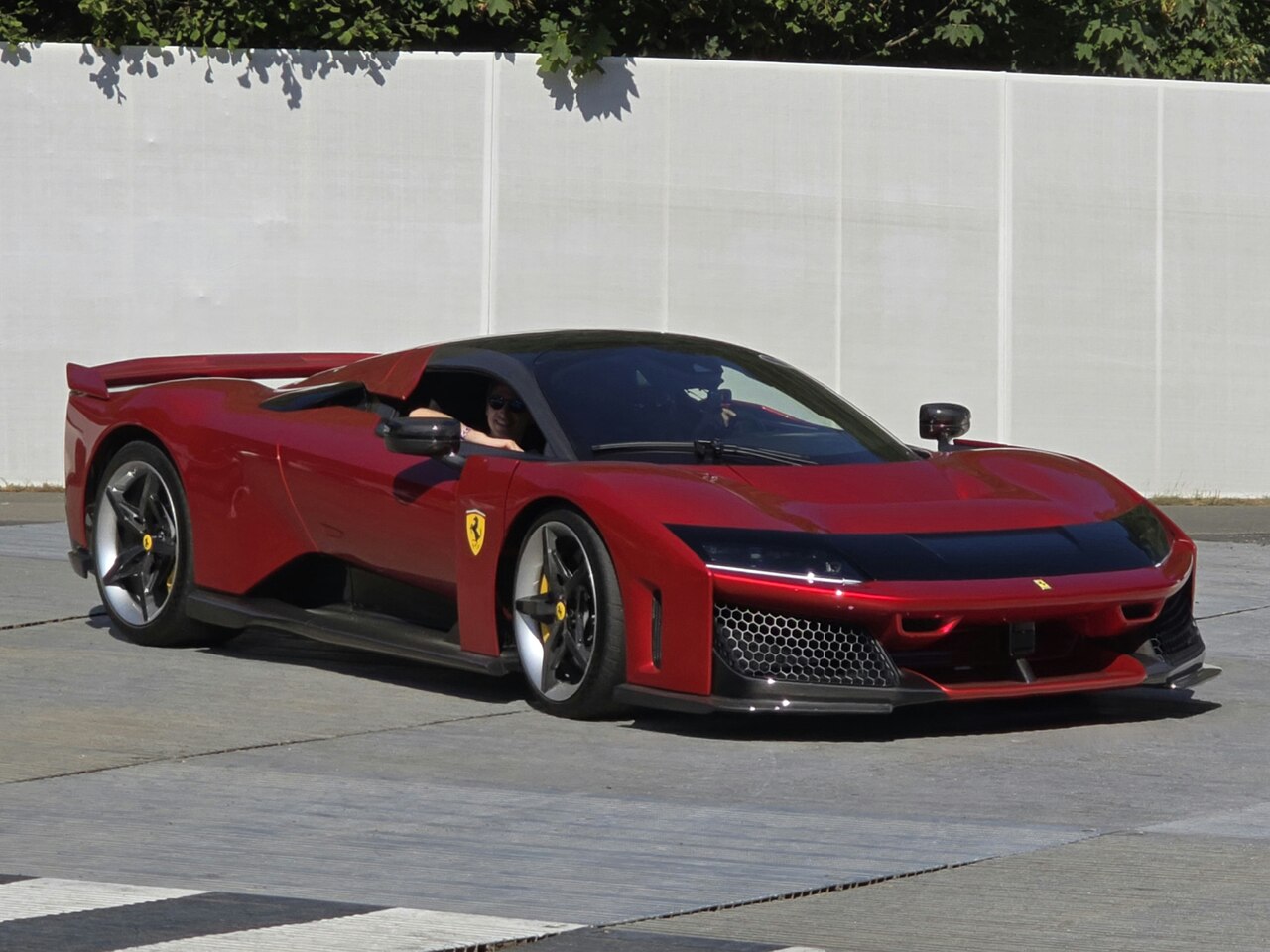
The manufacturer describes a three-litre 120-degree V6 contributing 900 cv, with electrical assistance bringing the combined quoted system figure to 1,200 cv. These are Ferrari’s metric power figures; they are not converted here into an independently measured road-test result. The hybrid layout works with a carbon-fibre structural approach and an extensive aerodynamic package. Visually, the supplied red F80 has a dark horizontal band across the front, deep lower openings and a prominent rear wing. The body combines a compact passenger volume with broad surrounding surfaces. The photograph helps explain the silhouette, while the manufacturer’s technical account supplies the mechanisms that cannot be established from an exterior view.
Identifying the original configuration
F80 identifies the customer supercar programme, rather than a generic prototype carrying development equipment. Its closed body and hybrid V6 architecture distinguish it from the earlier V12-hybrid LaFerrari. Ferrari links elements of its technology to the 499P endurance-racing programme, but that relationship does not turn an F80 into a road-registered 499P or combine their manufacturing counts. For an individual example, the chassis identity and original delivery specification remain the appropriate record. The supplied Commons file identifies the visible car as an F80. Its filename is an image identifier, not proof that every F80 was introduced, constructed or delivered in the same year.
Collector context and preservation
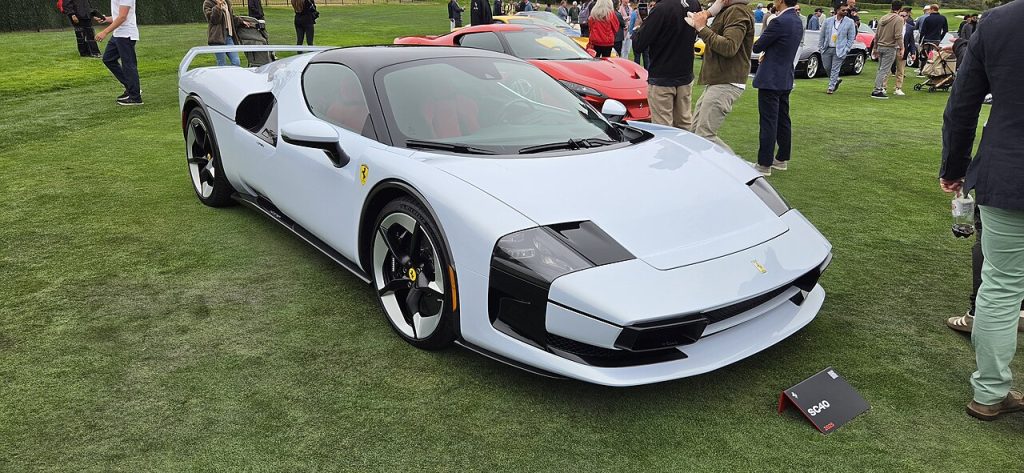
The most useful collector record connects the limited programme with the details that make this particular generation of flagship Ferrari distinctive. Preserve the factory specification, original finishes, model-specific aerodynamic pieces and servicing history alongside dated photographs. A hybrid system also makes the relationship between mechanical and electrical components part of the car’s identity, rather than an incidental addition to its engine description. The 799-car published limit is useful for catalogue eligibility, but later research should attach any completed production tally to a dated primary source. Comparing F80 with the 296-based SC40 places two different uses of modern Ferrari V6 technology together: a numbered flagship programme and a single bespoke design commission.
Reading the evidence for this profile
The original source links below identify the programme and the historical statements used in this article. The photograph has its own creator and licence record, separate from the manufacturer’s vehicle history. Keep both when transferring this profile into a collection catalogue. A manufacturing tally describes how many cars belong to a defined original programme; it does not measure how many survive, how many are publicly visible, or how many retain all their original components. Those individual questions require dated chassis and restoration evidence. The reference year likewise describes the programme’s introduction or named historic configuration, while the supplied caption states the photographed setting and any established individual identity. This lets future research expand the car’s history without blurring the scope of the record already assembled here.
Specifications and verified rarity
| Reference year | 2024 |
|---|---|
| Model / programme | F80 |
| Body / role | Limited-programme closed hybrid supercar |
| Engine architecture | Mid-rear three-litre 120-degree twin-turbo V6 with electric hybrid drive |
| Transmission / platform reference | Eight-speed dual-clutch transmission |
| Exact manufacturing tally | Not established |
| Eligibility bound | 799 for the documented scope or parent programme |
| Rarity scope | Published global F80 programme ceiling: 799 customer cars. This is an announced finite manufacturing limit, not an independently verified completed production tally. |
| Inventory reference | FER-235 — Verified |
Frequently asked questions
What is the F80?
Ferrari’s 2024-introduced V6-hybrid flagship, with a published worldwide programme ceiling of 799 customer examples; a completed manufacturing tally is not asserted.
What engine and transmission does it use?
Mid-rear three-litre 120-degree twin-turbo V6 with electric hybrid drive. Eight-speed dual-clutch transmission. These entries describe the documented vehicle or explicitly named donor architecture. They should be read alongside the body and programme scope, rather than transferred to every Ferrari carrying a similar badge.
Why is 2024 the reference year?
The title follows the documented introduction, public presentation or custodial model-year record explained in the history section. An individual delivery can occur later. Original workbook titles remain identity aliases when research corrects their year.
How should an individual example be identified?
Start with its chassis record and original configuration, then compare dated photographs, factory or commission paperwork and the service history. Model-level specifications explain the design, while the individual file establishes the identity and condition of the particular car.
What rarity or archive scope is verified?
Published global F80 programme ceiling: 799 customer cars. This is an announced finite manufacturing limit, not an independently verified completed production tally.
Who took the supplied photograph?
Calreyn88 via Wikimedia Commons, under CC BY-SA 4.0. The original file and licence links accompany the image. Retain that credit when the photograph is uploaded, exported or reused.
Related Ferrari profiles
Sources and photo credits
- Original manufacturer, commission or custodial record
- Ferrari: original F80 introduction
- Ferrari: 799-car limit and production period
Photograph: Calreyn88 via Wikimedia Commons original file, CC BY-SA 4.0. Source-provided photograph supplied without local cropping, retouching or text removal. A source thumbnail is used where available. Source-identified Ferrari F80 in red. The reference year is the 2024 programme introduction, separate from the photograph’s filename and later vehicle appearances.
Built in limited numbers
Published global F80 programme ceiling: 799 customer cars. This is an announced finite manufacturing limit, not an independently verified completed production tally.
Gallery
Specifications
Factory specifications may vary by model year, market and configuration.
Identity & production
- Official model
- F80