1966 Ferrari 365 P Berlinetta Speciale Tre Posti
Explore 365 P Berlinetta Speciale Tre Posti: verified history, design, rarity scope and specifications, with a credited documentary photograph.
The Ferrari 365 P Berlinetta Speciale made the driving position part of its central design argument.
History and purpose
The Ferrari 365 P Berlinetta Speciale made the driving position part of its central design argument. Ferrari’s history credits the 1966 Pininfarina project to Aldo Brovarone and records its Paris presentation in White Gardenia. Gianni Agnelli then commissioned a second car, delivered the following year in metallic grey with a rear spoiler. The complete original scope therefore contains two cars, while the reference year remains the project’s 1966 introduction. Tre Posti identifies the three-seat arrangement. It is not the name of a wider road-car production series or permission to merge this design study with the separate 365 P competition models.
Design and engineering
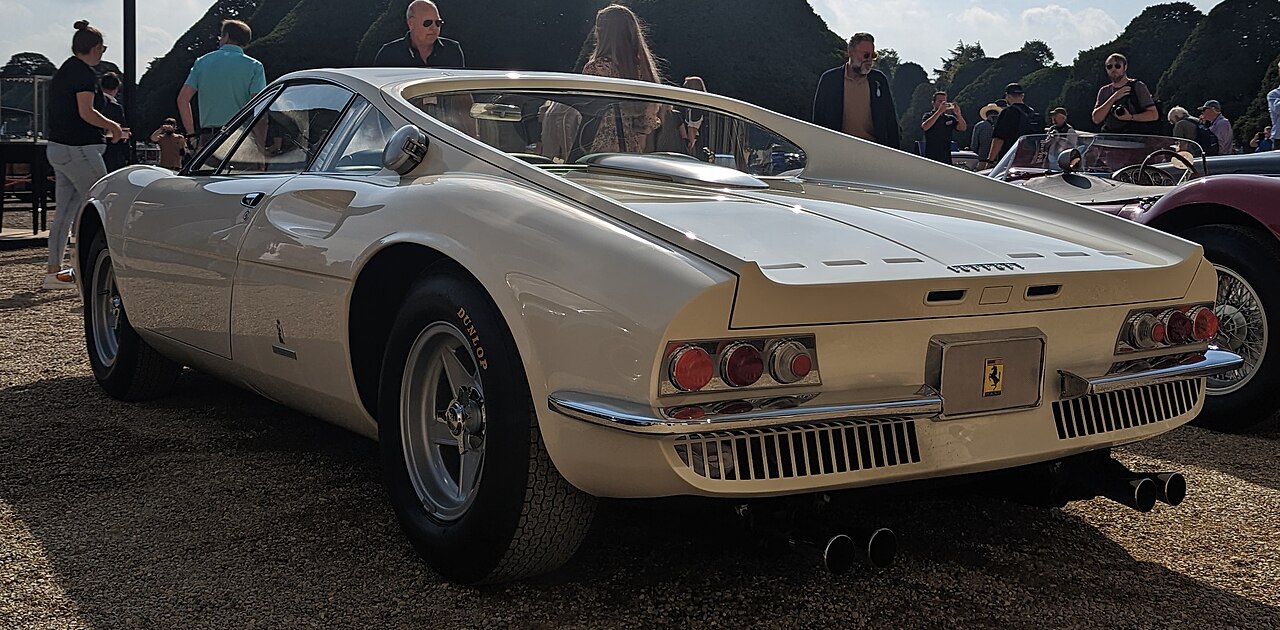
The rear-quarter photograph shows a pale berlinetta with an extended glazed cabin and a low, long rear body. The roof and side glazing give the enclosed passenger compartment a particularly prominent role. Ferrari’s original history describes a central driving position with passengers to either side, an arrangement that changes the organisation of the cabin rather than merely adding another seat to a conventional dashboard. The exterior photograph does not show every interior detail, so the seating description comes from the factory history. No claim is made that the pictured car’s mechanical components or finish have remained untouched since its original exhibition programme.
Identifying the original configuration
The two original bodies deserve to be recognised individually. The second commission’s metallic grey finish and spoiler are part of its own history, not universal equipment for the white Paris show car. This profile covers the original two-car project while avoiding a chassis assignment that is not established by the supplied image metadata. Ferrari’s account supplies the programme distinction and construction sequence. A later car inspired by the same central-seat idea would need its own identity and build history. A similar roofline or a three-seat cabin alone would not connect it to the original Pininfarina commissions.
Collector context and preservation
The model is valuable to an archive because it makes an unusual interior idea visible within a complete physical car. It can be studied as a relationship among driver position, glazing and engine placement, without assuming that its arrangement became a standard Ferrari road-car solution. A collection record should retain the show documentation and the second commission separately, then add individual custodial and restoration evidence where available. The two-car total is a manufacturing scope, not a claim about current ownership or public accessibility. Preserving those distinctions allows the Tre Posti to be appreciated as a specific Pininfarina design achievement rather than a generic exotic concept with an attractive but unsupported one-off label.
Reading the evidence for this profile
The original source links below identify the programme and the historical statements used in this article. The photograph has its own creator and licence record, separate from the manufacturer’s vehicle history. Keep both when transferring this profile into a collection catalogue. A manufacturing tally describes how many cars belong to a defined original programme; it does not measure how many survive, how many are publicly visible, or how many retain all their original components. Those individual questions require dated chassis and restoration evidence. The reference year likewise describes the programme’s introduction or named historic configuration, while the supplied caption states the photographed setting and any established individual identity. This lets future research expand the car’s history without blurring the scope of the record already assembled here.
Specifications and verified rarity
| Reference year | 1966 |
|---|---|
| Model / programme | 365 P Berlinetta Speciale Tre Posti |
| Body / role | Three-seat central-driver design berlinetta |
| Engine architecture | Rear-mid-mounted 4.4-litre V12 |
| Transmission | Five-speed manual |
| Exact manufacturing tally | 2 |
| Eligibility bound | 2 for the documented scope or parent programme |
| Rarity scope | The two original Pininfarina 365 P Berlinetta Speciale cars: the 1966 white show car and the second commission delivered in 1967. |
| Inventory reference | FER-089 — Verified |
Frequently asked questions
Why is the project called Tre Posti?
It describes the three-seat arrangement with the driver in the centre.
How many original cars are documented?
Ferrari describes the original white show car and a second commission delivered in 1967.
Was the second car identical in appearance?
No. Ferrari records metallic grey and a rear spoiler for the second commission.
Does the image establish a chassis number?
No chassis number is assigned from this photograph. The project identity and original two-car scope are documented separately.
What rarity or archive scope is verified?
The two original Pininfarina 365 P Berlinetta Speciale cars: the 1966 white show car and the second commission delivered in 1967.
Who took the supplied photograph?
Calreyn88 via Wikimedia Commons, under CC BY-SA 4.0. The original file and licence links accompany the image. Retain that credit when the photograph is uploaded, exported or reused.
Related Ferrari profiles
Sources and photo credits
Photograph: Calreyn88 via Wikimedia Commons original file, CC BY-SA 4.0. Source-provided photograph supplied without local cropping, retouching or text removal. A source thumbnail is used where available. Original-style Ferrari 365 P Berlinetta Speciale Tre Posti, documented in a modern exhibition photograph. No unverified chassis number is assigned.
Built in limited numbers
The two original Pininfarina 365 P Berlinetta Speciale cars: the 1966 white show car and the second commission delivered in 1967.
Gallery
Specifications
Factory specifications may vary by model year, market and configuration.
Identity & production
- Official model
- 365 P Berlinetta Speciale Tre Posti