1952 Lotus Mark VI
Explore the 1952 Lotus Mark VI: programme history, design, verified rarity scope, specifications and credited photography.
The Lotus Mark VI turned Chapman’s lightweight experiments into a customer sports-car programme. Its purpose-designed spaceframe and adaptable power-unit choices explain why the same basic model could appear on the road, at a hillclimb or in a club-racing paddock.
History and verified programme identity
Lotus dates Mark VI production to 1952–1955 and reports approximately 110 cars. The manufacturer identifies it as the first model built in volume for customers. Its account describes the prototype XML 6 competing at Silverstone in July 1952, while Classic Team Lotus explains the later production and component-sales context. The reference year therefore marks the programme’s beginning, not the date of every surviving example. The inventory’s Archive priority is preserved, but the physical programme also had road-going customer cars. Its published approximate output belongs to the whole Mark VI programme and is not converted into a precise completed manufacturing tally.
Engineering and design
A spaceframe distributes loads through a network of relatively small members rather than relying on a heavy conventional ladder frame. That gives the Mark VI a different starting point from the Austin-based trials specials. The aluminium body can be considered alongside the frame as part of a compact structural arrangement, but the manufacturer’s broad model description should not be read as a measurement of every individual car. Customer-supplied engines also make variation fundamental to the programme. An MG-powered example, a Ford-powered car and a Coventry-Climax installation may all require different cooling, exhaust and mounting details. A catalogue that records those differences is more useful than assigning one universal engine specification to the entire production run.
The physical car in the supplied photograph
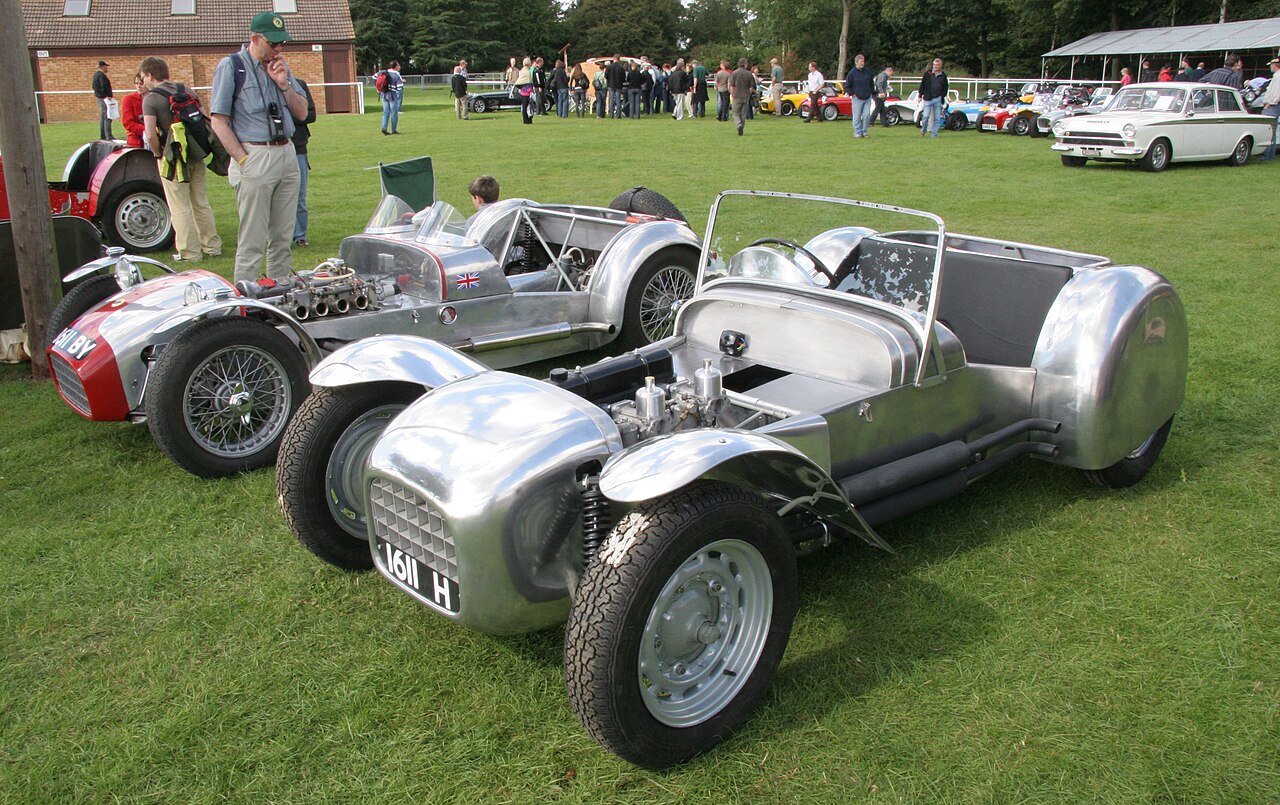
The supplied photograph identifies a 1953 Mark VI, chassis number 9, in the foreground of a Lotus gathering. Its unpainted body, separate front wings and low open cabin are visible against other early sports cars. The original creator description specifies a Ford side-valve engine for this example. That individual description remains separate from the programme’s wider engine choices and from the approximate total published by Lotus.
Component assembly is part of the identity
The Mark VI’s component-sales context makes an owner’s assembly choices part of the original story. A conventional production model often invites one specification table for every car in the named range. Here, that approach can hide the buyer’s power unit and the practical work needed to fit it. The photo of chassis 9 is especially useful because several related early cars appear together: they share an open sports-car vocabulary, yet their engine and body details need separate records. Looking closely at one example encourages a more precise question about what was supplied by Lotus and what was selected or assembled by its first owner. That division can be documented without treating the completed car as less significant. It also prevents an apparently tidy modern specification from overwriting the variation that was built into the programme’s original customer relationship.
Collecting and chassis evidence
For an early component-built sports car, the assembly record can matter as much as a conventional factory invoice. Chassis identity, the purchaser’s chosen power unit and the date of completion together explain what the car originally was. Later race preparation should be traced rather than compressed into a claim that every visible detail is a standard Mark VI feature. The photograph’s chassis identification is retained as a creator-supplied description, without implying that the image alone authenticates all surviving components. The complete programme reference remains approximately 110, with no separate addition for a photographed chassis or a later restored body.
Related Lotus designs and meaningful comparisons
The Mark II offers a useful starting comparison because its adapted donor frame shows the earlier development method. The Seven Series 1 follows the customer sports-car idea into a later, more familiar shape. The Mark VI sits between them: sufficiently defined to be offered to buyers, yet flexible enough to accommodate different engines and competition uses. Reading these three records together makes Lotus’s progress visible without treating every open, cycle-winged car as the same model. The distinction is especially valuable when a modern Seven derivative appears in a mixed historic gathering.
Reading the sources
The programme sources and the photograph answer different questions. Manufacturer and custodial records establish the original model, Type, category and published production scope. The creator’s file establishes the pictured subject, setting and image permission. An individual chassis history can then add ownership, competition entries and dated repairs without changing the scope of the original programme. Build references are not survivor counts, and a later specification does not automatically become an additional newly manufactured vehicle. Where primary evidence does not establish a complete fabrication census, that field remains unassigned.
Specifications and rarity evidence
| Programme reference year | 1952 |
|---|---|
| Model / Type | Mark VI — Type 6 |
| Body / competition role | Open spaceframe road and club-racing sports car |
| Programme period | 1952–1955 |
| Structure | Purpose-designed tubular spaceframe |
| Body construction | Aluminium |
| Engine scope | Ford, MG and Coventry-Climax programme choices |
| Photographed example | 1953 car; chassis 9 in creator description |
| Published build / register reference | Approximately 110 |
| Independently audited completed tally | Not assigned |
| Count scope | Published complete named programme reference: Approximately 110. This is a source-reported reference, not an independently audited completed tally or a surviving-car census. |
| Original inventory status | LOT-005 — Verified |
Frequently asked questions
Does every Mark VI use the same engine?
No. Lotus records Ford, MG and Coventry-Climax engine choices, and customer component assembly created individual variations. The supplied photo’s creator describes chassis 9 with Ford side-valve power.
How is Mark VI classified?
This is a named original Lotus road-car production programme. Its source-reported series reference is below the 7,500 screening threshold; it is not a surviving-car estimate or an announced numbered allocation.
Which technical details are established for the programme?
The primary record supports programme period: 1952–1955; structure: Purpose-designed tubular spaceframe; body construction: Aluminium. These are programme or explicitly attributed photo references. A particular surviving car’s engine, chassis repairs and competition preparation require its own dated documentation.
Does the photographed appearance establish factory originality?
The caption records a real creator-identified Mark VI subject and its later setting. It establishes the illustration’s scope, while original components, restoration work and individual race provenance require chassis-specific evidence. A competition number, current paint or museum display is not used as an originality certificate.
What rarity or archive scope is verified?
Published complete named programme reference: Approximately 110. This is a source-reported reference, not an independently audited completed tally or a surviving-car census.
Who photographed the supplied image?
Brian Snelson via Wikimedia Commons, under CC BY 2.0. The original file and licence are linked with the image. Retain the creator, source and licence when uploading, exporting or reusing it; local retouching and synthetic enlargement have not been performed.
Related Lotus profiles
Sources and photo credits
Photograph: Brian Snelson via Wikimedia Commons original source, CC BY 2.0. Source-provided thumbnail supplied without local cropping, retouching or synthetic enlargement.
Built in limited numbers
Published complete named programme reference: Approximately 110. This is a source-reported reference, not an independently audited completed tally or a surviving-car census.
Gallery
Specifications
Factory specifications may vary by model year, market and configuration.
Identity & production
- Official model
- Mark VI