1949 Lotus Mark II
Explore the 1949 Lotus Mark II: programme history, design, verified rarity scope, specifications and credited photography.
The 1949 Lotus Mark II records the transition from Colin Chapman’s personal trials experiments toward the Lotus name. Its importance lies in one documented development car, with a history that precedes the later production sports cars and Team Lotus racers.
History and verified programme identity
Lotus identifies the Mark II as Chapman’s second car, built around an Austin Seven chassis and registered LJH 702. The manufacturer’s statistics date it to 1949 and list one example. The factory timeline’s 1950 entry instead discusses its trials activity and sale, so those two dates describe different parts of the history rather than competing production runs. Ford side-valve power replaced the original Austin engine approach; the manufacturer describes a progression from Ford 8 to Ford 10. The programme belongs to Chapman’s early development work, before the 1952 formation of Lotus Engineering.
Engineering and design
The engineering interest is the reuse of available components with a different structural purpose. Lotus describes boxed chassis members and tubular replacements for the cross members, while retaining an Austin rear axle and four-speed gearbox. A light special asks each component to justify its place: the frame supports the body, the running gear establishes the stance, and the power unit must suit the competition task. This is not simply a small conventional saloon with its roof removed. The altered relationship between chassis and body expresses a particular approach to trials, where traction, clearance and controllable power matter alongside weight. The surviving car’s present setup still needs dated documentation before an individual engine or suspension component can be called original.
The physical car in the supplied photograph
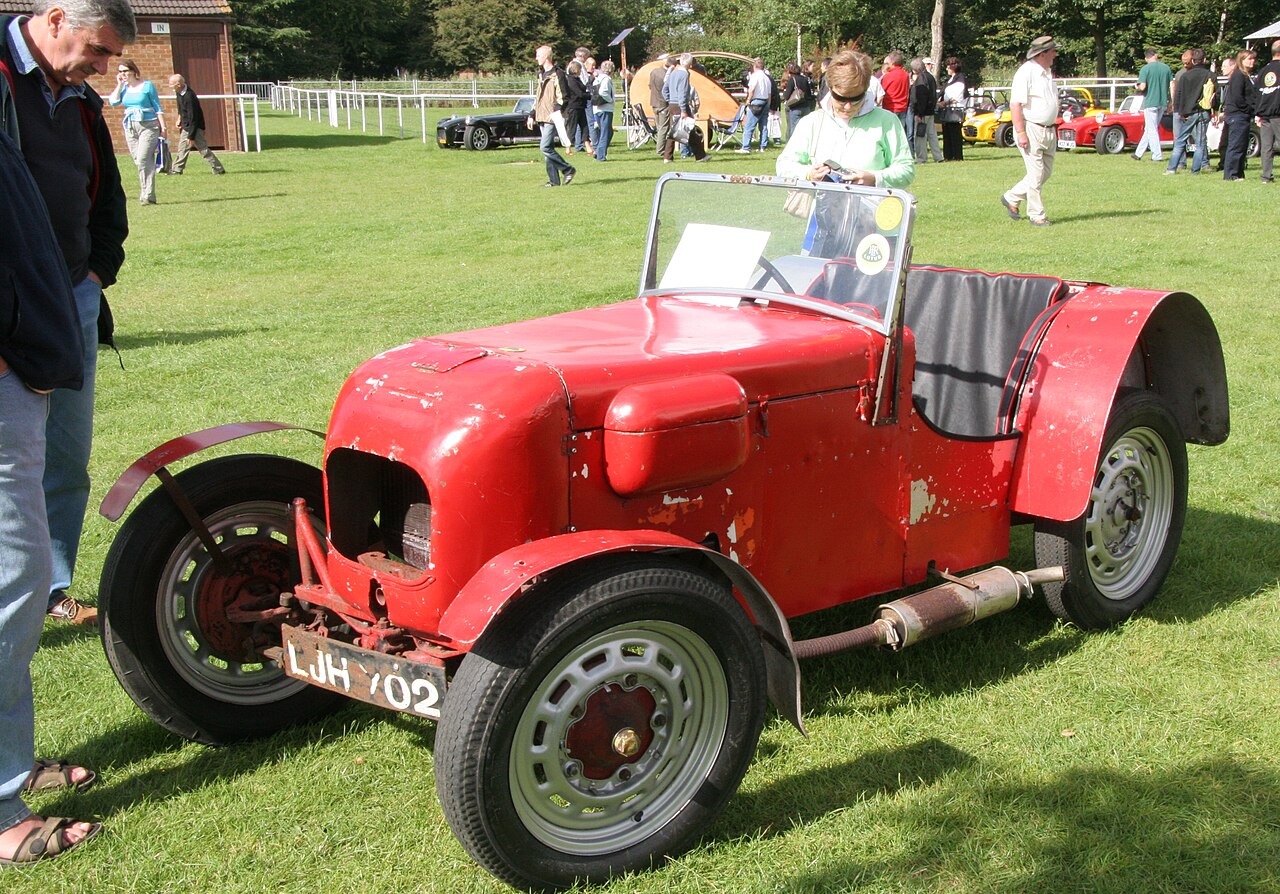
The supplied photograph shows the red Mark II outdoors at a Lotus gathering, with registration LJH 702 visible. Its upright screen, open passenger compartment, separate wheels and tall stance make the trials role easy to recognize. The modern event setting documents a later appearance of the historical car. It does not turn surrounding vehicles into part of the Mark II programme or establish the restoration history of the photographed example.
From a trials special to a named car
A trials special has a different visual and practical purpose from a later low circuit racer. In the Mark II photograph, the upright screen and tall open body place the occupants above a chassis whose wheels remain plainly separate. That makes clearance and the route of the running gear easy to appreciate, even without a technical drawing. The car’s modest overall scale also keeps the relationship with its original donor visible. The interesting historical step is the decision to alter that donor’s structure and combine components to meet Chapman’s own purpose. A later sports car can pursue the same interest in low mass through an entirely new frame; the Mark II records the earlier process of adaptation. For a reader tracing the Lotus name, this difference is useful. It explains why the personal special belongs in the history while preserving the distinction between an individual experiment and the later customer manufacturing business.
Collecting and chassis evidence
The useful collection record begins with the original identity and then dates the changes. The manufacturer provides a build reference and registration; photographs document subsequent appearances. Registration is a useful link between those records, but a continuous history still depends on ownership papers, workshop records and contemporary images. In a small development special, an engine change can be historically significant rather than merely a loss of originality. It should be described in sequence, with the reason and date retained wherever the evidence permits. The one-car factory reference is recorded here as a published programme statement; it is separate from any assessment of how much original material remains in the displayed vehicle.
Related Lotus designs and meaningful comparisons
The Mark VI shows what happened when the development approach became a product that other drivers could purchase. Comparing the two makes the transition more legible: an adapted donor chassis and a personal trials history give way to a purpose-designed frame and customer assembly. The Seven Series 1 offers a later road-oriented expression of the same interest in a minimal open car. Those relationships are historical comparisons, not a claim that all three share a chassis. Keeping each programme separate preserves the steps in Lotus’s early development.
Reading the sources
The programme sources and the photograph answer different questions. Manufacturer and custodial records establish the original model, Type, category and published production scope. The creator’s file establishes the pictured subject, setting and image permission. An individual chassis history can then add ownership, competition entries and dated repairs without changing the scope of the original programme. Build references are not survivor counts, and a later specification does not automatically become an additional newly manufactured vehicle. Where primary evidence does not establish a complete fabrication census, that field remains unassigned.
Specifications and rarity evidence
| Programme reference year | 1949 |
|---|---|
| Model / Type | Mark II — Mark II |
| Body / competition role | Austin-based trials special |
| Programme year | 1949, manufacturer statistics |
| Original registration | LJH 702 |
| Original basis | Modified Austin Seven chassis |
| Power-unit development | Ford 8 side-valve, later Ford 10 |
| Transmission reference | Austin four-speed gearbox |
| Published build / register reference | 1 |
| Independently audited completed tally | Not assigned |
| Count scope | Published complete named programme reference: 1. This is a source-reported reference, not an independently audited completed tally or a surviving-car census. |
| Original inventory status | LOT-002 — Verified |
Frequently asked questions
Why do some Lotus histories place the Mark II in 1950?
Lotus’s model statistics use 1949 for its production year, while the timeline’s 1950 entry covers its competition activity and sale. The profile retains 1949 and dates the later events separately.
How is Mark II classified?
This is an individual early development car in the historic archive. Its manufacturer reference is retained separately from present component originality and subsequent restoration history.
Which technical details are established for the programme?
The primary record supports programme year: 1949, manufacturer statistics; original registration: LJH 702; original basis: Modified Austin Seven chassis. These are programme or explicitly attributed photo references. A particular surviving car’s engine, chassis repairs and competition preparation require its own dated documentation.
Does the photographed appearance establish factory originality?
The caption records a real creator-identified Mark II subject and its later setting. It establishes the illustration’s scope, while original components, restoration work and individual race provenance require chassis-specific evidence. A competition number, current paint or museum display is not used as an originality certificate.
What rarity or archive scope is verified?
Published complete named programme reference: 1. This is a source-reported reference, not an independently audited completed tally or a surviving-car census.
Who photographed the supplied image?
Brian Snelson via Wikimedia Commons, under CC BY 2.0. The original file and licence are linked with the image. Retain the creator, source and licence when uploading, exporting or reusing it; local retouching and synthetic enlargement have not been performed.
Related Lotus profiles
Sources and photo credits
Photograph: Brian Snelson via Wikimedia Commons original source, CC BY 2.0. Source-provided thumbnail supplied without local cropping, retouching or synthetic enlargement.
Built in limited numbers
Published complete named programme reference: 1. This is a source-reported reference, not an independently audited completed tally or a surviving-car census.
Gallery
Specifications
Factory specifications may vary by model year, market and configuration.
Identity & production
- Official model
- Mark II